
Technical Support & Resources
Information provided in the product description is from published literature. Due to the nature of scientific experimentation, your results (e.g., selectivity and effective concentrations) or specific application for this product may differ. If you have questions about how this product fits your application, please contact our technical support staff.
Visit our FAQ
Contact Us
Toll Free Phone (USA and Canada Only): (888) 526-5351
Direct Phone: (734) 975-3888

Technical Information
- Sanasin
- Sanazin
- Pyocyanine
Shipping & Storage Information
Recommended Products





Certificates of Analysis & Batch Specific Data
Provide batch numbers separated by commas to download or request available product inserts, QC sheets, certificates of analysis, data packs, and GC-MS data.
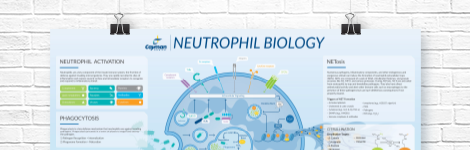
Neutrophil Biology Wall Poster
Explore how neutrophils shape the immune response in health and disease. This poster highlights neutrophil pathogen defense mechanisms, including phagocytosis, degranulation, and NETosis, as well as neutrophil roles in inflammation and NET-associated pathologies.
DOWNLOAD NOWProduct Description
Pyocyanin, which can reach concentrations of 100 µM in cystic fibrosis patients infected with P. aeruginosa, activates the aryl hydrocarbon receptor with a Ki value of 5.4 µM.1 This induces the expression of both detoxifying enzymes, resulting in pyocyanin degradation, and cytokines that facilitate the clearance of bacteria.1 Pyocyanin has been shown to accelerate neutrophil apoptosis in vitro, resulting in resolution of acute inflammation, which is beneficial for bacterial survival. It also induces a 10-fold acceleration of neutrophil apoptosis in vivo.2 Pyocyanin production results in reduced bacterial clearance from the lungs of immunocompromised patients. It has also been reported to induce apoptosis in human lung epithelial cells and to induce premature cellular senescence in mammalian cells.3 Pyocyanin undergoes nonenzymatic reduction by NADPH, which produces hydrogen peroxide and depletes intracellular glutathione levels, causing oxidative stress in susceptible cells.4
WARNING This product is not for human or veterinary use.
References & Product Citations
1. AhR sensing of bacterial pigments regulates antibacterial defence. Nature 512(7515), 387-392 (2014).
2. Pyocyanin production by Pseudomonas aeruginosa induces neutrophil apoptosis and impairs neutrophil-
3. Premature cellular senescence induced by pyocyanin, a redox-
4. Pyocyanin induces oxidative stress in human endothelial cells and modulates the glutathione redox cycle. Free Radic. Biol. Med. 33(11), 1527-1533 (2002).
Contact Info
Cayman Chemical1180 East Ellsworth RoadAnn Arbor, Michigan 48108 USAToll Free: (800) 364-9897(USA and Canada only)Fax: (734) 971-3640


