
Technical Support & Resources
Visit our FAQ
Contact Us
Toll Free Phone (USA and Canada Only): (888) 526-5351
Direct Phone: (734) 975-3888
Technical Information
- mOrange mRNA (Cap-1; N1-Methylpseudouridine)
Shipping & Storage Information
Recommended Products
Certificates of Analysis & Batch Specific Data
Provide batch numbers separated by commas to download or request available product inserts, QC sheets, certificates of analysis, data packs, and GC-MS data.

Visit Our Lipid Nanoparticle Resource Center for Additional Tools & Resources
EXPLORE NOWProduct Description
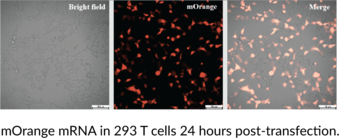
mOrange mRNA (Cap-1; m1Ψ) encodes mOrange, an orange fluorescent protein and derivative of Discosoma red fluorescent protein (DsRed) that displays excitation and emission maxima to 548 and 562 nm, respectively.1 It is capped using a co-transcriptional capping method, resulting in the naturally occurring Cap-1 structure with high capping efficiency. mOrange mRNA is also polyadenylated and modified with N1-methylpseudouridine (m1Ψ) to reduce the host cell immune response and enhance mRNA stability. Encapsulation of mOrange mRNA (Cap-1; m1ψ) in lipid nanoparticles (LNPs) can be used for mRNA delivery and expression of mOrange.
WARNING This product is not for human or veterinary use.
References & Product Citations
1. Improved monomeric red, orange and yellow fluorescent proteins derived from Discosoma sp. red fluorescent protein. Nat. Biotechnol. 22(12), 1567-1572 (2004).
Contact Info
Cayman Chemical1180 East Ellsworth RoadAnn Arbor, Michigan 48108 USAToll Free: (800) 364-9897(USA and Canada only)Fax: (734) 971-3640


