Competitive ELISA for quantitation of PGD2 in biological samples
Features
  • Treatment of samples with MOX hydrochloride converts unstable PGD2 to stable PGD2-MOX
  • Highly sensitive
  • Measure PGD2-MOX levels down to 3.1 pg/ml
  • Incubation: 18 hours | Development: 90-120 minutes | Read: Colorimetric at 405-420 nm
Technical Support & Resources

Visit our FAQ

Contact Us

Toll Free Phone (USA and Canada Only): (888) 526-5351
Direct Phone: (734) 975-3888

Request Technical Support

Technical Support Request

To streamline the process attach the appropriate questionnaire to your inquiry.

Download IHC QuestionnaireDownload WB Questionnaire

View Our Privacy Statement for details on how we use and protect your data. In addition, this site is protected by hCaptcha and its Privacy Policy and Terms of Service apply.

Prostaglandin D2-MOX ELISA Kit

Item No. 512011

Technical Information
Synonyms
  • PGD2-MOX EIA Kit
Assay Range
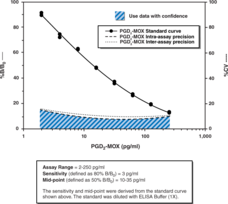
2.0-250 pg/ml
Sensitivity
80% B/B0: 3 pg/ml
Cross Reactivity
(Prostaglandin D2-MOX) 100%(Prostaglandin D2) 0.2%(tetranor-PGEM) <0.01%(tetranor-PGFM) <0.01%(Prostaglandin E2-MOX) <0.01%(6-keto Prostaglandin F-MOX) <0.01%(Prostaglandin F) <0.01%(Thromboxane B2-MOX) <0.01%
Origin
Animal/Bovine, Animal/Eel, Animal/Mouse, Animal/Rabbit
Shipping & Storage Information
Storage
-80°C
Shipping
Wet ice in continental US; may vary elsewhere
Recommended Products

Certificates of Analysis & Batch Specific Data

Provide batch numbers separated by commas to download or request available product inserts, QC sheets, certificates of analysis, data packs, and GC-MS data.

    Add

    Add

    Add

    Add

    Lipid Resource Center
    Discover Products & Resources for Lipid Research
    • High-purity lipid standards
    • Lipid roles in biology
    • Lipids in health & disease
    • Lipids for pharmaceutical development
    • Protocols, advice, & resources
    EXPLORE NOW
    Product Description

    Prostaglandin D2 (PGD2) is biosynthesized in the brain by a soluble, 26 kD glutathione-independent lipocalin-type PGD2 synthase.1 PGD2 accumulates in the cerebrospinal fluid (CSF), where it induces physiologic sleep in rats and humans.2 PGD2 is also synthesized by mast cells and leukocytes by a cellular, myeloid-type, glutathione-dependent PGD synthase. This PGD2 which is formed in the intracellular and vascular compartments is rapidly metabolized to 11β-PGF.3 Thus, urinary measurements of PGD synthesis are most appropriately focused on the measurement of 11β-PGF. Measurement of the parent eicosanoid PGD2 is appropriate in the supernatants of cell cultures, where PGD2 levels may reach several ng/ml, and in CSF, where concentrations of several hundred pg/ml have been measured.4 All studies of PGD2 biosynthesis should take into consideration the chemical instability of PGD2 and its rapid degradation in the presence of serum proteins such as albumin.5 PGD2 also readily degrades in both acidic and basic media to give a variety of decomposition products. Similarly, antigenic protein conjugates of PGD2, synthesized for the production of antisera, show considerable amounts of decomposition. Thus, the resulting antibody response is heterogeneous with poor specificity. This makes PGD2 assay systems based on the parent compound unreliable and difficult to interpret. This PGD2-MOX ELISA is based on the conversion of PGD2 to a stable MOX derivative. Treatment of the sample with methoxylamine hydrochloride (MOX HCl) converts PGD2 into PGD2-MOX, preventing its further chemical degradation. The antiserum used in the assay was developed using conjugates of this derivative and is very specific for PGD2-MOX. The assay has been validated against stable isotope dilution GC/MS. Measurements using both techniques on identical samples showed a correlation coefficient of 0.97.

    Needed but not supplied: Please download the kit booklet to verify if UltraPure Water (Milli-Q or equivalent) or any other components are needed for this assay.

    WARNING This product is not for human or veterinary use.

    References & Product Citations
    Product Description References

    1. Urade, Y., Tanaka, T., Eguchi, N., et alStructural and functional significance of cysteine residues of glutathione-independent prostaglandin D synthase. The Journal of Biological Chemisty 270(3), 1422-1428 (1995).

    2. Satoh, S., Matsumura, H., Nakajima, T., et alPromotion of sleep by prostaglandin D2 in rats made insomniac by pretreatment with para-chlorophenylalanine. Neurosci. Res. 21(1), 41-50 (1995).

    3. Roberts, L.J., II, and Sweetman, B.J. Metabolic fate of endogenously synthesized prostaglandin D2 in a human female with mastocytosis. Prostaglandins 30(3), 383-400 (1985).

    4. Ujihara, M., Urade, Y., Eguchi, N., et alProstaglandin D2 formation and characterization of its synthetases in various tissues of adult rats. Arch. Biochem. Biophys. 260(2), 521-531 (1988).

    5. Fitzpatrick, F.A., and Wynalda, M.A. Albumin-catalyzed metabolism of prostaglandin D2. Identification of products formed in vitro. The Journal of Biological Chemisty 258(19), 11713-11718 (1983).

    Product Citations

    Johnsson, A.K., Choi, J.H., Rönnberg, E., et alSelective inhibition of prostaglandin D2 biosynthesis in human mast cells to overcome need for multiple receptor antagonists: Biochemical consequences. Clin. Exp. Allergy 51(4), 594-603 (2021).

    Maric, J., Ravindran, A., Mazzurana, L., et alCytokine-induced endogenous production of prostaglandin D2 is essential for human group 2 innate lymphoid cell activation. J. Allergy Clin. Immunol. 143(6), 2202-2214 (2019).

    Fujimori, K., Aritake, K., Oishi, Y., et alL-PGDS-produced PGD2 in premature, but not in mature, adipocytes increases obesity and insulin resistance. Sci. Rep. 9(1), 1931 (2019).

    Grabocka, E., and Bar-Sagi, D. Mutant KRAS enhances tumor cell fitness by upregulating stress granules. Cell 167(7), 1803-1813 (2016).