
Features
- Measure pyruvate in serum, plasma, blood, urine, and saliva
- Assay 40 samples in duplicate
- Assay range: 0-75 µM (fluorometric) and 0-150 µM (colorimetric)
- Plate-based fluorometric measurement (ex 530-540 nm, em 585-595 nm) or colorimetric absorbance at 570 nm
Technical Support & Resources
Visit our FAQ
Contact Us
Toll Free Phone (USA and Canada Only): (888) 526-5351
Direct Phone: (734) 975-3888
Product Categories
Application



Technical Information
- Pyruvic Acid Assay Kit
Shipping & Storage Information
Recommended Products
Certificates of Analysis & Batch Specific Data
Provide batch numbers separated by commas to download or request available product inserts, QC sheets, certificates of analysis, data packs, and GC-MS data.

Visit Our Cancer Resource Center
Find Tools & Resources to Study the Hallmarks of Cancer
- Cancer cell signaling & regulation
- Cancer metabolism
- Tumor microenvironment
Product Description
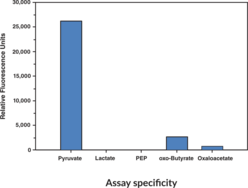
Cayman’s Pyruvate Assay provides both a fluorescence- and absorbance-based methods for quantifying pyruvate in biological samples such as serum, plasma, blood, urine, and saliva. It can also be utilized to determine intracellular and extracellular pyruvate concentrations in cell culture samples. In the assay, pyruvate oxidase catalyzes the conversion of pyruvate to acetyl phosphate, hydrogen peroxide (H2O2), and carbon dioxide. In the presence of horseradish peroxidase (HRP), H2O2 reacts stoichiometrically with 10-acetyl-3,7,-dihydroxyphenoxazine (ADHP) to produce the compound resorufin. Resorufin fluorescence is analyzed with an excitation wavelength between 530-540 nm and an emission wavelength between 585-595 nm. Resorufin absorbance is measured at a wavelength of 570 nm.
This assay offers the option to measure absorbance or fluorescence. It is at the user’s discretion to choose the mode of measurement (and corresponding standard curve preparation) that best fits their needs. When read fluorometrically, this assay has a range of 0-75 µM and a lower limit of quantification (LLOQ) of 1.5 µM. When read colorimetrically, the range is 0-150 µM with an LLOQ of 3.0 µM.
Needed but not supplied: Please download the kit booklet to verify if UltraPure Water (Milli-Q or equivalent) or any other components are needed for this assay.
WARNING This product is not for human or veterinary use.
References & Product Citations
Pyruvate modifies metabolic flux and nutrient sensing during extracorporeal membrane oxygenation in an immature swine model. Am. J. Physiol. Heart Circ. Physiol. 309, H137-H146 (2015).
Deletion of cyclophilin D impairs b-
Contact Info
Cayman Chemical1180 East Ellsworth RoadAnn Arbor, Michigan 48108 USAToll Free: (800) 364-9897(USA and Canada only)Fax: (734) 971-3640


