
Technical Support & Resources
Information provided in the product description is from published literature. Due to the nature of scientific experimentation, your results (e.g., selectivity and effective concentrations) or specific application for this product may differ. If you have questions about how this product fits your application, please contact our technical support staff.
Visit our FAQ
Contact Us
Toll Free Phone (USA and Canada Only): (888) 526-5351
Direct Phone: (734) 975-3888
Product Categories
Research Area
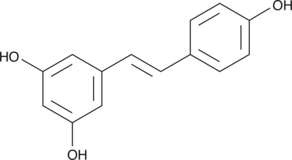
Technical Information
- (E)-
Resveratrol
Shipping & Storage Information
Recommended Products
Certificates of Analysis & Batch Specific Data
Provide batch numbers separated by commas to download or request available product inserts, QC sheets, certificates of analysis, data packs, and GC-MS data.
Lipid Resource Center
Discover Products & Resources for Lipid Research
- High-purity lipid standards
- Lipid roles in biology
- Lipids in health & disease
- Lipids for pharmaceutical development
- Protocols, advice, & resources
Product Description
trans-Resveratrol is a polyphenol that has been found in grapes and has diverse biological activities.1,2 It inhibits the cyclooxygenase and hydroperoxidase activities of COX-1 (EC50s = 15 and 3.7 μM, respectively) but not COX-2 (EC50s = >100 μM and 85 μM, respectively).1 trans-Resveratrol (200 μM) also activates sirtuin 1 (SIRT1), as well as inhibits a variety of targets including ERK1, JNK1, Src, PKCα, aromatase/CYP19, and DNA polymerases α and δ (IC50s = 37, 50, 20, <10, 25, 3.3, and 5 μM, respectively) in vitro.3,2 It inhibits free radical formation induced by phorbol 12-myristate 13-acetate (TPA; Item No. 10008014) in HL-60 cells and reduces the tumor incidence and number of tumors in a two-stage mouse model of skin cancer induced by TPA and 7,12-dimethyl-benz[a]anthracene (DMBA). trans-Resveratrol (3 and 8 mg/kg) inhibits carrageenan-induced paw edema in mice. Intravaginal administration of trans-resveratrol (12.5% v/v) inhibits herpes simplex virus 1 (HSV-1) and HSV-2 replication and delays the development of extravaginal disease in mouse models of vaginal HSV infection.4 It also prolongs lifespan in model organisms including C. elegans, D. melanogaster, and mice.2
WARNING This product is not for human or veterinary use.
References & Product Citations
1. Cancer chemopreventive activity of resveratrol, a natural product derived from grapes. Science 275(5297), 218-220 (1997).
2. Resveratrol: One molecule, many targets. IUMBM Life 60(5), 323-332 (2008).
3. Mechanism of human SIRT1 activation by resveratrol. The Journal of Biological Chemisty 280(17), 17187-17195 (2005).
4. Effect of resveratrol on herpes simplex virus vaginal infection in the mouse. Antiviral Res. 67(3), 155-162 (2005).
ε-
A high-
Contact Info
Cayman Chemical1180 East Ellsworth RoadAnn Arbor, Michigan 48108 USAToll Free: (800) 364-9897(USA and Canada only)Fax: (734) 971-3640


