Login · Register

Holiday Notification: Cayman Chemical will be closed Monday, September 6, 2010, in observance of the Labor Day holiday. More…
Please feel free to continue placing orders via our website or via fax at 734-971-3640. You may send an email to customer service at custserv@caymanchem.com , or to technical support at techserv@caymanchem.com which we will respond to the next business day. Cayman will resume regular business hours and shipping schedules on Tuesday, September 7, 2010. Thank you for your patience.

SREBP-2 Polyclonal Antibody

Cayman Chemical Item Number 10007663

Sterol Regulatory Element-binding Transcription Factor 2; SREBF2; Sterol Regulatory Element-binding Protein-2

SREBP-2 Polyclonal Antibody

See more
Synonyms
  • Sterol Regulatory Element-binding Transcription Factor 2
  • SREBF2
  • Sterol Regulatory Element-binding Protein-2
Formulation An affinity-purified IgG
Stability 1 year
Storage -20°C
Shipping WET ICE in continental US; may vary elsewhere
Specificity
human SREBP2 +
murine SREBP2 +
rat SREBP2 +

Description

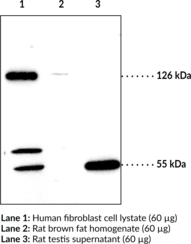
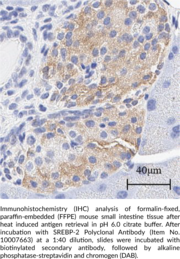
Antigen: human SREBP-2 amino acids 455-469 (SPLLDDAKVKDEPDS) · Host: rabbit · Application(s): WB and ICC; other applications not tested · SREBPs, including SREBP-1a, SREBP-1c, and SREBP-2, constitute a family of basic helix-loop-helix (bHLH) transcription factors that play a critical role in lipid homeostasis by regulating genes involved in cholesterol and fatty acid metabolism.1 Each SREBP consists of three domains, including an amino-terminal transcription factor domain of ~480 amino acids, a middle hydrophobic region of ~80 amino acids containing two hydrophobic transmembrane segments, and a carboxy-terminal regulatory domain of ~590 amino acids.1 SREBP-2 regulates cholesterol synthesis by activating the transcription of genes for HMG-CoA reductase and other enzymes of the cholesterol synthetic pathway.2 SREBP-2 is ubiquitously detected in various tissues.3 Under basal conditions SREBP is bound to ER membranes as a glycosylated precursor protein. Upon cholesterol depletion, the protein is cleaved to its active forms (about 50-68 kDa) and translocated into the nucleus to stimulate transcription of genes involved in the uptake and synthesis of cholesterol.4 Cayman’s SREBP-2 polyclonal antibody detects both precursor and active forms of the protein in tissues and cells such as liver, brown fat, testis, Hep-G2 cells, and human fibroblast. The apparent molecular weight on SDS-PAGE may be higher than the calculated molecular weight (about 126 kDa) due to glycosylation of the protein.5

1 Brown, M.S., Goldstein, J.L. The SREBP pathway: Regulation of cholesterol metabolism by proteolysis of a membrane-bound transcription factor. Cell 89 331-340 (1997).

2 Sakai, J., Nohturfft, A., Goldstein, J.L., et al. Cleavage of sterol regulatory element-binding proteins (SREBPs) at site-1 requires interaction with SREBP cleavage-activating protein. Evidence from in vivo competition studies. J Biol Chem 273(10) 5785-5793 (1998).

3 Iizuka, K., Bruick, R.K., Liang, G., et al. Deficiency of carbohydrate response element-binding protein (ChREBP) reduces lipogenesis as well as glycolysis. Proc Natl Acad Sci USA 101(19) 7281-7286 (2004).

4 Smith, L.H., Petrie, M.S., Morrow, J.D., et al. 7The sterol response element binding protein regulates cyclooxygenase-2 gene expression in endothelial cells. J Lipid Res 46 862-871 (2005).

5 Hua, X., Sakai, J., Ho, Y.K., et al. Hairpin orientation of sterol regulatory element-binding protein-2 in cell membranes as determined by protease protection. J Biol Chem 270(49) 29422-29427 (1995).

Related Articles

Brown, M.S., Goldstein, J.L. The SREBP pathway: Regulation of cholesterol metabolism by proteolysis of a membrane-bound transcription factor. Cell 89 331-340 (1997).

Hua, X., Sakai, J., Ho, Y.K., et al. Hairpin orientation of sterol regulatory element-binding protein-2 in cell membranes as determined by protease protection. J Biol Chem 270(49) 29422-29427 (1995).

Sakai, J., Nohturfft, A., Goldstein, J.L., et al. Cleavage of sterol regulatory element-binding proteins (SREBPs) at site-1 requires interaction with SREBP cleavage-activating protein. Evidence from in vivo competition studies. J Biol Chem 273(10) 5785-5793 (1998).

Iizuka, K., Bruick, R.K., Liang, G., et al. Deficiency of carbohydrate response element-binding protein (ChREBP) reduces lipogenesis as well as glycolysis. Proc Natl Acad Sci USA 101(19) 7281-7286 (2004).

Smith, L.H., Petrie, M.S., Morrow, J.D., et al. 7The sterol response element binding protein regulates cyclooxygenase-2 gene expression in endothelial cells. J Lipid Res 46 862-871 (2005).

Show all 5 Hide all but first 3

Pricing updated 2010-09-06. Prices are subject to change without notice.

Pricing is for North America only. Other customers should contact a distributor in their region.

Cayman strives to be a reliable biochemical reagent vendor by providing the best possible products and services. To ask for assistance with one of our products please contact a Technical Support Scientist.

Warning This product is not for human or veterinary use.

Related Products

ACAT-1 Polyclonal Antibody
ACAT-2 Polyclonal Antibody
ApoA1 Western Ready Control
Cholesterol Assay Kit
Cholesterol Cell-Based Detection Assay Kit
LDL Receptor Polyclonal Antibody
PCSK9 (human) Polyclonal Antibody
SREBP-2 Blocking Peptide
SREBP-2 Cell-Based Translocation Assay Kit
SREBP-2 Western Ready Control
Show all 10 Hide all but first 3

Downloads

Other Resources
Management Team Company Profile Company History ChemAssistant Tools FAQs Cayman Europe Cayman Pharma CaBRI Cayman Gear Press Releases Illustrations and Charts Key Research Area Posters Article and Newsletter Archives Analysis Tools Order Terms Browser Recommendation Privacy Statement Site Map

Cayman Chemical Company · 1180 East Ellsworth Road · Ann Arbor, Michigan 48108 · USA

Toll Free: (800) 364-9897 (USA and Canada Only) · Fax: (734) 971-3640

Copyright 2010 Cayman Chemical Company