
Q:
What can I use to dissolve my compound?
What can I use to dissolve my compound?
Cayman's Product Information sheets provide solubility data for most compounds using common polar and non-polar solvents. Solvents such as water (protic), PBS (protic), ethanol (protic), DMSO (aprotic), and dimethyl formamide (DMF) (aprotic) are commonly listed. Your specific application may require the use of a solvent that is not listed, and the compatibility of that solvent with your compound may not be known. The choice of appropriate solvent will depend on the polarity of the solvent and polarity of your compound (solute).
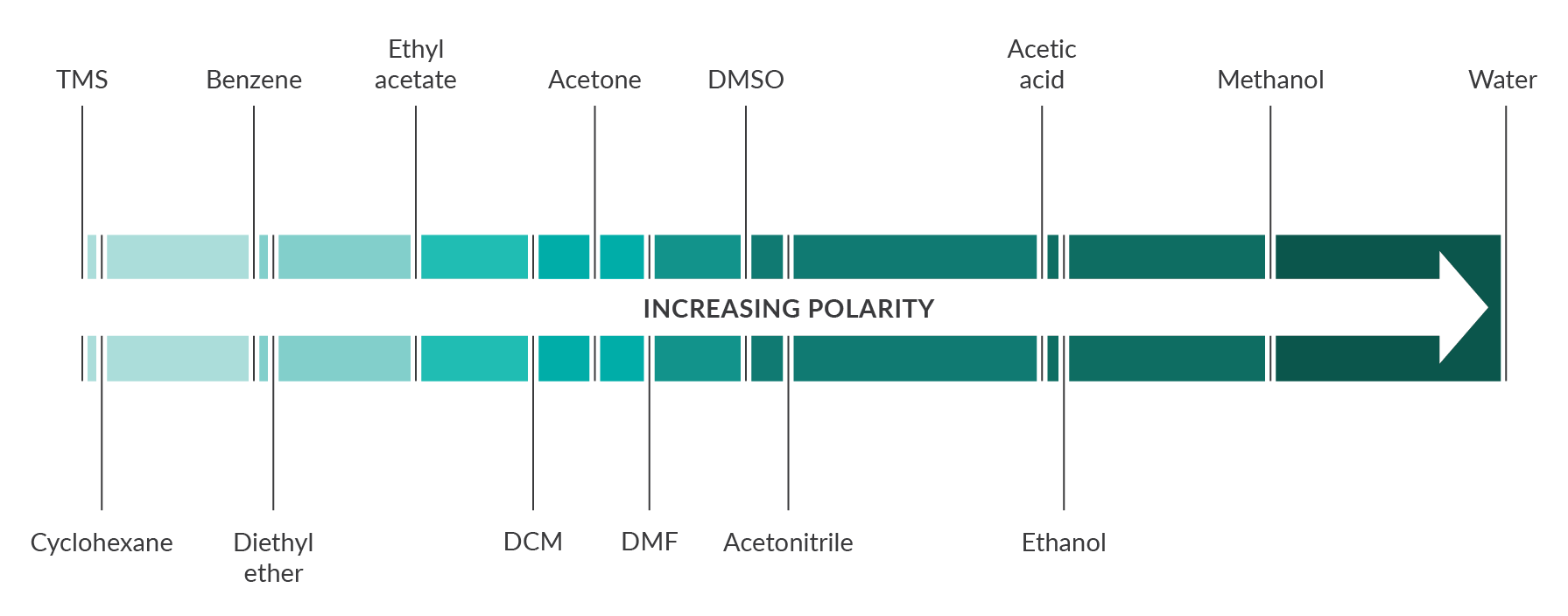
A solvent polarity scale derived from Reichardt's dye, representing solvent polarity in correlation with chemical kinetics and equilibria (Sherwood, J. Bio-based solvents for organic synthesis, 2014).
Other factors such as size and crystal structure of your solute may also affect solubility. You may need to heat, stir, or even sonicate your solution for complete dissolution. Be aware that compounds in solution may become unstable. It is best practice to make fresh solutions for your experiments or store pre-made solutions at -80°C.
Having trouble getting your compound into solution? Please contact our Technical Support scientists.
Learn More About Solubility Factors When Choosing a Solvent
Contact Info
Cayman Chemical1180 East Ellsworth RoadAnn Arbor, Michigan 48108 USAToll Free: (800) 364-9897(USA and Canada only)Fax: (734) 971-3640


