
N-Propionitrile Chlorphine: Cayman NPS Metabolism Monograph, Issue 4
Monographs
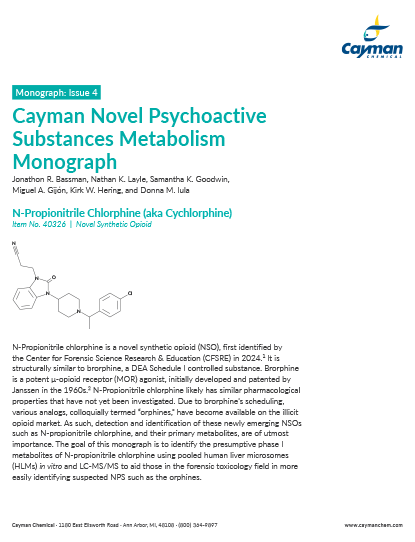
This NPS metabolism monograph highlights N-propionitrile chlorphine (also known as cyclorphine or cychlorphine), a novel synthetic opioid (NSO) first identified by the CFSRE in 2024. Structurally related to brorphine, a potent μ-opioid receptor agonist and DEA Schedule I controlled substance, this analog reflects the growing global prevalence of modified synthetic opioids in the emerging "orphine" class. Using pooled human liver microsomes in vitro and LC-MS/MS, the monograph identifies presumptive phase I metabolites to support forensic toxicologists in detecting emerging NSOs.
To cite this monograph: Bassman, J.R., Layle, N.K., Goodwin, S.K., et al. N-Propionitrile Chlorphine. Cayman NPS Metabolism Monograph Issue 4 (2025).
Δ9-THC, Δ10-THC, and Δ6a,10a-THC: Cayman NPS Metabolism Monograph, Issue 3
Monographs
The goal of this monograph is to identify the probable metabolites of the newly emerging semi-synthetic cannabinoids Δ10-THC and Δ6a,10a-THC using human liver microsomes (HLMs) and high-resolution mass spectrometry. The metabolism of Δ9-THC with HLMs was also investigated to provide forensic toxicologists a comparative understanding of the key fragments needed for identification.
This monograph was updated on April 18th, 2025, to provide clarification on the interpretation of the (6aR,9R)-Δ10-THC metabolite at R.T. 14.16 minutes in Figure 8.
To cite this monograph: Bassman, J.R., Layle, N.K., Gregerson, M.C., et al. Δ9-THC, Δ10-THC, and Δ6a,10a-THC. Cayman NPS Metabolism Monograph Issue 3 (2025).
New Drug Monograph: N-Propionitrile Chlorphine
Monographs
New Drug Monograph: CHO-4'Me-5'Br-FUBOXPYRA
Monographs
In July 2021, China banned several common synthetic cannabinoid core scaffolds to control the manufacturing and trafficking of these substances. This NPS Discovery Monograph documents the first report of CHO-4'Me-5'Br-FUBOXPYRA, a novel synthetic cannabinoid possessing an alternative 2-oxopyridine core scaffold. Cayman and the CFSRE established the “OXPYRA” systematic naming convention to be structurally informative and parallel existing synthetic cannabinoid NPS nomenclature, such as the OXIZID and IATA class.
New Drug Monograph: ADB-5'Br-BINACA (ADB-5'Br-BUTINACA)
Monographs
New synthetic cannabinoids continue to emerge in the recreational drug supply following the class-wide ban implemented by China in July 2021. This NPS Discovery Monograph documents the newly identified synthetic cannabinoid ADB-5'Br-BINACA (ADB-5'Br-BUTINACA) containing a brominated indazole core, confirmed using Cayman's reference standard. To avoid confusion with tail substituents, Cayman and the CFSRE have developed a revised naming convention for new synthetic cannabinoids containing core substituents, denoted by a prime (‘) designation placed in the middle of the name.
New Drug Monograph: ADB-FUBIATA
Monographs
N-butyl Pentylone: Cayman NPS Metabolism Monograph, Issue 2
Monographs
N-butyl Pentylone is a synthetic cathinone first reported in 1960s German patent literature, emerging on the recreational drug market in late 2018. Cathinone analogs have seen widespread abuse since the mid-2000s and are derived from the alkaloid cathinone found in khat. N-butyl Pentylone has been identified on illicit research chemical websites and in seized drug samples. While several similar cathinone analogs are Schedule I controlled substances, N-butyl pentylone remains uncontrolled as of mid-2020. The goal of this monograph is to identify its probable phase I metabolites using HLM assays. This study can provide insights into the metabolic pathway of N-butyl pentylone, and by analysis with high-resolution Orbitrap mass spectrometry, we aim to provide forensic toxicologists with the key ions/fragments that can help identify this novel synthetic cathinone in biological samples.
2-methyl AP-237: Cayman NPS Metabolism Monograph, Issue 1
Monographs
2-methyl AP-237 was originally synthesized and reported in Japan in the 1970s. Related analogs have been used for pain management internationally but never in the US. This compound has appeared on the dark web and illicit research chemical websites, and it has been identified by forensic chemists and toxicologists in seized samples and drug screens. The goal of this monograph is to identify the probable metabolites of this newly emerging synthetic opioid using human liver microsome (HLM) assays and computational simulations. By using high resolution Orbitrap mass spectrometry, we aim to provide forensic toxicologists with the key mass spectrometry fragments and ions needed to identify the novel synthetic opioid, 2-methyl AP-237.
To cite this monograph: Hassanien, S.H., Layle, N.K., Holt, M.C., et al. 2-methyl AP-237. Cayman NPS Metabolism Monograph Issue 1 (2019).
Contact Info
Cayman Chemical1180 East Ellsworth RoadAnn Arbor, Michigan 48108 USAToll Free: (800) 364-9897(USA and Canada only)Fax: (734) 971-3640


