
Orphines Naming Guide
Featured Guides
NPS Snapshot: Kratom-Derived Semi-Synthetic Opioids
Featured Guides
A growing wave of consumer products labeled as ‘kratom’, ‘7-hydroxy mitragynine’, or ‘7-OH’—which contain potent semi-synthetic opioids—marks the emergence of a new class of kratom-derived NPS. Since 2024, new kratom-related products containing 7-hydroxy mitragynine and mitragynine pseudoindoxyl have entered the market, often disguised as natural supplements. Though structurally distinct from traditional opioids, these compounds can mimic opioid effects and are frequently misrepresented in labeling. This NPS Snapshot summarizes the structures of potent kratom-related NPS, mitragynine conversion pathways, and the historical context of natural kratom alkaloids.
View All Kratom Alkaloids & Semi-Synthetics
To cite this NPS snapshot: Iula, D.M. NPS snapshot: kratom-derived semi-synthetic opioids. Cayman Chemical (October 2025).
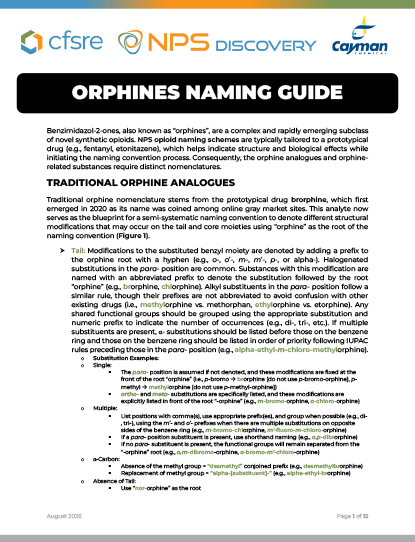
NPS Snapshot: Orphines
Guides
NPS Snapshot: Semi-synthetic Cannabinoids
Guides
Histone Modification: Inhibition Strategies & Research Tools
Guides
Histone modification is an epigenetic mechanism that enables fine-tuning of gene expression by altering chromatin structure and the accessibility of DNA for transcription. Numerous chemical tools have been developed to study the function of histone modifying proteins and their roles in physiological and pathological states. Use this guide to learn about writers, erasers, and readers of two major forms of histone modification, methylation and acetylation, and determine the best chemical modulation strategy for your experiments.
Oxidative Stress: Markers & Detection Tools
Guides
Lipid Nanoparticle Formulation: Basic Concepts & Preparation Procedures
Guides
Standardized Naming System for Cinnamylpiperazines
Guides
Cell Death Mechanisms & Detection Tools
Guides
Cell death occurs for both physiological and pathological reasons. Varying modes of death are either programmed to safely remove healthy cells that are no longer useful or to stimulate an inflammatory response to clear cells that are useful but no longer healthy. To distinguish among the multiple ways a cell can self-destruct, distinct morphological changes, triggers, and biochemical hallmarks are monitored. Use this guide to learn about the tools available to investigate multiple molecular pathways and cell death markers to help you determine the cell death mechanism(s) occurring under your experimental circumstances.
Choosing & Using Chemical Probes
Guides
Chemical probes are well-characterized small molecules that potently and selectively modulate target protein activity. Use this guide, which includes the defining criteria for chemical probes, important "do's and don'ts", and a step-by-step guide for evaluating compound quality and suitability, to help you choose the best chemical probe for your experiments.
Psychedelic Targets Research & Development
Guides
New Systematic Naming for Synthetic Cannabinoid “MDA-19” and Its Related Analogues: BZO-HEXOXIZID, 5F-BZO-POXIZID, and BZO-POXIZID
Guides
Long COVID Impacts
Guides
cGAS Inhibitor Screening Assay Kit
Guides
Dysregulation of the cyclic GMP-AMP (cGAMP) synthase (cGAS) pathway leads to chronic inflammation, autoimmune disorders, and even tumorigenesis; therefore, cGAS modulators are of particular interest in searching for novel ways to treat these diseases. Learn more about Cayman's novel cGAS Inhibitor Screening Assay Kit that directly measures the product of the cGAS reaction, cGAMP.
Read our article Targeting cGAS Activity in the STING Pathway: Assays for Drug Discovery or watch the Development and Validation of a Novel cGAS Inhibitor Screening Assay virtual scientific poster.
Eicosanoid GPCR Poster Introduction
Guides
Forensic Chemistry and Toxicology
Guides
DEA 222 Form Instructions for Schedule I & II Substances
Guides
A DEA Form 222 is necessary for the purchase of Schedule I or II controlled substances. We have provided step-by-step instructions to prepare and mail your DEA form 222 to Cayman Chemical.
NPS Snapshot: Nitazenes
Guides
Updated October 2025
Nitazenes are one of several types of novel analgesics developed in the 20th century as potential alternatives to traditional opiates. Since first appearing on the illicit market in 2018, several novel 2-benzylbenzimidazole opioids have emerged as novel psychoactive substances (NPS). These compounds are structurally different from fentanyl and most are not well characterized, but some have been reported to cause physiological effects similar to heroin, fentanyl, and other opioids. Dozens of nitazene analogs have now been identified in circulation across the world, further complicating efforts to monitor and understand their pharmacological profiles. This NPS Snapshot summarizes structures of various nitazene compounds as well as key historical dates, prototypical structure, and known pharmacology.
Learn more in our recent webinar: Making a splash: Nitazenes and Orphines, the latest wave of opioid NPS.
To cite this NPS snapshot: Iula, D.M., St. Germaine, D.M., and Layle, N.K. NPS snapshot: nitazenes. Cayman Chemical (September 2020).
Certified Reference Materials for the Cannabis Industry: Solving the Production Puzzle
Guides
As more analytical laboratories involved in Cannabis testing fall under regulatory and/or accreditation requirements, they are expected to utilize CRMs when available. This article outlines several production steps Cayman considers when creating a CRM to address questions frequently heard from our customers about how compounds are selected to be made into CRMs and how long it takes to produce them.
This article was first published in the July/August issue of Terpenes and Testing.
Viral Infection Life Cycle
Guides
Immunopeptidome Profiling Services
Guides
The adaptive immune system is equipped to recognize and react to specific threats and holds a memory of previous attacks. Learn how our Immunopeptidome Profiling Services can help you harness this machinery to fight cancer, viral infections, and autoimmune diseases.
Improved Potency Testing
Guides
Want to streamline your Cannabis potency testing and cannabinoid profiling? Watch how different reference standard preparation methods stack up and see why testing labs are implementing Cayman’s pre-made, multi-component CRM mixtures into their workflows. Cayman offers a suite of CRM mixtures for mass spectrometry applications. The Phytocannabinoid 10 Mixture (CRM) featured in this video contains ten phytocannabinoids prevalent in Cannabis.
Access the data in our application note: CRM Mixtures Improve Quantitation Accuracy.
Export/Import of Controlled Substances Overseas
Guides
Delivery time of controlled reference materials requires the careful navigation of governmental agencies of both the country of origin and country of import. Several processes are in place to document the transfer of goods and additional steps are needed if the compound is recognized as an internationally or locally controlled substance. Review the procedures and estimated timeline for the export/import of controlled substances.
Supplemental Material: Differentiation of Isobaric and Isomeric Fentanyl Analogs by Gas Chromatography-Mass Spectrometry (GC-MS)
Guides
Fentanyl (hydrochloride) (CRM) and all fentanyl analogs (provided as neat materials) used in the study are Cayman products. Single component solutions for each fentanyl analog were prepared by dissolving 1 mg of neat material in 1 ml of HPLC-grade methanol (EMD Millipore). Twenty multicomponent mixtures were prepared by transferring 200 μl aliquots of each single component solution with a 200 μl aliquot of internal standard into a vial and dried under nitrogen. The multicomponent mixtures were reconstituted with 200 μl of methanol for a final nominal concentration of 1.0 mg/ml per component. The multicomponent solutions were transferred to autosampler vials with insert prior to injection. The 20 multicomponent mixtures were used in the GC separation study.
Targeting PPARs: A guide to function and structure
Guides
While PPARs display a high degree of homology at the protein level, each subtype exhibits distinct, noninterchangeable roles in energy metabolism that range from energy burning to energy storage.
Request a physical copy in Cayman Currents Issue 31: Fatty Liver Disease (NAFLD/NASH)
Contact Info
Cayman Chemical1180 East Ellsworth RoadAnn Arbor, Michigan 48108 USAToll Free: (800) 364-9897(USA and Canada only)Fax: (734) 971-3640


