
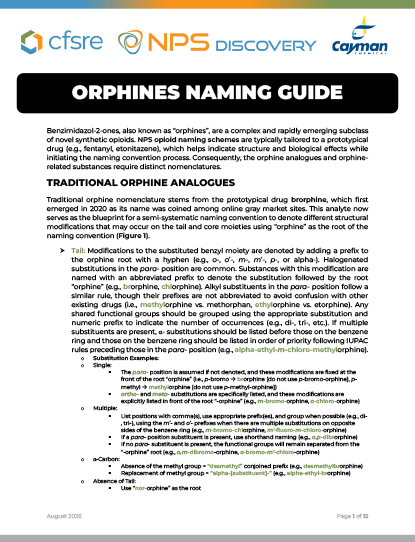
Orphines Naming Guide
Featured Guides
BSA Complexes for Cellular Delivery of Fatty Acids
Featured Brochures
Quantitation of 6-PPD-Q and Its Metabolites in Fish Using LC-MS/MS
Featured Application notes
This study establishes a novel LC-MS/MS method to measure tire rubber antioxidant 6-PPD, its toxic oxidized transformation product 6-PPD-Q, and several potential metabolites in fish tissue. This method can be further extended to include additional PPD compounds and metabolites and could be useful for monitoring water contamination and bioaccumulation.
To cite this technical brief: Kennedy, P.D., Goodwin, S.K., Kiewski, M.J., et al. Quantitation of 6-PPD-Q and its metabolites in fish using LC-MS/MS. Technical Brief, Cayman Chemical Company (2026).
Lipids for LNP Targeting: Passive & Active Approaches
Featured Brochures
Cayman offers a comprehensive portfolio of high‑purity lipids and conjugation‑ready components designed to support both passive and active targeting strategies in lipid nanoparticle (LNP) formulation. From ionizable cationic lipids to PEGylated and ligand‑modified components, our solutions help researchers optimize LNP stability, biodistribution, and targeted delivery for advanced therapeutic applications.
NPS Snapshot: Kratom-Derived Semi-Synthetic Opioids
Featured Guides
A growing wave of consumer products labeled as ‘kratom’, ‘7-hydroxy mitragynine’, or ‘7-OH’—which contain potent semi-synthetic opioids—marks the emergence of a new class of kratom-derived NPS. Since 2024, new kratom-related products containing 7-hydroxy mitragynine and mitragynine pseudoindoxyl have entered the market, often disguised as natural supplements. Though structurally distinct from traditional opioids, these compounds can mimic opioid effects and are frequently misrepresented in labeling. This NPS Snapshot summarizes the structures of potent kratom-related NPS, mitragynine conversion pathways, and the historical context of natural kratom alkaloids.
View All Kratom Alkaloids & Semi-Synthetics
To cite this NPS snapshot: Iula, D.M. NPS snapshot: kratom-derived semi-synthetic opioids. Cayman Chemical (October 2025).
Steroid Hormone Assay Kits
Featured Brochures
Rise of the Orphines: Understanding the evolution, naming, and structural elucidation of a rapidly emerging piperidinylbenzimidazolone scaffold
Webinars
Orphines are a class of rapidly evolving NSOs (novel synthetic opioids) sporting a piperidinylbenzimidazolone core. Orphines like cychlorphine have been implicated in multiple fatalities and continue to make international headlines. These opioids can be easily modified to circumvent regulation without losing potency at the µ-opioid receptor (MOR), potentiating their capacity for harm.
Listen as Danielle St. Germaine, a senior scientist at Cayman Chemical, addresses this emerging threat by providing an overview of the history, pharmacology, nomenclature, marketplace trends, and evolution of the piperidinylbenzimidazolone scaffold. Tips for structural elucidation utilizing EI-MS fragmentation will be provided as well as other valuable resources.
Presented as part of the 2026 ONIC Law Enforcement Drug Summit.
Do you have a question or comment for the presenter? Let us know.
Understanding the Metabolism of Ethylbromazolam Using Human Liver Microsomes
Scientific posters
Ethylbromazolam is a novel psychoactive substance (NPS) structurally similar to the known benzodiazepine Bromazolam. This ethyl analogue emerged on the illicit drug market in early 2025, with reports of detection in multiple countries throughout that year and more following in 2026. Much is known about Bromazolam in terms of its pharmacology and toxicology, however, there is limited availability of information around this new ethyl analogue. Ethylbromazolam has not been approved for medical use and its presence in counterfeit pharmaceuticals poses a health risk.
In this scientific poster, we report the study to identify probable phase I metabolites of the novel designer benzodiazepine Ethylbromazolam through incubation with human liver microsomes (HLMs) followed by liquid chromatography and high-resolution mass spectrometry analysis.
Do you have a question or comment for the presenter? Let us know.
To cite this poster: Layle, N., Bassman, J., Goodwin, S., et al. Understanding the Metabolism of Ethylbromazolam Using Human Liver Microsomes. Poster presented at: SOFT-TIAFT 2026 Joint Meeting; September 19 – 24, 2026; Chicago, IL.
Ethylbromazolam: Cayman NPS Metabolism Monograph, Issue 5
Monographs
Ethylbromazolam is a novel psychoactive substance (NPS) structurally similar to the known benzodiazepine bromazolam. This ethyl analog emerged on the illicit drug market in early 2025, with reports of detection in multiple countries throughout that year and more following in 2026. Much is known about bromazolam, but limited information is available on the pharmacology and toxicology of this new ethyl analogue. This study uses pooled human liver microsomes and LC-MS/MS analysis to identify presumptive phase I metabolites of ethylbromazolam, supporting forensic toxicologists in detecting emerging designer benzodiazepines.
To cite this monograph: Bassman, J.R., Layle, N.K., Goodwin, S.K., et al. Ethylbromazolam. Cayman NPS Metabolism Monograph Issue 5 (2026).
Exploring Microbial Dark Matter Isolation of a Novel Streptomyces Strain Exhibiting Potent Antibacterial Activity Against Multidrug-Resistant Staphylococcus Species
Scientific posters
Widespread antibiotic resistance is outpacing the discovery of new antibiotics, creating a public health emergency. Since the golden age of antibiotics discovery of the mid-20th century, the discovery and clinical development of new antibiotics have relied heavily upon the screening of bioactive secondary metabolites produced by soil microorganisms. However, these discovery efforts focused predominantly on screening of metabolites from culturable soil bacteria which represent a minor component of the total environmental microbial diversity. Overreliance on this limited pool of biological and chemical diversity has resulted in a sharp decrease in the number of new antimicrobial natural products being discovered and prompted new methods for investigating the underexplored natural product chemical space possessed by previously uncultured soil microorganisms.
In this scientific poster, we report the use of the Isolation Chip (iChip) cultivation method for the discovery of a putatively novel environmental Streptomyces strain possessing potentially novel antimicrobial metabolites with strong inhibitory activity against multidrug-resistant strains of Staphylococcus spp.
Do you have a question or comment for the presenter? Let us know.
To cite this poster: Alverson, D., Koch, A., Maxey, K. et al. Exploring Microbial Dark Matter: Isolation of a Novel Streptomyces Strain Exhibiting Potent Antibacterial Activity Against Multidrug-Resistant Staphylococcus Species. Poster presented at: 2026 ASP Annual Meeting; July 26 - 29, 2026; Denver, CO.
What’s new with benzodiazepine NPS: Here come the ethyl analogues!
Webinars
Benzodiazepines were discovered in the 1950s and were rapidly adopted as prescription medicines for the treatment of a variety of conditions, such as anxiety or use as sedatives. However, the increase in popularity of benzodiazepines, along with their addictive properties, also led to an increase in the misuse and abuse of these compounds.
In this presentation, Kirk Hering, Director of Process Exploration and Psychoactive Substance Chemistry at Cayman Chemical, reviews the known metabolic pathways of established designer benzodiazepines and discusses the metabolites likely to form from emerging NPS ethyltriazolobenzodiazepines.
Presented as part of the CFSRE's 2026 Current Trends in Forensic Toxicology Symposium.
Do you have a question or comment for the presenter? Let us know.
NSOs, DBZDs, and HLMs! Oh My!
Webinars
Novel designer benzodiazepines (DBZD) and novel synthetic opioids (NSO) continue to emerge on the illicit novel psychoactive substance (NPS) market. Given this trend, and the continuing rise in benzodiazepine prescriptions, the likelihood for benzodiazepines to appear in toxicological samples alongside synthetic opioids is high. Understanding the synthesis and analytical interpretation of both NPS classes can help prepare forensic toxicologists for the appearance of unknown compounds in their casework.
Join Nathan Layle and Becca Boyce, synthetic organic chemists at Cayman Chemical, as they present the results of our in-house human liver microsome (HLM) studies and demonstrate how these findings can be applied to new analogs. Attendees will gain insights into emerging compounds and metabolites that may soon appear in forensic casework.
Presented as part of the CFSRE's 2026 Current Trends in Forensic Toxicology Symposium.
Do you have a question or comment for the presenter? Let us know.
Development of an LC-MS/MS Method for the Quantitation of 6-PPD-Q and Its Metabolites in Fish
Scientific posters
Developing robust protocols for quantifying 6-PPD-Q in diverse aquatic organisms as well as in water is essential for environmental monitoring of bioaccumulation and food chain safety. Existing publications report analytical methods for monitoring of 6-PPD and 6-PPD-Q but not typically the potential metabolites of 6-PPD-Q due to the previous lack of availability of authentic standards. This study aims to establish a new method for the extraction and quantitation of 6-PPD, 6-PPD-Q, and three hydroxylated metabolites of 6-PPD-Q in various tissues from freshwater fish in the Great Lakes region.
Do you have a question or comment for the presenter? Let us know.
To cite this poster: Kennedy, P.D., Goodwin, S.K., Kiewski, M.J., et al. Development of an LC-MS/MS Method for the Quantitation of 6-PPD-Q and Its Metabolites in Fish. Poster presented at: 74th ASMS Conference on Mass Spectrometry; May 31 – June 4, 2026; San Diego, CA.
Analysis of a Complex Mixture of 13 Benzodiazepines Using HPLC-PDA Detection
Application notes
Outer Membrane Permeabilization via Perfringolysin O Treatment
Application notes
Perfringolysin O (PFOC459A) treatment permeabilizes the outer membrane of live cells, allowing for the investigation of biochemical reactions in whole cells with intact intracellular compartments, including mitochondria.
To cite this technical brief: Foss, M. and Assar, Z. Outer membrane permeabilization via perfringolysin O treatment. Technical Brief, Cayman Chemical Company (2026).
ApoE3 Lipid Particles Assembly, Dynamics, and Biological Roles
Scientific posters
Apolipoproteins are a diverse class of lipid-binding proteins that regulate lipid transport, metabolism, and cellular signaling. Major families, including ApoA, ApoB, ApoC, ApoD, ApoE, ApoH, ApoJ (clusterin), ApoL, and ApoM, serve as structural components of lipoproteins and modulators of lipid-associated pathways. Apolipoprotein E (ApoE) is critically involved in the pathogenesis of Alzheimer’s disease and exists in three major isoforms (ApoE2, ApoE3, and ApoE4) which differentially influence the disease risk and progression. ApoE3 exhibits relatively stable lipid interactions and supports more effective amyloid clearance compared to pathogenic isoforms, thereby reducing neurotoxicity. Since ApoE3 drives receptor-mediated interactions, ApoE3:POPC:cholesterol nanoparticles provide a physiologically relevant and tunable platform to study receptor-mediated lipid efflux and cellular lipid trafficking. Here we demonstrate how ApoE3-POPC and ApoE3-POPC-Cholesterol nanoparticles enhance the efflux of fluorescently tagged saturated fatty acids and cholesterol.
Do you have a question or comment for the presenter? Let us know.
To cite this poster: Khatri, Y., Bae, J.-Y., Anders, A., et al. ApoE3 Lipid Particles: Assembly, Dynamics, and Biological Roles. Poster presented at: 2026 Lipids@Wayne Research Symposium; May 5 – 6, 2026; Detroit, MI.
Chromatographic Separation of 7-Hydroxy Mitragynine from Mitragynine Pseudoindoxyl
Application notes
Key Features:
- The co-elution of 7-hydroxy mitragynine (7-HMG; 7-OH) and mitragynine pseudoindoxyl (MP), two important mitragynine-related alkaloids, by traditional GC-MS methods makes testing a challenge for analysts.
- If testing methods are unable to resolve these two substances in casework, identification and quantification can become compromised.
- The rise of consumer products on the drug market containing potent semi-synthetic opioids derived from kratom, such as 7-hydroxy mitragynine and mitragynine pseudoindoxyl, is of great public health and safety concern.
- Several chromatographic methods to achieve separation are explored in this application note. Method information presented herein may be used to assist labs in developing methods to identify and quantify 7-hydroxy mitragynine and mitragynine pseudoindoxyl in seized drug analysis and/or toxicology cases.
Environmental Toxicology Research Tools
Brochures
Cayman offers chemicals, assay kits, fit-for-purpose standards, and services to study the environmental and biological effects of environmental contaminants including microcystins, mycotoxins, PFAS, PPDs & PPD-Qs, dioxins, pesticides, and more.
Validation and Characterization of Anti-Citrulline Antibodies and Citrullinated Proteins
Scientific posters
Do you have a question or comment for the presenter? Let us know.
To cite this poster: Muzzarelli, K., Bickel, J., Norris, C., et al. Validation and Characterization of Anti-Citrulline Antibodies and Citrullinated Proteins. Poster presented at: 21st Annual Drug Discovery Chemistry Conference; April 13-16, 2026; San Diego, CA.
Ancillary Materials for Cell and Gene Therapies
Brochures
Cell and gene therapies offer transformative potential by targeting the cellular or genetic drivers of disease. Ancillary materials play a critical role in ensuring the safety and quality of the finished therapies, even though they are not intended to be part of the final product. Cayman provides two small‑molecule quality ranges: Ancillary Material and GMP Ancillary Material grades. These products meet the expectations outlined in USP <1043> Ancillary Materials for Cell, Gene, and Tissue‑Engineered Products and support consistent, reliable workflows as your programs advance from development to clinical and commercial stages.
Analysis of a Complex Mixture of Orphines Using HPLC-PDA Detection
Application notes
SM-102-based Lipid Nanoparticles as a Benchmark for the Development of Novel Formulations
Application notes
Semi-Synthetic Opioids: Cracking the Kratom Code
Webinars
Mitragynine is an indole-based alkaloid and is one of the main psychoactive constituents in the Southeast Asian plant Mitragyna speciosa, commonly known as kratom. It is an atypical opioid that is typically consumed as a part of kratom for its pain-relieving and euphoric effects and has also been researched for its use to potentially manage symptoms of opioid withdrawal and as a treatment for alcohol use disorder (AUD). More recently, analogs of mitragynine have begun to appear in the unregulated consumer marketplace and some are readily available in gas stations and vape shops in products branded as "7-hydroxymitragynine" or "7OH" causing heightened concern due to studies showing that 7-hydroxy mitragynine and mitragynine pseudoindoxyl (the rearrangement product of 7-hydroxy mitragynine) are more potent opioid agonists, exceeding that of mitragynine on the order of 10x and 100x, respectively.
Listen as Nathan Layle and Camille Waston-Gooden, synthetic chemists at Cayman Chemical, explain more about the history, pharmacology, metabolism, semi-synthetic modifications, and new emerging analogs of Mitragynine.
Presented as part of the CFSRE's 2026 Current Trends in Seized Drug Analysis Symposium.
Do you have a question or comment for the presenter? Let us know.
What's New With NPS: The Rise of Semi-synthetics Complicates the Picture
Webinars
Donna Iula summarizes the novel substances of greatest concern across classes such as synthetic opioids, benzodiazepines, stimulants, and synthetic cannabinoids including the concerning rise of semi-synthetic opioid NPS derived from Kratom, which are extremely potent.
Presented as part of the CFSRE's 2026 Current Trends in Seized Drug Analysis Symposium.
Do you have a question or comment for the presenter? Let us know.
N-Propionitrile Chlorphine: Cayman NPS Metabolism Monograph, Issue 4
Monographs
This NPS metabolism monograph highlights N-propionitrile chlorphine (also known as cyclorphine or cychlorphine), a novel synthetic opioid (NSO) first identified by the CFSRE in 2024. Structurally related to brorphine, a potent μ-opioid receptor agonist and DEA Schedule I controlled substance, this analog reflects the growing global prevalence of modified synthetic opioids in the emerging "orphine" class. Using pooled human liver microsomes in vitro and LC-MS/MS, the monograph identifies presumptive phase I metabolites to support forensic toxicologists in detecting emerging NSOs.
To cite this monograph: Bassman, J.R., Layle, N.K., Goodwin, S.K., et al. N-Propionitrile Chlorphine. Cayman NPS Metabolism Monograph Issue 4 (2025).
Contact Info
Cayman Chemical1180 East Ellsworth RoadAnn Arbor, Michigan 48108 USAToll Free: (800) 364-9897(USA and Canada only)Fax: (734) 971-3640


