
Literature & Media
ApoE3 Lipid Particles Assembly, Dynamics, and Biological Roles
Scientific posters
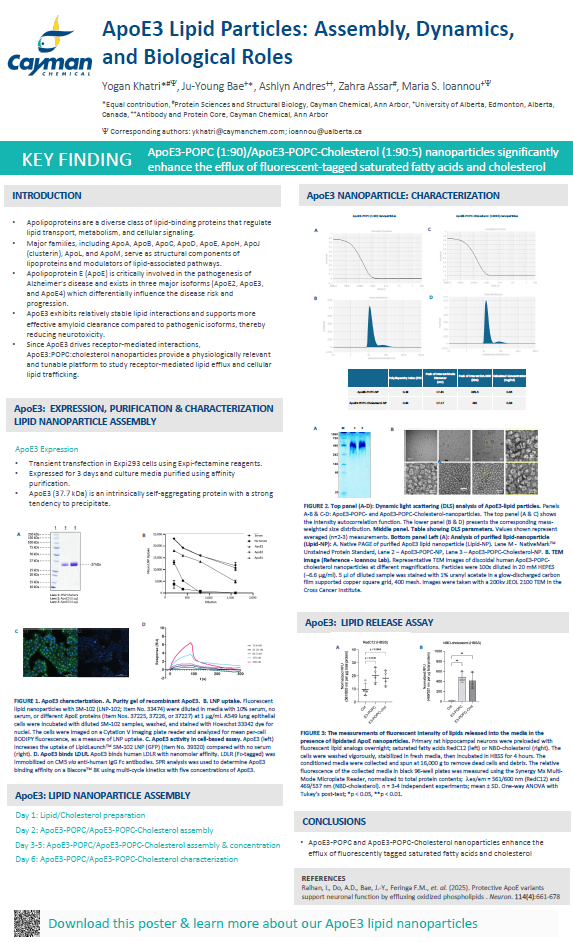
Apolipoproteins are a diverse class of lipid-binding proteins that regulate lipid transport, metabolism, and cellular signaling. Major families, including ApoA, ApoB, ApoC, ApoD, ApoE, ApoH, ApoJ (clusterin), ApoL, and ApoM, serve as structural components of lipoproteins and modulators of lipid-associated pathways. Apolipoprotein E (ApoE) is critically involved in the pathogenesis of Alzheimer’s disease and exists in three major isoforms (ApoE2, ApoE3, and ApoE4) which differentially influence the disease risk and progression. ApoE3 exhibits relatively stable lipid interactions and supports more effective amyloid clearance compared to pathogenic isoforms, thereby reducing neurotoxicity. Since ApoE3 drives receptor-mediated interactions, ApoE3:POPC:cholesterol nanoparticles provide a physiologically relevant and tunable platform to study receptor-mediated lipid efflux and cellular lipid trafficking. Here we demonstrate how ApoE3-POPC and ApoE3-POPC-Cholesterol nanoparticles enhance the efflux of fluorescently tagged saturated fatty acids and cholesterol.
Do you have a question or comment for the presenter? Let us know.
To cite this poster: Khatri, Y., Bae, J.-Y., Anders, A., et al. ApoE3 Lipid Particles: Assembly, Dynamics, and Biological Roles. Poster presented at: 2026 Lipids@Wayne Research Symposium; May 5 – 6, 2026; Detroit, MI.



Contact Info
Cayman Chemical1180 East Ellsworth RoadAnn Arbor, Michigan 48108 USAToll Free: (800) 364-9897(USA and Canada only)Fax: (734) 971-3640