
Literature & Media
Cancer Neoepitope Identification in Soluble HLA from Patient Plasma
Scientific posters
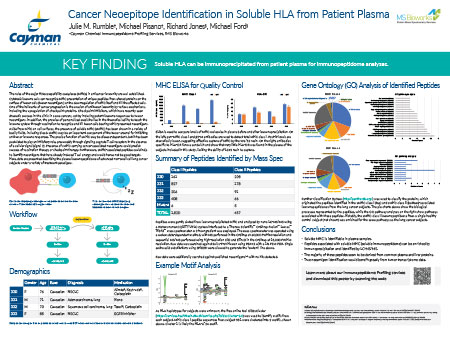
The roles of the major histocompatibility complexes (MHCs) in anticancer immunity are well established. Cytotoxic immune cells can recognize MHC presentation of unique peptides from altered proteins on the surface of tumor cells (tumor neoantigens) or the downregulation of MHC itself and kill the affected cells. One of the hallmarks of cancer progression is the evasion of antitumor immunity by various mechanisms, including the upregulation of checkpoint proteins. Checkpoint inhibitors, which have recently seen dramatic success in the clinic in some cancers, act by inducing potent immune responses to tumor neoantigens. In addition, the promise of personalized medicine lies in the theoretical ability to teach the immune system through vaccination to recognize and kill tumor cells bearing MHC-presented neoantigens.
Do you have a question or comment for the presenter? Let us know.
To cite this poster: Rumble, J.M., Pisano, M., Jones, R., et al. Cancer neoepitope identification in soluble HLA from patient plasma. Poster presented at: 2020 American Association for Cancer Research (AACR) Virtual Meeting II; June 22-24, 2020.



Contact Info
Cayman Chemical1180 East Ellsworth RoadAnn Arbor, Michigan 48108 USAToll Free: (800) 364-9897(USA and Canada only)Fax: (734) 971-3640