
Literature & Media
Differentiation of Isobaric and Isomeric Fentanyl Analogs by Gas Chromatography-Mass Spectrometry (GC-MS)
Scientific posters
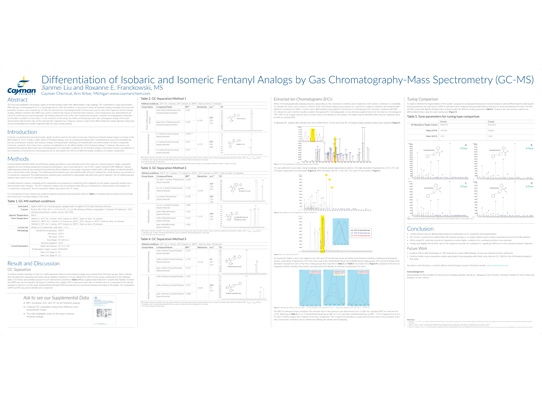
The structural similarities and isomeric nature of fentanyl analogs makes their differentiation a big challenge. The combination of mass spectrometry (MS) with gas chromatography (GC) is a promising way to solve the problem. In the present study, 60 fentanyl analogs, including structural and geometric isomers, were analyzed by GC-MS. An extracted ion chromatogram (EIC) function was used to select key fragments of the fentanyl analogs. Relative retention time (RRT) was used to minimize the impact of retention time variation. Oven temperature was determined to be critical to achieving successful separation. By slowing down the rate of the oven temperature program, complete chromatographic separation and baseline resolution of more than 1.5 was achieved. In this study, the effects of tuning type were also investigated. Tuning of the mass spectrometer affected the ratio of the characteristic fragment ions. However, isomers could not be differentiated by simply altering tuning type as they would likely have similar fragments with the same tuning method. (You can also download supplemental material for this poster.)
Do you have a question or comment for the presenter? Let us know.
To cite this poster: Liu, J. and Franckowski, R.E. Differentiation of isobaric and isomeric fentanyl analogs by gas chromatography-mass spectrometry (GC-MS). Poster presented at: AAFS 71st Annual Scientific Meeting; February 18-23, 2019; Baltimore, MD.



Contact Info
Cayman Chemical1180 East Ellsworth RoadAnn Arbor, Michigan 48108 USAToll Free: (800) 364-9897(USA and Canada only)Fax: (734) 971-3640