
Literature & Media
In Vivo Investigation of pDNA Delivery Using Various Lipid Nanoparticle Formulations in A549 and Huh7 Cell Lines
Scientific posters
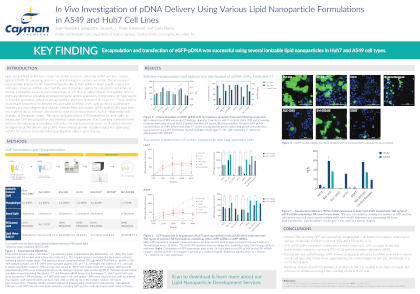
In this study, we investigated the efficiency of LNPs loaded with GFP-encoding pDNA using several previously published ionizable lipids, including DLin-MC3-DMA (MC3), CIN-16645 (LP-01), ALC-0315, 4A3-SC8, and DOTAP (SORT), SM-102, and β-sitosterol as a cholesterol analogue in SM-102. Key formulation characteristics, such as polydispersity index (PDI), Z-average diameter (Z-Avg), encapsulation efficiency (%EE), and freeze-thaw stability, were examined through plate-based methods. Our results show that all LNP formulations achieved ≥85% encapsulation of pDNA-eGFP with PDI values ≤0.10, indicating efficient nanoparticle formation. Next, we evaluated the transfection efficiency and mean fluorescence intensity (MFI) of pDNA-loaded LNPs in Huh-7 hepatocytes and A549 lung epithelial cells. We show that pDNA-eGFP-loaded LNPs exhibited comparable GFP intensities, with slightly lower transfection efficiencies than mRNA-loaded LNPs. Both Huh-7 and A549 cells were successfully transfected with pDNA-encapsulated LNPs
Do you have a question or comment for the presenter? Let us know.
To cite this poster: Konopka, S., Stewart, S., Gronevelt, J.P., et al. In vivo investigation of pDNA delivery using lipid nanoparticle formulations in A549 and Huh7 cell lines. Poster presented at: Cell Bio 2024; December 14-18, San Diego, CA.



Contact Info
Cayman Chemical1180 East Ellsworth RoadAnn Arbor, Michigan 48108 USAToll Free: (800) 364-9897(USA and Canada only)Fax: (734) 971-3640