
Log InRegister
Literature & Media
Development of an LC-MS/MS Method for the Quantitation of 6-PPD-Q and Its Metabolites in Fish
Scientific posters
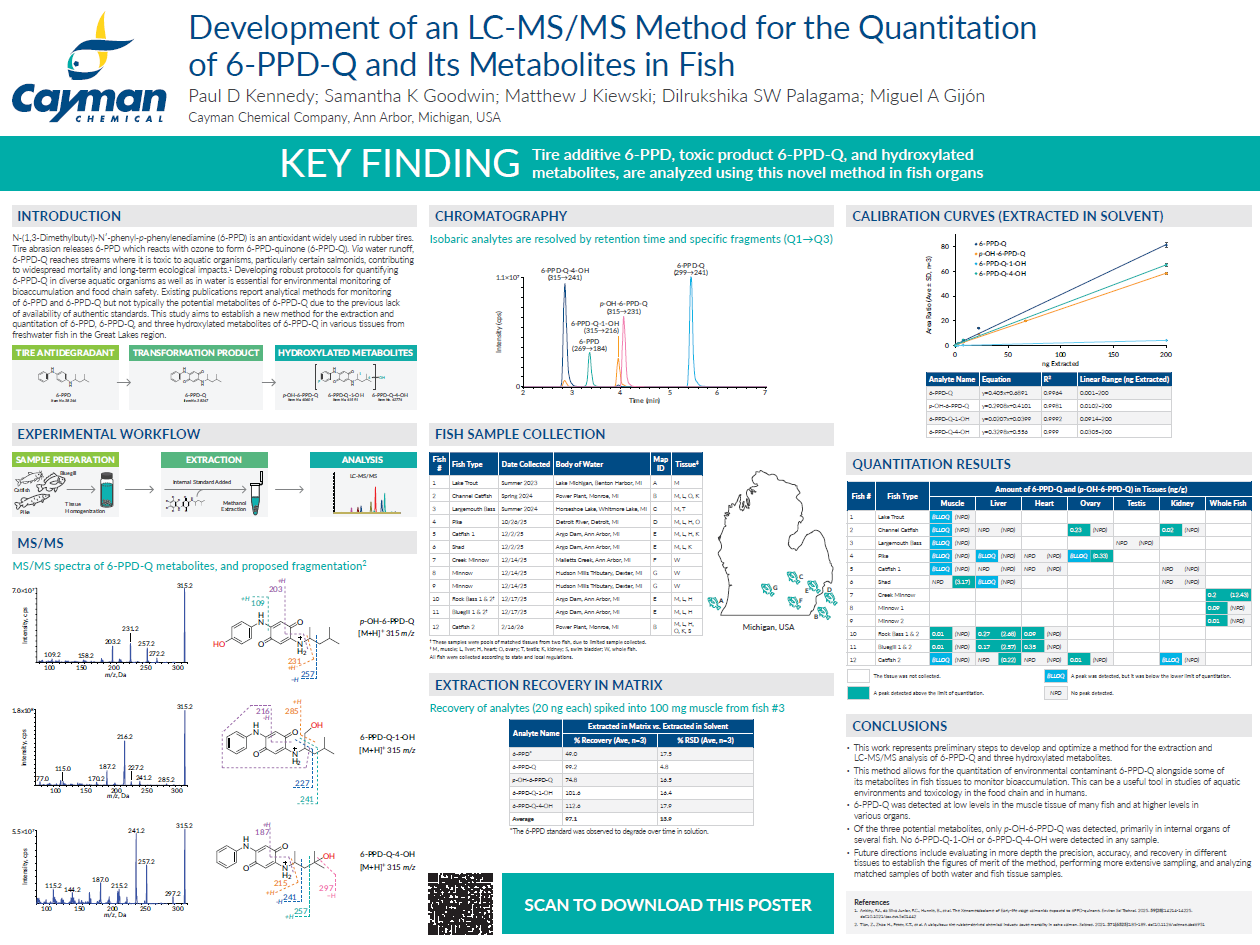
N-(1,3-Dimethylbutyl)-N′-phenyl-p-phenylenediamine (6-PPD) is an antioxidant widely used in rubber tires. Tire abrasion releases 6-PPD which reacts with ozone to form 6-PPD-quinone (6-PPD-Q). Via water runoff, 6-PPD-Q reaches streams where it is toxic to aquatic organisms, particularly certain salmonids, contributing to widespread mortality and long-term ecological impacts.
Developing robust protocols for quantifying 6-PPD-Q in diverse aquatic organisms as well as in water is essential for environmental monitoring of bioaccumulation and food chain safety. Existing publications report analytical methods for monitoring of 6-PPD and 6-PPD-Q but not typically the potential metabolites of 6-PPD-Q due to the previous lack of availability of authentic standards. This study aims to establish a new method for the extraction and quantitation of 6-PPD, 6-PPD-Q, and three hydroxylated metabolites of 6-PPD-Q in various tissues from freshwater fish in the Great Lakes region.
Do you have a question or comment for the presenter? Let us know.
To cite this poster: Kennedy, P.D., Goodwin, S.K., Kiewski, M.J., et al. Development of an LC-MS/MS Method for the Quantitation of 6-PPD-Q and Its Metabolites in Fish. Poster presented at: 74th ASMS Conference on Mass Spectrometry; May 31 – June 4, 2026; San Diego, CA.
Download Copy (PDF)Developing robust protocols for quantifying 6-PPD-Q in diverse aquatic organisms as well as in water is essential for environmental monitoring of bioaccumulation and food chain safety. Existing publications report analytical methods for monitoring of 6-PPD and 6-PPD-Q but not typically the potential metabolites of 6-PPD-Q due to the previous lack of availability of authentic standards. This study aims to establish a new method for the extraction and quantitation of 6-PPD, 6-PPD-Q, and three hydroxylated metabolites of 6-PPD-Q in various tissues from freshwater fish in the Great Lakes region.
Do you have a question or comment for the presenter? Let us know.
To cite this poster: Kennedy, P.D., Goodwin, S.K., Kiewski, M.J., et al. Development of an LC-MS/MS Method for the Quantitation of 6-PPD-Q and Its Metabolites in Fish. Poster presented at: 74th ASMS Conference on Mass Spectrometry; May 31 – June 4, 2026; San Diego, CA.



Contact Info
Cayman Chemical1180 East Ellsworth RoadAnn Arbor, Michigan 48108 USAToll Free: (800) 364-9897(USA and Canada only)Fax: (734) 971-3640