
Log InRegister
Literature & Media
Mitochondrial Fuel Flexibility Assessment in a Tumor-Relevant Model
Application notes
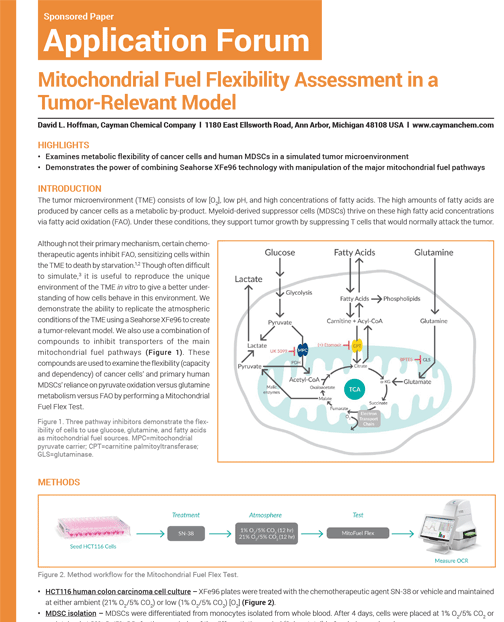
The tumor microenvironment (TME) consists of low [O2], low pH, and high concentrations of fatty acids. The high amounts of fatty acids are produced by cancer cells as a metabolic by-product. Myeloid-derived suppressor cells (MDSCs) thrive on these high fatty acid concentrations via fatty acid oxidation (FAO). Under these conditions, they support tumor growth by suppressing T cells that would normally attack the tumor.
Download Copy (PDF)Highlights:
- Examines metabolic flexibility of cancer cells and human MDSCs in a simulated tumor microenvironment
- Demonstrates the power of combining Seahorse XFe96 technology with manipulation of the major mitochondrial fuel pathways
To cite this application note: Hoffman, D.L. Mitochondrial fuel flexibility assessment in a tumor-relevant model. BioTechniques67(3), 139-140 (2019).



Contact Info
Cayman Chemical1180 East Ellsworth RoadAnn Arbor, Michigan 48108 USAToll Free: (800) 364-9897(USA and Canada only)Fax: (734) 971-3640