
Literature & Media
Generation of Presumptive Metabolites of a Novel Synthetic Opioid Using Human Liver Microsomes and Subsequent Analysis by Orbitrap LC-MS/MS
Scientific posters
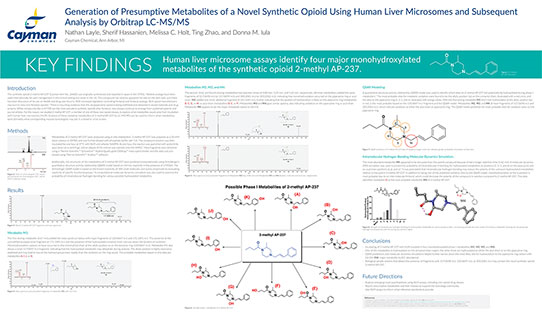
There is mounting evidence that 2-methyl AP-237, an acylpiperazine opioid, is being trafficked and detected in seized materials and drug screens. While compounds like U-47700 are the most prevalent synthetic opioids after fentanyl, new classes continue to emerge from published patents and journal articles. For this reason, we studied 2-methyl AP-237, a member of one of these new opioid classes, to explore what metabolites would arise from incubation with human liver microsomes (HLM). Analysis of these oxidative metabolites of 2-methyl AP-237 by LC-MS/MS can be used to inform what metabolites (and ultimately what corresponding masses) toxicologists may see in a blood or urine screen.
Do you have a question or comment for the presenter? Let us know.
To cite this poster: Layle, N., Hassanien, S., Holt, M.C., et al. Generation of presumptive metabolites of a novel synthetic opioid using human liver microsomes and subsequent analysis by Orbitrap LC-MS/MS. Poster presented at: Society of Forensic Toxicologists (SOFT) Annual Meeting 2019; October 13-18, 2019; San Antonio, TX.



Contact Info
Cayman Chemical1180 East Ellsworth RoadAnn Arbor, Michigan 48108 USAToll Free: (800) 364-9897(USA and Canada only)Fax: (734) 971-3640