
Literature & Media
Response of Metabolic Phenotype to Chemotherapy Agents in a Simulated Tumor Microenvironment
Scientific posters
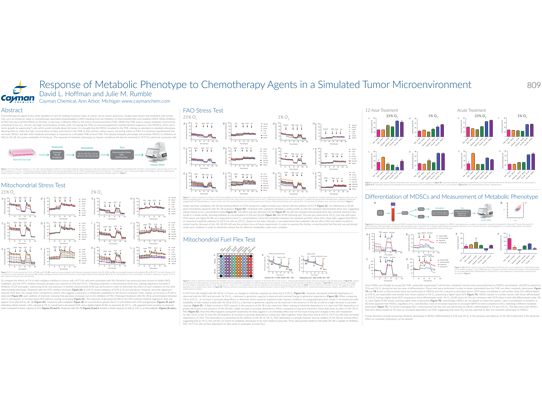
Chemotherapeutic agents (CAs), while standard-of-care for treating numerous types of cancer, are by nature, poisonous. Studies have shown that treatment with certain CAs, such as irinotecan, leads to chemotherapy-associated steatohepatitis (CASH) resulting from the inhibition of mitochondrial fatty acid oxidation (FAO). While inhibition of FAO may have harmful effects on the liver, it may have a different effect in the tumor microenvironment (TME). Within the TME exists a unique metabolic environment, consisting of low [O2], low pH, and high concentrations of fatty acids. Occupying the TME are immunosuppressive myeloid-derived suppressor cells (MDSCs), which aid in tumor growth by suppressing T cells, which would normally attack the tumor. It is thought that the MDSCs localized to the TME undergo an alteration in metabolic phenotype, allowing them to utilize the high concentrations of fatty acids found in the TME as their primary carbon source, becoming reliant on FAO. It is therefore hypothesized that normoxic MDSCs will alter their metabolic phenotype in response to a simulated TME to favor FAO. This altered metabolic phenotype will sensitize MDSCs to inhibition of FAO by SN-38, the active metabolite of irinotecan. The response of metabolic phenotype to hypoxic conditions will also be examined in HCT116 colorectal carcinoma cells.
Do you have a question or comment for the presenter? Let us know.
To cite this poster: Hoffman, D.L. and Rumble, J.M. Response of metabolic phenotype to chemotherapy agents in a simulated tumor microenvironment. Poster presented at: 2019 American Association for Cancer Research (AACR) Annual Meeting; March 29-April 3, 2019; Atlanta, GA.



Contact Info
Cayman Chemical1180 East Ellsworth RoadAnn Arbor, Michigan 48108 USAToll Free: (800) 364-9897(USA and Canada only)Fax: (734) 971-3640