
News & Announcements
EOS
EOS
Article from 2020-02-27
A role for ω-hydroxy VLCFA ceramides in the skin’s lipid matrix
Updated February 27, 2020
Ceramides are most recognizable for their use in skincare products. Indeed, one of their many important biological functions is to maintain skin moisture. A unique class of ceramides is indispensable for the skin’s natural barrier. This class of lipids contains linoleic acid (18:2), the most abundant essential fatty acid in the epidermis, esterified to the ω-hydroxyl group of a very long-chain fatty acid (VLCFA) linked at the N-acyl moiety to sphingosine (18:1) (Figure 1). These epidermis-specific lipids were named EOS to describe their chemical makeup: esterified omega-hydroxyacyl-sphingosine. The EOS family is composed of a group of structural analogs that differ in carbon chain length (mostly C30-C36) and number of double bonds in the amide-linked VLCFA. The sphingoid base can also vary among sphingosine (EOS), phytosphingosine (EOP), dihydrosphingosine (EOdS), 6-hydroxysphingosine (EOH), and the recently described 1-O-acylsphingosine (1-O-E_S).
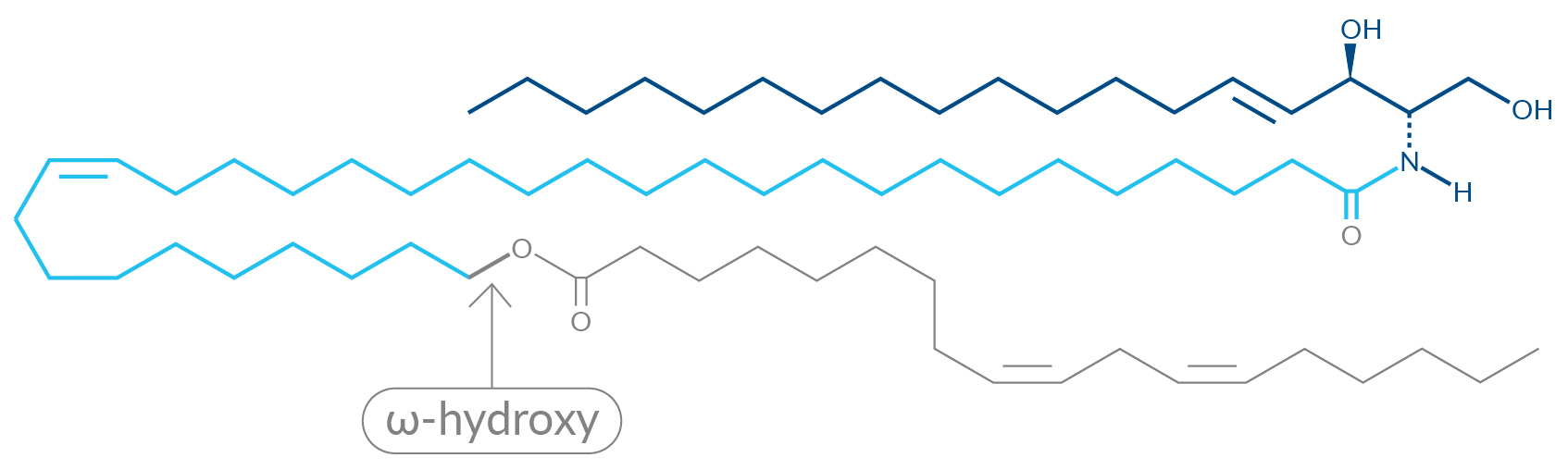
Figure 1. EOS (d18:1/32:1/18:2) is representative of the class of ceramides found in the outer layer of the epidermis.
Structural Organization and Function
EOS is arranged within the stratum corneum alongside cholesterol and saturated fatty acids and organized into trilaminar units that surround corneocytes, the flattened dead cells of the outermost layer of skin (Figure 2). The extremely long fatty acid chain of EOS is essential for skin barrier function. Neutron diffraction studies on stratum corneum lipid model systems imply that one EOS molecule stretches from one lipid membrane layer and penetrates an adjacent layer. This organization helps to form a long periodicity phase that is important for tightening neighboring bilayers densely together to decrease water diffusion. However, the exact lipid organization of the stratum corneum is still under debate, since it is difficult to study an intact internal structure in native skin tissues.
Figure 2. The skin barrier consists of corneocytes surrounded by a multilamellar lipid matrix of ceramides, free fatty acids, and cholesterol densely packed in an approximately 1:1:1 molar ratio. Although depicted in hairpin conformation, it is theoretically possible (due to their multilamellar arrangement) for the lipids of the stratum corneum to have an extended, splayed-chain conformation that connects adjacent lipid layers.
EOS Oxidation
The linoleate moiety in EOS can be oxidized by 12(R)-lipoxygenase (12(R)-LO) to form 9(R)-HpODE-EOS and further transformed by epidermis-type lipoxygenase 3 (eLOX3) to a specific epoxy alcohol derivative (9(R),10(R),13(R)-EpOH-EOS). Short-chain dehydrogenase/reductase family 9C member 7 (SDR9C7) then catalyzes the formation of an epoxy-enone derivative that is capable of reacting nonenzymatically to form covalent bonds with proteins of the outer surface of corneocytes within the protein layer of the stratum corneum (Figure 3). This initiates the formation of the corneocyte lipid envelope (CLE). Free VLCFAs (lacking a sphingosine base) are also linked to the CLE closely packed between lipid chains. The CLE lies between intercellular lamellar lipids and cross-linked proteins within corneocytes, functioning to seal the gap between lipid and protein layers and to create a tortuous water barrier (Figure 2).
Figure 3. EOS from the intercellular lamellar lipid layer is transformed by lipoxygenases and dehydrogenated into a reactive epoxy-enonecapable of covalent coupling to cross-linked proteins of the cornified envelope to create the CLE.
Ichthyosis
Congenital ichthyosis is a dry, scaling skin condition where a fundamental problem exists in the skin barrier. As an autosomal recessive disorder, patients with inactivating mutations in 12(R)-LO (ALOX12B), eLOX3 (ALOXE3), and SDR9C7 (Sdr9c7) genes prevent proper formation of the CLE. Another essential enzyme in skin barrier formation is the transacylase that generates EOS, patatin-like domain-containing 1 (PNPLA1). This recently discovered enzyme esterifies linoleic acid to the ω-hydroxyl group of the VLCFA using triglyceride as a substrate. Mutant forms of PNPLA1 are found in patients with ichthyosis suggesting that decreases in EOS levels are a cause of skin barrier defects. Researchers are working to bypass this defect by finding ways to topically apply these crucial ceramides.
EOS Research Tools
Cayman offers EOS (d18:1/32:1/18:2), EOS (d18:1/30:0/18:2), and EOS-d9 (d18:1-d9/32:0/18:2) as research tools to help better understand the arrangement of ceramides in the skin barrier. With multiple species of skin barrier ceramides possible, many additional variations to carbon chain length and number of double bonds in the amide-linked VLCFA and ceramide base can also be created. Contact us to let us know what ceramide species are best suited for your research studies. Our lipid experts can synthesize any ceramide to your specifications.
Need custom synthesis of your particular EOS?
Email us at contractresearch@caymanchem.com.
Suggested Reading
Hirabayashi, T., Anjo, T., Kaneko, A., et al. PNPLA1 has a crucial role in skin barrier function by directing acylceramide biosynthesis. Nat. Commun. 8, 14609 (2017).
Kessner, D., Kiselev, M., Dante, S. et al. Arrangement of ceramide [EOS] in a stratum corneum lipid model matrix: New aspects revealed by neutron diffraction studies. Eur. Biophys. J.37(6), 989-999 (2008).
Krieg, P., Rosenberger, S., de Juanes, S., et al. Aloxe3 knockout mice reveal a function of epidermal lipoxygenase-3 as hepoxilin synthase and its pivotal role in barrier formation. J. Invest. Dermatol.133(1), 172-180 (2013).
Mojumdar, E.H., Gooris, G.S., Groen, D. et al. Stratum corneum lipid matrix: Location of acyl ceramide and cholesterol in the unit cell of the long periodicity phase. Biochim. Biophys. Acta. 1858(8), 1926-1934 (2016).
Muñoz-Garcia, A., Thomas, C.P., Keeney, D.S., et al. The importance of the lipoxygenase-hepoxilin pathway in the mammalian epidermal barrier. Biochim Biophys. Acta. 1841(3), 401-408 (2014).
Ohno, Y., Kamiyama, N., Nakamichi, S., et al. PNPLA1 is a transacylase essential for the generation of the skin barrier lipid w-O-acylceramide. Nat. Commun.8(14610), 1-8 (2017).
Takeichi, T., Hirabayashi, T., Miyasaka, Y., et al. SDR9C7 catalyzes critical dehydrogenation of acylceramides for skin barrier formation. J. Clin. Invest.130(2), 890-903 (2020).
Vávrová, K., Kováčik, A., and Opálka, L. Ceramides in the skin barrier. Eur. Pharm. J. 64(2), 28-35 (2017).
Zheng, Y., Yun, H., Boeglin, W.E., et al. Lipoxygenases mediate the effect of essential fatty acid in skin barrier formation: A proposed role in releasing omega-hydroxyceramide for construction of the corneocyte lipid envelope. J. Biol. Chem. 286(27), 24046-24056 (2011).
Contact Info
Cayman Chemical1180 East Ellsworth RoadAnn Arbor, Michigan 48108 USAToll Free: (800) 364-9897(USA and Canada only)Fax: (734) 971-3640


