
News & Announcements
N-Glycolyl-Ganglioside GM3: Cancer Biomarker with Unusual Sialic Acid Content
Article from 2020-12-18
Sialic acids are important for cell-cell recognition and cell-pathogen interactions. They can be found on gangliosides localized to plasma membranes, where sialylated sugar chains protrude out of cells, serving as specific antigens in immune reactions and contacts for glycan-binding proteins to mediate cell-cell interactions.1 N-Acetylneuraminic acid (Neu5Ac) and its hydroxylated form, N-glycolylneuraminic acid (Neu5Gc), are the two major variants of sialic acid found in most mammals.2 Neu5Gc is mainly derived from Neu5Ac through enzymatic hydroxylation of cytidine-5'-monophospho-NeuAc (CMP-Neu5Ac) but can also be synthesized by hydroxylation of free Neu5Ac or glycoconjugate-linked Neu5Ac. CMP-Neu5Ac hydroxylase, a cytosolic NADH-dependent monooxygenase that requires cytochrome b5 and cytochrome b5 reductase for activity, plays a role in regulating Neu5Gc expression in glycoconjugates by controlling the ratio of Neu5Gc to Neu5Ac.
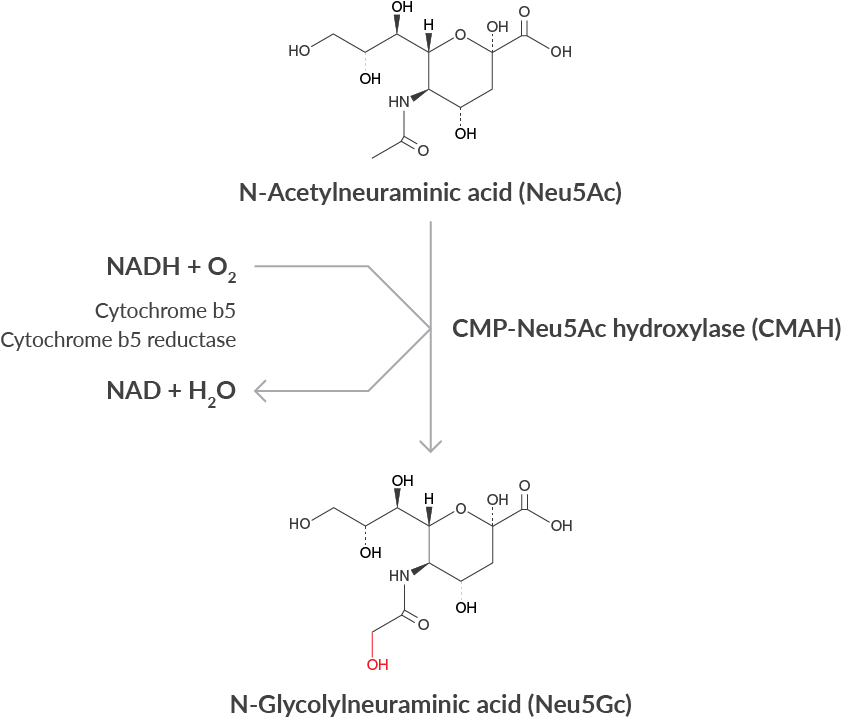
Neu5Gc is generated from Neu5Ac by the enzyme CMP-Neu5Ac hydroxylase (CMAH).
Though Neu5Gc is found in most mammals, its presence in humans is limited due to a partial truncation of the CMP-Neu5Ac hydroxylase gene that renders the biosynthetic enzyme inactive.3 Therefore, human cells are not capable of synthesizing their own Neu5Gc-sialoconjugates.4 The possibility that other Neu5Gc-biosynthesis pathways are present in humans has been ruled out since no other biosynthetic enzymes have been identified. However, Neu5Gc can be metabolically incorporated into human cells through diet, primarily from red meat and milk products.5,6 Neu5Gc is highly immunogenic to humans, and human heterophile antibodies that agglutinate animal erythrocytes, termed Hanganutziu-Deicher (HD) antibodies, detect non-human Neu5Gc.7 A prolonged antibody reaction to this type of xeno-autoantigen can generate chronic inflammation that leads to cancer or the development of inflammatory or autoimmune diseases.
Despite zero to minimal amounts of Neu5Gc being found in healthy human tissues, higher levels of Neu5Gc have been detected in a variety of tumors and are associated with their progression and metastasis.8,9 For example, abnormal expression of N-glycolyl-Ganglioside GM3 (N-glycolyl-GM3), a Neu5Gc-containing ganglioside, is found mostly on the surface of malignant tumors.10 In breast cancer, both O-acetylated and Neu5Gc-containing gangliosides have been detected.9 Any alterations to the ceramide portion of these unusual gangliosides could weaken its anchor in the cell membrane, enabling them to be actively shed and taken up by other cells.4 In both pediatric and adult sarcomas, N-glycolyl-GM3 expression was increased by 59.3-100%.10 Another study conducted on 27 cases of neuroectodermal tumors found 85% were reported to have N-glycolyl-GM3.11 These 23 N-glycolyl-GM3-positive tumors were more aggressive than those in the other four cases. The most aggressive urinary bladder tumors and malignant gliomas also contain N-glycolyl-GM3. Reports of reduced survival have been linked to colon adenocarcinomas and non-small cell lung cancer (NSCLC) cells bearing N-glycolyl-GM3.10
Because N-glycolyl-GM3 is easily detected on the surface of malignant cells, and this expression is minimal in healthy cells, the presence of these tumor-associated antigens provides a basis for early (and potentially pre-malignant) immunological localization and diagnosis. These antigens also serve as an excellent target for immunotherapy to suppress tumor growth through macrophage activation or antibody-dependent cytotoxicity. At least two vaccines, racotumomab and NGcGM3/VSSP, that specifically target Neu5Gc tumor antigens are being developed to fight breast tumors, melanoma, and NSCLC.12-14 Both of these vaccines have been found to improve the survival of patients with an immune response to the N-glycolyl-GM3 antigen.
As gangliosides are minor components in human tissues, sensitive methods for their quantitative isolation and analysis are needed. Cayman's scientists have developed a high-quality standard for N-glycolyl-GM3 detection to advance this research.
Related Ganglioside Cancer Biomarkers
| Biomarker | Cancer Type |
NSCLC, bladder, gliomas, neuroectodermal tumors, colon adenocarcinomas | |
Breast, renal | |
Melanomas, gliomas, neuroblastomas, breast | |
Breast | |
Gliomas, astrocytomas | |
Melanomas, gliomas, neuroblastomas, breast, bladder | |
Melanomas, gliomas, neuroblastomas, breast, ovarian | |
SCLC | |
Metastatic brain tumors, Ehrlich ascites carcinoma |
Cayman offers more than 30 gangliosides including deuterium-labeled standards to help you identify and quantify your analyte of interest. If you cannot find the ganglioside you need, contact us for a custom synthesis quote.
References
1. Lopez, P.H.H. and Schnaar, R.L. Gangliosides in cell recognition and membrane protein regulation. Curr. Opin. Struct. Biol. 19(5), 549-557 (2009).
2. Kooner, A.S., Yu, H., and Chen, X. Synthesis of N-glycolylneuraminic acid (Neu5Gc) and its glycosides. Front. Immunol. 10, 2004 (2019).
3. Irie, A. and Suzuki, A. CMP-N-Acetylneuraminic acid hydroxylase is exclusively inactive in humans. Biochem. Biophys. Res. Commun. 248(2), 330-333 (1998).
4. Blanco, R. N-glycolyl GM3 ganglioside as a relevant tumor antigen in humans. J. Mol. Biomark. Diagn. 7(6), 1000e124 (2016).
5. Bardor, M., Nguyen, D.H., Diaz, S., et al. Mechanism of uptake and incorporation of the non-human sialic acid N-glycolylneuraminic acid into human cells. J. Biol. Chem. 280(6), 4228-4237 (2005).
6. Nguyen, D.H., Tangvoranuntakul, P., and Varki, A. Effects of natural human antibodies against a nonhuman sialic acid that metabolically incorporates into activated and malignant immune cells. J. Immunol. 175(1), 228-236 (2005).
7. Padler-Karavani, V., Yu, H., Cao, H., et al. Diversity in specificity, abundance, and composition of anti-Neu5Gc antibodies in normal humans: Potential implications for disease. Glycobiology 18(10), 818-830 (2008).
8. Yin, J., Hashimoto, A., Izawa, M., et al. Hypoxic culture induces expression of sialin, a sialic acid transporter, and cancer-associated gangliosides containing non-human sialic acid on human cancer cells. Cancer Res. 66(6), 2937-2945 (2006).
9. Marquina, G., Waki, H., Fernandez, L.E., et al. Gangliosides expressed in human breast cancer. Cancer Res. 56(22), 5165-5171 (1996).
10. Pilco-Janeta, D., De la Cruz Puebla, M., Soriano, J., et al. Aberrant expression of N-glycolyl GM3 ganglioside is associated with the aggressive biological behavior of human sarcomas. BMC Cancer 19(1), 556 (2019).
11. Scursoni, A.M., Galluzzo, L., Camarero, S., et al. Detection of N-glycolyl GM3 ganglioside in neuroectodermal tumors by immunohistochemistry: An attractive vaccine target for aggressive pediatric cancer. Clin. Dev. Immunol. 245181 (2011).
12. Pérez, K., Osorio, M., Hernández, J., et al. NGcGM3/VSSP vaccine as treatment for melanoma patients. Hum. Vaccin. Immunother. 9(6), 1237-1240 (2013).
13. Fernandez, L.E., Gabri, M.R., Guthmann, M.D. et al. NGcGM3 ganglioside: A privileged target for cancer vaccines. Clin. Dev. Immunol. 814397 (2010).
14. Labrada, M., Dorvignit, D., Hevia, G., et al. GM3(Neu5Gc) ganglioside: An evolution fixed neoantigen for cancer immunotherapy. Semin. Oncol. 45(1-2), 41-51 (2018).
Contact Info
Cayman Chemical1180 East Ellsworth RoadAnn Arbor, Michigan 48108 USAToll Free: (800) 364-9897(USA and Canada only)Fax: (734) 971-3640


