
News & Announcements
Certified Reference Materials for the Cannabis Industry: Solving the Production Puzzle
Article from 2020-07-15
By Roxanne Franckowski, Manager of ISO Quality at Cayman Chemical
This article was first published in the July/August issue of Terpenes and Testing.
As the manager of ISO (International Organization for Standardization) Quality for Cayman Chemical, I have the privilege to engage with fellow scientists at scientific meetings and networking events. Prior to my current role as a Reference Material Producer (RMP), I worked as a chemist in the environmental and forensic fields. The common thread throughout each of these experiences is the need for certified reference materials (CRMs) to ensure the quality of testing and accuracy of measurements.
As more analytical laboratories involved in Cannabis testing fall under regulatory and/or accreditation requirements, they too are expected to utilize CRMs when available. For readers that may be unfamiliar with CRMs, the best definition of a CRM is that given by ISO. CRM is defined by ISO as a material that is sufficiently homogeneous, stable, characterized using metrologically valid procedures, and is fit for its intended use.1 CRMs are accompanied by a certificate that provides the value of the measured property, the associated uncertainty, and a statement of metrological traceability. RMPs accredited under ISO 17034 standards are responsible for project planning, management, and assigning property values and associated uncertainties to ensure that CRMs meet these criteria.2
CRMs are ideal for analyses requiring accurate, quantitative measurements. If the purpose of the experiment is qualitative in nature, it is possible a Reference Material (RM) could be a better fit. An RM is still manufactured under ISO 17034, but it’s not accompanied by a certificate with an uncertainty value or metrologically traceable to an SI unit (International System of Units) of measurement (e.g., kilogram).
Two questions frequently heard from our customers are: how do you choose which compounds to make into CRMs and how long does it take to make a CRM?
Selecting a material and creating a production plan for a CRM is like solving a jigsaw puzzle. The time it takes to complete the puzzle is dependent on the complexity. Just as there are strategies used when putting a jigsaw puzzle together, such as starting with the edges or using the picture on the box as a guide, there are strategies we follow to complete the CRM design. To determine the best strategy, several production steps are considered.
A common tactic is to first find the corner pieces when solving a jigsaw puzzle and build from there. Selecting a material to elevate to a CRM is how we begin to complete this puzzle. With numerous compounds to choose from, how do we prioritize? Prioritization decisions are based on the needs of the industries we serve. We can make such determinations by reviewing relevant literature and understanding our customers’ needs. Therefore, the most influential factor is customer engagement and feedback.
Once we’ve identified a candidate material, the purpose, specifications, and testing acceptance criteria of the CRM are defined and documented. Just as the edge pieces create a border for a jigsaw puzzle, this documentation creates the parameters crucial for maintaining consistency between batches. Once the border is set, the rest of the puzzle can be completed. Drawing upon prior knowledge, we can save time (and headaches) in identifying potential problems, including analyte incompatibility and/or stability issues, before producing and testing the CRM.
CRMs for Cannabis testing laboratories may be provided as solutions at mg/ml or µg/ml concentrations in a solvent, such as methanol or acetonitrile. CRMs are often prepared in solution. These pre-made solutions offer two advantages: ease of use in laboratories, saving time and effort, and the elimination of regulatory restrictions related to the distribution and storage of these items in certain countries. A neat material is made into a CRM after a thorough verification of the identity and overall purity by several orthogonal techniques. These assessments are used to fully characterize and determine the certified concentration of the resulting CRM.
In our experience, CRM concentrations tend to be higher than the concentration the customer requires for their analysis, which may require manipulation by the customer prior to use. The RMP utilizing similar instrumentation as their customer base is ideal, but not required. The analytical methods used to qualify the CRM may be different than customers’ methods. Under the ISO 17034 standard, analytical testing for CRMs must meet the ISO/IEC 17025 standard.3 Some RMPs have both ISO 17034 and ISO/IEC 17025 accreditations, while some are only accredited under ISO 17034. Having or not having both accreditations does not indicate that an RMP is better or worse than the next. What is important is that the RMP is ISO 17034 accredited. Products produced solely under ISO/IEC 17025 accreditation are not recognized as CRMs.
Whether it’s in solution or neat, RMPs must establish homogeneity, stability, and metrological traceability of the CRMs in the primary packaging which has direct contact with the material, so it’s important that an appropriate container is selected for long-term storage. Our CRMs are packaged in amber, heat-sealed ampules purged with an inert gas to maximize shelf life.
Diluents are carefully considered since solvent choice is critical to the overall accuracy and stability of the CRM. An incompatible solvent will negatively impact the CRM. For example, if the neat material is not fully soluble or precipitates out over time, then the CRM will not be sufficiently homogeneous. If the solvent is too acidic, this could cause steep degradation of the material, impacting the stability. Compound incompatibilities within multi-component mixtures need additional evaluation. For instance, single-component CRMs may show stability for several years. However, when placed in a multi-component solution, interactions between the components may cause an accelerated degradation and render components in the solution inaccurate.
One of the defined criteria for a CRM is that it must be sufficiently stable. This is realized through a series of short-term (accelerated) and long-term (real-time) stability tests. The stability studies may be evaluated at different temperatures to provide the optimal shipping and storage temperatures. If the stability study shows degradation of a material under ambient conditions over a two-week period, then shipping on cold packs or dry ice may be required. Stability assessments are only one time-consuming part of the puzzle. The analytical sections of the CRM puzzle require considerable instrumentation and analyst time for the RMP lab, each contributing to the length of the manufacturing process.
The complete picture is accomplished when all puzzle pieces fall into place. By nurturing good collaborative customer relationships, we can select materials and design CRMs that are relevant to the customer. The complexity of the CRM puzzle is defined by the production considerations discussed. The time to complete a CRM can be as short as a couple of weeks if all the components and metrologically validated analytical methods are available and stability is understood. Conversely, it could be several months in the case of novel, complex multi-component mixtures since more research and development is required. Sometimes the plan we start with does not work, and the strategy needs some adjustments. In some instances, the stability of a solution has caused us to rethink the design of some CRMs. After all production, testing, and stability pieces are in place, a highly qualified CRM is manufactured meeting the customer’s intended use.
Cayman’s Phytocannabinoid Single CRMs and Mixtures
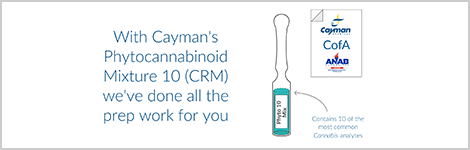
Cayman offers a suite of ISO 17034-produced single CRMs and multi-component CRM mixtures designed and engineered to the highest standards to give you confidence in your analytical data. While offering simplicity in its use, these materials provide highly accurate and precise data when used with proper methodology.
| Item No. | Single CRMs | Phytocannabinoid Mixture 3 (CRM) 1 mg/ml each | Phytocannabinoid Mixture 4 (CRM) 1 mg/ml each | Phytocannabinoid Mixture 5 (CRM) 500 μg/ml each | Phytocannabinoid Mixture 6 (CRM) 500 μg/ml each | Phytocannabinoid Mixture 10 (CRM) 250 μg/ml each |
| Cannabidiol (CRM) | | | | | | |
Cannabinol (CRM) | | | | | | |
Cannabinol (CRMΔ9-THC (CRM) | | | | | | |
Cannabidiolic Acid (CRM) | | | | |||
THCA-A (CRM) | | | | | ||
Cannabigerol (CRM) | | | | | | |
(±)-Cannabichromene (CRM) | | | | | | |
Cannabidivarin (CRM) | ||||||
Cannabigerolic Acid (CRM) | ||||||
Δ8-THC (CRM) |
|
Search our Phytocannabinoid CRMs and Mixtures
You May Also Be Interested In
Improved Potency Testing (video)
Download the original version of this article
References
1. ISO GUIDE 30. Reference materials — Selected terms and definitions. (2015).
2. ISO 17034. General requirements for the competence of reference material producers. (2016).
3. International Standard ISO/IEC 17025. General requirements for the competence of testing and calibration laboratories. (2017).
Contact Info
Cayman Chemical1180 East Ellsworth RoadAnn Arbor, Michigan 48108 USAToll Free: (800) 364-9897(USA and Canada only)Fax: (734) 971-3640


