
News & Announcements
D-PDMP Demonstrates Important Implications of Glucosylceramides and Lactosylceramides
Article from 2018-11-01
This article was originally published in the November 2018 edition of Matreya’s Newsletter for Glyco/Sphingolipid Research (PDF).
(+)-D-threo-PDMP (D-PDMP) is a small molecular weight glucosylceramide synthase and lactosylceramide synthase inhibitor that closely resembles the natural sphingolipid substrate ceramide and is an analog of glucosylceramide. It has been used to inhibit glucosylceramide synthesis in patients with Gaucher’s disease to prevent the accumulation of glucosylceramide and glucosylsphingosine but has also shown promise for the treatment of atherosclerosis, renal cancer, cardiac hypertrophy, skin inflammation, and hair loss.
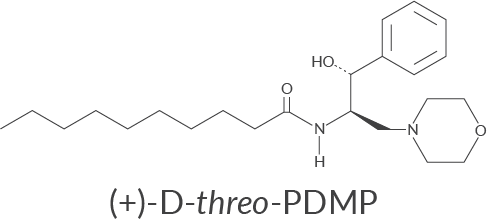
The effective dose of D-PDMP in mice is 10 mg/kg when given orally and 10-fold higher doses are well tolerated by experimental animals such as mice, rats, and rabbits. The residence time of D-PDMP is short (~52 minutes in mice), enabling it to be rapidly detoxified and excreted with little or no side effects. Delivery of D-PDMP by oral gavage or intraperitoneal injection has no effect on appetite and overall well-being of experimental animals.1 Work has also been done to establish a nanoparticle delivery system that is absorbed quickly and resides in the circulation four times longer to increase on-target efficacy.
Atherosclerosis
Consumption of a high-fat, high-cholesterol diet leads to markedly increased vascular thickness, oxidized LDL, Ca2+ deposits, and glucosylceramide and lactosylceramide synthase activity in apolipoprotein E (ApoE)-/- mice and rabbits. However, the onset of atherosclerosis and arterial stiffness in these animals was shown to be ameliorated with D-PDMP treatment.1 D-PDMP decreased cholesterol and triglyceride levels in these animals in association with an increased expression of SREBP-2, LDL receptor, HMG-CoA reductase, and the cholesterol efflux genes ABCG5 and ABCG8. D-PDMP also affected VLDL catabolism by increasing the gene expression of lipoprotein lipase and VLDL receptor.
Cancer
Sphingolipids play a role in proliferation, adhesion, and angiogenesis, all of which are implicated in tumor growth and metastasis. In renal cancer, there is a strong correlation between tumor volume and lactosylceramide levels. D-PDMP has been used to decrease lactosylceramide levels in a mouse model of renal cancer as a means to inhibit tumor progression.2 Because of its role in cell proliferation and tumor angiogenesis, inhibiting glycosphingolipid synthesis may be a sound approach to prevent the progression of cancer more broadly.
Cardiac Hypertrophy
Increased glycosphingolipid synthesis is also associated with hypertrophy in cardiomyocytes due to increased oxidative stress from superoxide generation and subsequent activation of the MAPK pathway. D-PDMP has been shown to prevent cardiac hypertrophy in ApoE-/- mice fed a high-fat, high-cholesterol diet by decreasing glycosphingolipid levels.3 Thus, inhibition of glycosphingolipid synthesis is also a potential approach to mitigate cardiac hypertrophy.
Hair Loss and Skin Damage
Increased levels of glycosphingolipids due to a diet rich in cholesterol and fat have been linked to hair loss, hair whitening, and skin inflammation. Through a series of experiments, researchers have used D-PDMP to reverse skin inflammation, hair discoloration, and hair loss in ApoE-/- mice fed a Western diet.4 Thus, inhibition of glycosphingolipid synthesis associated with the activation of inflammation represents a unique therapeutic approach relevant to skin and hair biology.
To support these lines of research and many others, Cayman offers several derivatives of this important inhibitor of sphingolipid synthesis.
Sphingolipid Biosynthesis Inhibitors
- PDMP (hydrochloride)
- (+)-D-threo-PDMP (hydrochloride)
- (−)-L-threo-PDMP (hydrochloride)
- DL-threo-PDMP (hydrochloride)
- D,L-erythro-PDMP (provided exclusively by Matreya, LLC)
- D-threo-PPMP (hydrochloride)
- L-threo-PPMP (hydrochloride)
- DL-threo-PPMP (hydrochloride)
- DL-erythro-PPMP (hydrochloride)
See all Sphingolipid Turnover products
See all Glucosylceramides and Lactosylceramides
References
1. Chatterjee, S., Bedja, D., Mishra, S., et al. Inhibition of glycosphingolipid synthesis ameliorates atherosclerosis and arterial stiffness in apolipoprotein E-/- mice and rabbits fed a high-fat and -cholesterol diet. Circulation 129(23), 2403-2413 (2014).
2. Chatterjee, S., Alsaeedi, N., Hou, J., et al. Use of a glycolipid inhibitor to ameliorate renal cancer in a mouse model. PLoS One8(5), e63726 (2013).
3. Mishra, S., Bedja, D., Amuzie, C., et al. Prevention of cardiac hypertrophy by the use of a glycosphingolipid synthesis inhibitor in ApoE-/- mice. Biochem. Biophys. Res. Commun. 465(1), 159-164 (2015).
4. Bedja, D., Yan, W., Lad, V., et al. Inhibition of glycosphingolipid synthesis reverses skin inflammation and hair loss in ApoE-/- mice fed western diet. Sci. Rep. 8, 11463 (2018).
Contact Info
Cayman Chemical1180 East Ellsworth RoadAnn Arbor, Michigan 48108 USAToll Free: (800) 364-9897(USA and Canada only)Fax: (734) 971-3640


