
News & Announcements
Deuterated GD3 as a New Mass Spectrometry Ganglioside Standard
Article from 2017-08-01
This article was originally published in the August 2017 edition of Matreya’s Newsletter for Glyco/Sphingolipid Research (PDF).
To effectively study the effects and pathologies of the highly versatile group of lipids known as gangliosides, it is important to have an arsenal of suitable and well-defined standards. In response to requests from numerous researchers, Cayman’s chemists have produced ganglioside standards for the highly specific research that is currently underway. With the use of Cayman's natural and stable isotope-labeled ganglioside standards, researchers can probe the mechanisms of ganglioside functions and metabolism. Cayman is proud to now introduce C18 Ganglioside GD3-d3, a stable isotope-labeled GD3, as a new mass spectrometry internal standard for ganglioside studies.
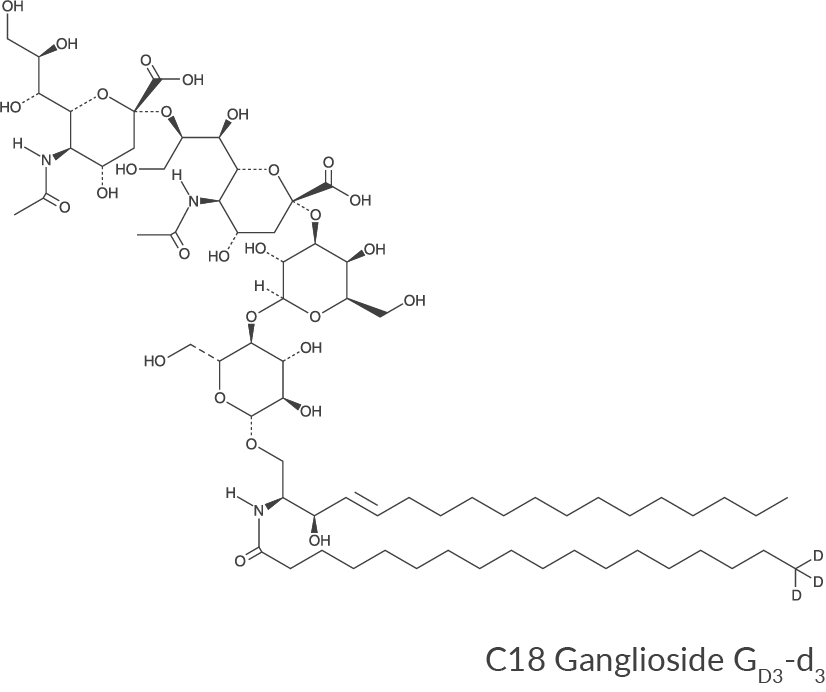
Gangliosides are acidic glycosphingolipids that accumulate in lipid domains in the outer leaflet of the plasma membrane, especially in neuronal cells in the central nervous system.1,2 These highly versatile lipids participate in numerous processes including cellular proliferation, differentiation, adhesion, signal transduction, cell-to-cell interactions, tumorigenesis, and metastasis. The accumulation of gangliosides has been linked to several diseases, such as Tay-Sachs, Sandhoff disease, and gangliosidosis. Ganglioside GD3 levels are high during neuronal development, and although they are very limited in adult tissues, they are critical in maintaining the self-renewal capacity of postnatal neural stem cells.3 Overproduction of GD3 can lead to apoptosis by recruiting mitochondria to apoptotic pathways and suppressing NF-κB activation.4 Increased levels of GD3 are associated with proliferative diseases, such as atherosclerosis. GD3 is considered to be a tumor-associated antigen as levels are unusually high in basal cell carcinomas and malignant melanomas.5 Although GD3 is not immunogenic, it has been investigated as a tool for immunotargeting human melanoma cells due to its unusually high presence.6 Gangliosides are also implicated in the pathogenesis of several neurodegenerative diseases. In addition, interventions which simultaneously increase the neuroprotective GM1 ganglioside and decrease the pro-apoptotic GD3 ganglioside are neuroprotective in vitro and in a number of preclinical models. Decreasing levels of GD3, by inhibiting GD3 synthase, has neuroprotective properties in a Parkinson's model and may warrant further investigation as a therapeutic target.7
View all Gangliosides
References
1. Schnaar, R.L. Gangliosides of the vertebrate nervous system. J. Mol. Biol. 428(16), 3325-3336 (2016).
2. Kolter, T., Proia, R.L., and Sandhoff, K. Combinatorial ganglioside biosynthesis. J. Biol. Chem. 277(29), 25859-25862 (2002).
3. Wang, J., Cheng, A., Wakade, C., et al. Ganglioside GD3 is required for neurogenesis and long-term maintenance of neural stem cells in the postnatal mouse brain. J. Neurosci. 34(41), 13790-13800 (2014).
4. París, R., Morales, A., Coll, O. et al. Ganglioside GD3 sensitizes human hepatoma cells to cancer therapy. J. Biol. Chem. 277(51), 49870-49876 (2002).
5. Dobrenkov, K., Ostrovnaya, I., Gu, J., et al. Oncotargets GD2 and GD3 are highly expressed in sarcomas of children, adolescents, and young adults. Pediatr. Blood Cancer 63(10), 1780-1785 (2016).
6. Zou, W., Borrelli, S., Gilbert, M., et al. Bioengineering of surface GD3 ganglioside for immunotargeting human melanoma cells. J. Biol. Chem. 279(24), 25390-25399 (2004).
7. Akkhawattanangkul, Y., Maiti, P., Xue, Y., et al. Targeted deletion of GD3 synthase protects against MPTP-induced neurodegeneration. Genes Brain Behav. 16(5), 522-536 (2017).
Contact Info
Cayman Chemical1180 East Ellsworth RoadAnn Arbor, Michigan 48108 USAToll Free: (800) 364-9897(USA and Canada only)Fax: (734) 971-3640


