
News & Announcements
Drugs Used in Conflict and Wars, Part 3 : Opium
Drugs Used in Conflict and Wars, Part 3 : Opium
Article from 2020-09-17
By Keith Williams, Ph.D. - Business Manager, Analytical Standards Europe, Cayman Chemical
From Homer and Hesiod in Ancient Greece to current-day music, it is not hard to find references to opiates and opioids in popular culture. It is difficult to establish when humanity first appreciated the effects of the active components of the opium poppy. Over time, opiates and opioids have become one of the most studied groups of drugs. The 2019 World Drug Report suggests that globally there were 53.4 million users of opioids in 2017, a rise of 56% from 2016 and representing 1.1% of the population aged between 15 and 64. During the same time period, 4% of the North American population used an opioid.1 In the recently published 2020 World Drug Report, the number of users has risen to 58 million globally, and accounted for two thirds of the global 167,000 deaths attributed to drug use disorders in 2017, which is equivalent to the loss of 21 million years due to early death or disability.2 It is likely that a significant portion of these deaths are caused directly by addiction to opiates/opioids.
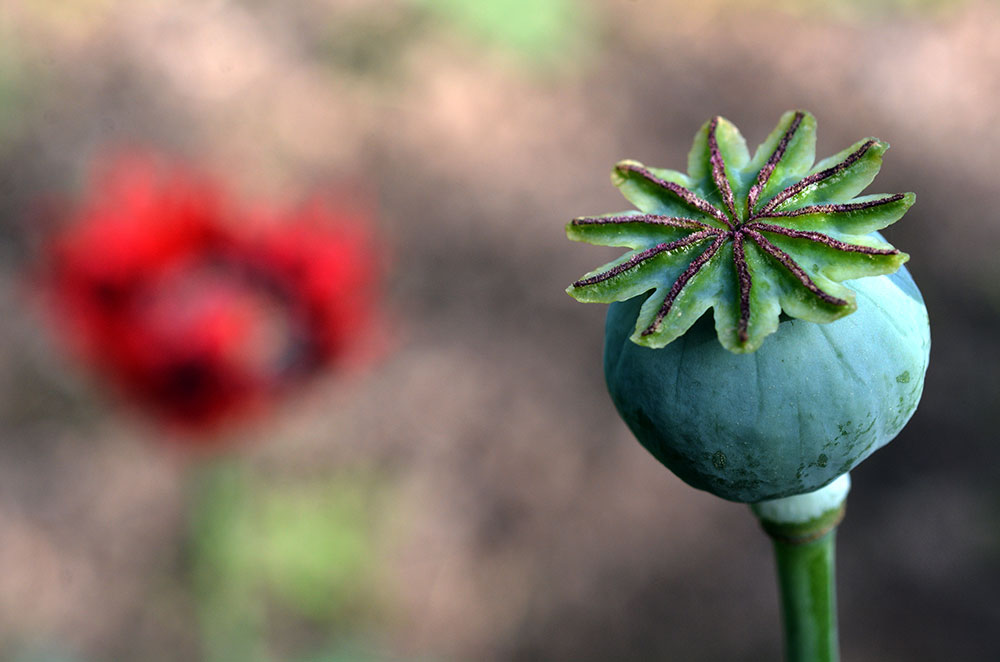
An opium poppy seed pod.
Opium is a dried latex collected from the seed capsules of the opium poppy, Papaver somniferum. The seed pod is traditionally incised with a three-bladed knife, enabling the latex to ooze from it. The pod is dried in the sun and then collected from the plants. Up to 12% of the latex can be morphine. It will also contain other active opiates such as codeine and thebaine, as well the inactive alkaloids papaverine and noscapine. Once dried it can be processed into the desired final form.
The milky latex extracted from the poppy seed pod contains several opiates and alkaloids.
We should not assume that access to pharmacologically significant quantities of morphine is restricted. Poppy seeds are freely available in many countries, and their consumption has been used to justify many positive opiate workplace drug testing results. Modern-day over-the-counter presentations still contain significant quantities of morphine, such as J. Collis Browne’s Mixture, a preparation that has evolved from the patented medicine chlorodyne. This mixture is available from pharmacists in the UK with no prescription, and its origins can be traced back to military roots. It was used extensively in the Crimean War and will be discussed further on in this article.
Naturally occurring opiates are derived from opium. So, how was it involved in armed conflicts over the centuries? How has opiate addiction impacted the battle readiness of troops, and what were the post-war consequences?
Ancient History Through to the 18th Century
Homer writes in his epic, The Odyssey, of soldiers imbibing the “drink of oblivion”, or nepenthes, to mask the pain of the death of their compatriots in the Trojan War. Although not specifically named, it is assumed that the active component added to the wine was opium. We now know that the effects felt by the soldiers were caused by the combination of alcohol and morphine rather than the individual substances.
Then Helen, daughter of Zeus, took other counsel.
Straightway she cast into the wine of which they were drinking a drug
to quiet all pain and strife, and bring forgetfulness of every ill.
—Odyssey, Book 4, v. 219–22
There appears to be little doubt that the effect of opium was well known, even though the pharmacological basis was unknown. There is not much evidence to suggest that opium was used in any systematic manner by physicians through the Middle Ages in Europe until we come to the beginning of the 16th century.
Middle Ages
One of the earliest surviving treatises on opium was published in Persia in the 16th century.3 Titled Afyunieh (literal translation “Of Opium”), it was written by the scholar Imad al-Din Mahmud and is divided into 15 chapters and a preface. While maybe not of the veracity of some modern-day reviews, it covers the topic of opium from the plant, manufacture, use, addiction, and a degree of social commentary. The authors suggest that the East India Company was active in Persia at this time in the opium trade that ultimately led to the two Opium Wars between the United Kingdom and China.
First and Second Opium Wars
The addictive properties of opium are attributed to leading to the Opium Wars between Great Britain and China in which Britain used opium to exert an economic influence on China to obtain access to what were then high value goods: tea and silk. Kamieński details how both sides in the conflict used opium, but in different quantities with different effects.4 The British military and local commanders declared that the limited use of opium in the Sikh regiment and other troops had few detrimental effects on performance and may, in fact, be beneficial. The Chinese commanders, however, reported that during the 1830s seven in ten soldiers were addicted to opium. This must have had a significant compromising impact on the efficacy and morale of the Chinese military forces in the conflict with the British, perhaps leading to an easier campaign than anticipated for the victors. Ultimately, Hong Kong was ceded to the British until 1997.
Military Development of Patent Medicines
In 1848, British Military doctor J. Collis Browne developed chlorodyne. Chlorodyne was a mixture of laudanum (an alcoholic extract of opium), tincture of Cannabis, and chloroform. It was used to treat cholera, diarrhoea, insomnia, neuralgia, and migraines, and there is a pharmacological basis for the preparation treating each of these conditions. Following its development in India, it was commonly used during the Crimean War (1853-1856). Afterwards, Dr. Browne entered a partnership with manufacturers in London, where the product was openly marketed and subsequently copied, resulting in a number of legal disputes.
Rival brand advertisements for chlorodyne from 1891.
Unlike many other Victorian patent medications, chlorodyne and its successor, J. Collis Browne’s Mixture, continue to be available, with their specific contents changing to reflect newly introduced drug controls. Case reports of individuals being addicted to chlorodyne were still being published in 1974, with one individual reportedly consuming 20 x 25 ml bottles daily, the equivalent of 120 milligrams of morphine.5
American Civil War
The surgical use of opium (and morphine that had been isolated in 1803-1805) was significant in the American Civil War (1861-1865). The Civil War is regarded as being one of the first industrialised wars. Trains, ships, and mass-produced weapons were all used to great effect. Injuries caused by these new weapons required surgery post battle and, in many cases, limbs were amputated. As well as for the treatment of pain, opium and opiates were used to relieve the symptoms of tuberculosis, rheumatism, malaria, toothache, headaches, stomach pain, and diarrhoea. Kamieński reports that 99.5% of all Union troops suffered from the last condition. With what appears to be a relatively relaxed attitude to the prescription of what we now know as a potentially addictive drug, including distribution from horseback and soldiers licking their allocated dose from an individual’s hand, it is maybe unsurprising that large numbers of individuals developed an addiction to opiates. To give an idea of scale of use, the Surgeon General’s report to the Secretary of War in 1866 lists the dispensing of 2,348,930 ounces of opium presentations (66,590 kg), including tinctures with or without camphor and powder. Morphine sulphate was also used but in far lower quantities (29,828 oz or 846 kg).6
As with cocaine, there were little international controls on the trade of opium, morphine, and diacetylmorphine until the introduction of the Harrison Narcotics Tax Act of 1914, Dangerous Drugs Act of 1920, and the League of Nations International Opium Convention. (See Drugs Used in Conflict and Wars, Part 2: Cocaine Use from Victorian Sports Doping to Modern-Day Conflicts for more details). Again, as with cocaine, any of these new regulations were driven by public concern over troops returning from World War I (WWI).
Ongoing Use of Opium in China
Although the British were the primary instigators of the Opium Wars, American merchants benefited from the eventual treaties that were agreed upon. US missionaries gained increased access to the heart of China and their antagonism towards opium. This missionary diplomacy continued to exert its influence and eventually, in 1909, Right Reverend Charles H. Brent persuaded President Theodore Roosevelt to hold the International Opium Commission in Shanghai, an early attempt to introduce controls and prohibition globally. Peter Andreas suggests that this was the start of the world turning against what had been acceptable until then.7 This did however have little success in restricting use in China, and by the 1930s, China was producing seven eights of the world’s supply.
The suppression of opium in China primarily drove the trade underground, and it continued to be a major issue throughout, what Andreas describes as “Internal Opium Wars” for several decades. Both sides, the nationalists and the communists, used opium to finance their activities. The revenues from trading opium were vast and in the 1930s Japan was estimated to have generated more that $300 million annually importing opium to the Chinese market.
Gold Times: The Golden Triangle and Operation Golden Flow
China effectively eliminated domestic opium production by 1953, substituting it with tobacco, now known to have its own issues. The Chinese nationalists took their knowledge of opium production and with their chemists, set up in the Golden Triangle—the borderlands of Burma, Thailand, and Laos. Though complicity with state intelligence services, opium and now heroin trade thrived as a mechanism to finance conflicts that benefited a foreign powers’ interest. Vietnam, where US troop numbers peaked at half a million, provided a ready market for the newly developed fine-grain heroin No 4. (80-99% pure). As with troops returning from WWI, images of heroin use in Vietnam caused public concern, and US troops were subjected to mandatory urine tests to demonstrate that they were drug free, a process nicknamed Operation Golden Flow. A single positive test resulted in a five-day methadone treatment program. Two positive tests resulted in a dishonourable discharge.
Changing Shape from a Triangle to a Crescent
The Golden Triangle continued its dominance of the global opium trade until the end of the cold war. But again, foreign state intervention generated new production areas. This time, the Golden Crescent—Afghanistan, Pakistan, and Iran. Opium was always present in this area, but the scorched-earth policy of the Russian government following the invasion of Afghanistan in December 1979, and the poppy with its ability to grow in poor soil offered a ready replacement. As in previous conflicts, it also offered a ready source of revenue for the purchase for arms and munitions to support conflicts in the region. Since 1984, opium production has increased from an estimated 140 metric tons to an estimated peak of 9,140 metric tons in 2017 (6,700 metric tons in 2019).8
Opium tinctures still exist today in the both US and the British Pharmacopoeia, but their use to a large degree has been supplanted by pharmacologically pure active ingredients derived from the poppy such as morphine, codeine, heroin/diacetylmorphine as well as synthetic opiates such as fentanyls. All these substances continue to cause issues in many countries globally, and the illicit trade in opium has always and continues to finance conflicts.
You May Also Be Interested In
 |  |
| Vikings’ Early Use of a Performance-Enhancing Drug? | Cocaine Use from Victorian Sports Doping to Modern-Day Conflicts |
References
1. UNODC. World Drug Report 2019, UN, New York (2019).
2. UNODC. World Drug Report 2020, Booklet 1 p17. UN, New York (2020).
3. Moosavyzadeh, A., Ghaffari, F., Mosavat, S.H., et al. The medieval Persian manuscript of Afyunieh: The first individual treatise on the opium and addiction in history. J. Integr. Med. 16(2), 77-83 (2018).
4. Kamieński, Ł. Shooting Up: A History of Drugs in Warfare. Hurst (2017).
5. Parker, R.R., Cobb, J.P., and Connell, P.H. Chlorodyne dependence. Br. Med. J. 1(5905), 427-429 (1974).
6. United States. War Department. Annual Report of the Secretary of War. Washington U.S. Govt. Print. Off. p 385 (1866).
7. Andreas, P. Killer High: A history of war in six drugs. Oxford University Press (2020).
8. ONDCP releases data on poppy cultivation and potential opium production in Afghanistan In: whitehouse.gov/briefings-statements. (2020). Available from: https://www.whitehouse.gov/briefings-statements/ondcp-releases-data-poppy-cultivation-potential-opium-production-afghanistan/
Contact Info
Cayman Chemical1180 East Ellsworth RoadAnn Arbor, Michigan 48108 USAToll Free: (800) 364-9897(USA and Canada only)Fax: (734) 971-3640


