
News & Announcements
Ganglioside GD2 and Breast Cancer
Article from 2019-06-03
This article was originally published in the June 2019 edition of Matreya’s Newsletter for Glyco/Sphingolipid Research (PDF).
Ganglioside GD2 is a sialic acid-containing glycosphingolipid that has important clinical and pathological implications. GD2 is synthesized in the endoplasmic reticulum and Golgi apparatus and is then transferred to the outside layer of the plasma membrane. On the cell surface, GD2 is involved in cell-to-cell adhesion and signal transduction, playing a crucial role both in physiological and pathological processes by driving proliferation, neoangiogenesis, immune-escape, and invasion. It is primarily expressed on the cell surface and is normally found mostly in the central nervous system and in low amounts in peripheral nerves and skin melanocytes. One of GD2's most important pathological implications is its presence in elevated amounts in numerous tumor types, including breast cancer cells.
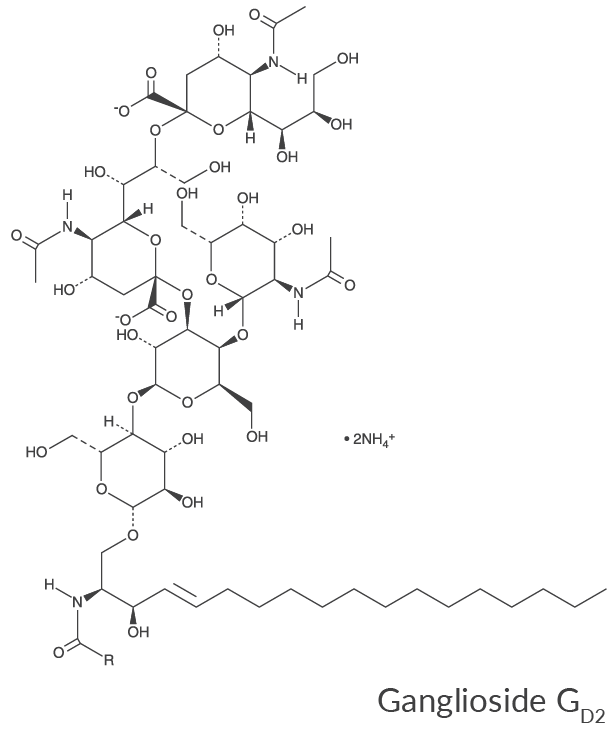
In malignant cells, GD2 is uniformly expressed in neuroblastomas, most melanomas, and to a variable degree, in a variety of other tumors, including bone and soft tissue sarcomas, small cell lung cancer, and brain tumors. GD2 is thought to play an important role in the attachment of tumor cells to extracellular matrix proteins, thereby increasing tumorigenesis.
Due to its prevalence in various tumor cells, GD2 can potentially be utilized as a biomarker for various cancers. GD2 was found to be consistently elevated in breast cancer patients, leading researchers to evaluate its usefulness as a biomarker for breast cancer.1 A statistically significant correlation of GD2 with triple-negative breast cancer has been found in comparison to several other breast cancer subtypes, confirming that GD2 may be a good candidate as a biomarker. Elevated GD2 expression might be related to breast cancer stem cells and activation of the epithelial-mesenchymal transition.
GD2 immunohistochemical staining has been used to show a possible correlation with breast cancer histotypes strongly associated with epithelial-mesenchymal transition. Although further studies utilizing larger patient pools are needed to confirm this finding, GD2 appears to be a new valid biomarker for certain breast cancer subtypes. This finding is especially important for triple-negative breast cancer patients, since this disease currently lacks any specific marker for diagnostics or targeted therapies.
View more Ganglioside mixtures available from Cayman.
Reference
1. Orsi, G., Barbolini, M., Ficarra, G., et al. GD2 expression in breast cancer. Oncotarget 8(19), 31592-31600 (2017).
Contact Info
Cayman Chemical1180 East Ellsworth RoadAnn Arbor, Michigan 48108 USAToll Free: (800) 364-9897(USA and Canada only)Fax: (734) 971-3640


