
News & Announcements
Gb3 and lyso-Gb3 and Fabry Disease
Gb3 and lyso-Gb3 and Fabry Disease
Article from 2019-12-02
This article was originally published in the December 2019 edition of Matreya’s Newsletter for Glyco/Sphingolipid Research (PDF).
Fabry disease is a multisystemic, X-linked disorder with variable prevalence ranging from 1:3,000 to 1:117,000 in newborn males. It is caused by deficiency in α-galactosidase, which leads to the storage of sphingolipids such as lyso-globotriaosylceramide (lyso-Gb3), globotriaosylceramide (Gb3), and galabiosylceramide (Ga2) in organs, tissues, and biological fluids.
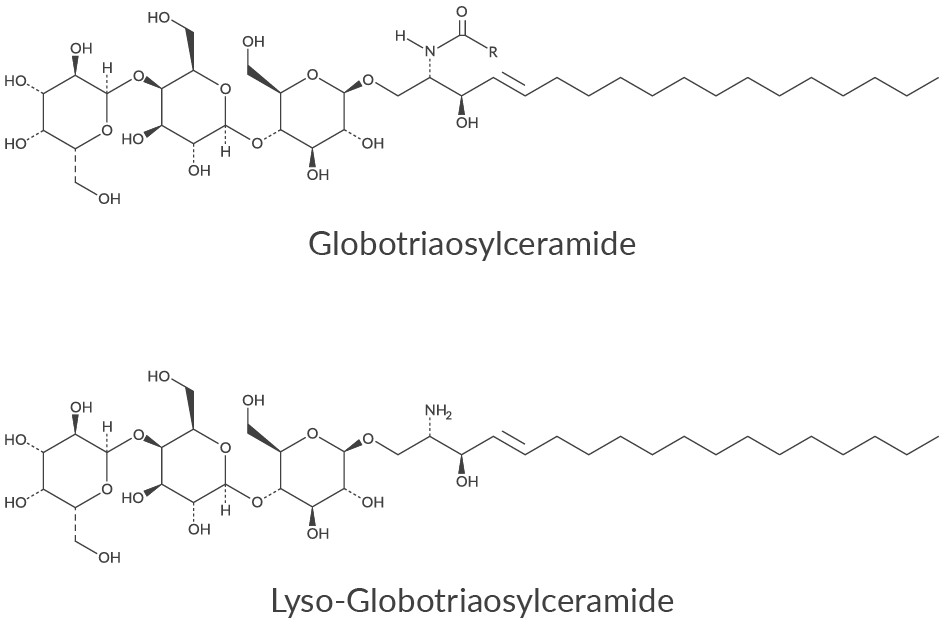
Enzyme replacement therapy (ERT) for the disease has been available since 2001. Several studies support the clinical benefit of ERT towards quality of life, disease progression, and stabilization of end organ structure and fuction.1
Thurberg et al. evaluated 48 Fabry patients on ERT and found good correlation of urinary Gb3 excretion normalized to creatine.2 However, other studies indicated incomplete relationships between plasma and urinary Gb3 levels and disease manifestations. Recently, Aerts et al. postulated that globotriaosylceramide metabolites could play a role in Fabry pathogenesis.3 They reported the presence of elevated lyso-Gb3 in the plasma of Fabry patients, and that plasma lyso-Gb3 levels were reduced after ERT.
Circulating lyso-Gb3 levels are an important indicator of Fabry disease and correlate significantly with cerebrovascular white matter lesions in males and the left ventricle mass in females. Urinary lyso-Gb3 levels correlate with mutation types, gender, and ERT status.
Cayman offers several standards and probes that can be used to study globotriaosylceramides.
References
1. Lavoie, P., Boutin, M., and Auray-Blais, C. Multiplex analysis of novel urinary lyso-Gb3-related biomarkers for Fabry disease by tandem mass spectrometry. Anal. Chem. 85(3), 1743-1752 (2013).
2. Thurberg, B.L., Rennke, H., Colvin, R.B., et al. Globotriaosylceramide accumulation in the Fabry kidney is cleared from multiple cell types after enzyme replacement therapy. Kidney Int.62(6), 1933-1946 (2002).
3. Aerts, J.M., Groener, J.E., Kuiper, S., et al. Elevated globotriaosylsphingosine is a hallmark of Fabry disease. Proc. Natl. Acad. Sci.USA 105(8), 2812-2817 (2008).
Contact Info
Cayman Chemical1180 East Ellsworth RoadAnn Arbor, Michigan 48108 USAToll Free: (800) 364-9897(USA and Canada only)Fax: (734) 971-3640


