
News & Announcements
Isotonitazene: The Latest Substance to Be Banned in the European Union
Isotonitazene: The Latest Substance to Be Banned in the European Union
Article from 2020-09-25
By Keith Williams, Ph.D. - Business Manager, Analytical Standards Europe, Cayman Chemical
On September 2, 2020, the European Commission announced that it was introducing a ban on the sale of isotonitazene.1 A novel analgesic, isotonitazene has been reported in at least five member states, and there have been reported deaths in Canada and the US as well as Europe due to exposure to this substance.
Although the ban is targeted specifically at isotonitazene, there are a number of related benzimidazole opioid substances that display pharmacological activity and are now being collectively called nitazenes.
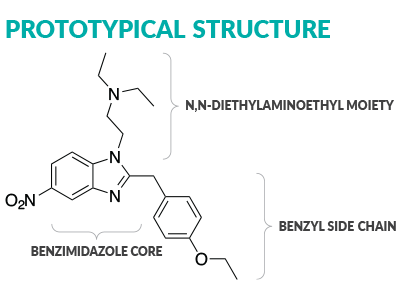
The core structure of the nitazenes allows for various alterations, and some of these are now starting to appear in several forums.
Originally developed in the 1950s by the pharmaceutical company Ciba AG, they were intended to be used as safer alternatives to morphine. This group of drugs is structurally unrelated to morphine but exerts a significant opioid response.2 Two of them (etonitazene and clonitazene) were placed on Schedule I of the United Nations Single Convention on Narcotic Drugs 1961 at the request of the US government, leaving the other variants uncontrolled. No product was ever brought to the market commercially. A toxicology report published in February 2020 describes the confirmation and quantitation of isotonitazene in blood, urine, and vitreous fluid and profiles in vivo metabolite formation in drug users.3 A technical report was published by the EMCDDA in June 2020 summarising the current position in the illicit market.4
To help laboratories identify these new psychoactive substances (NPS), Cayman has produced a range of reference materials and analytical standards, covering both parent compounds and metabolites, as well as two isotopically labelled products for use as internal standards. We have collated these products on the first of our Cayman NPS Snapshots, a handy guide that summarises the structures of the various nitazene compounds as well as key historical dates, prototypical structure, and known pharmacology. The snapshot is a useful resource for scientists to familiarize themselves with the new emerging nitazene class. As new products are released, we will update it appropriately.
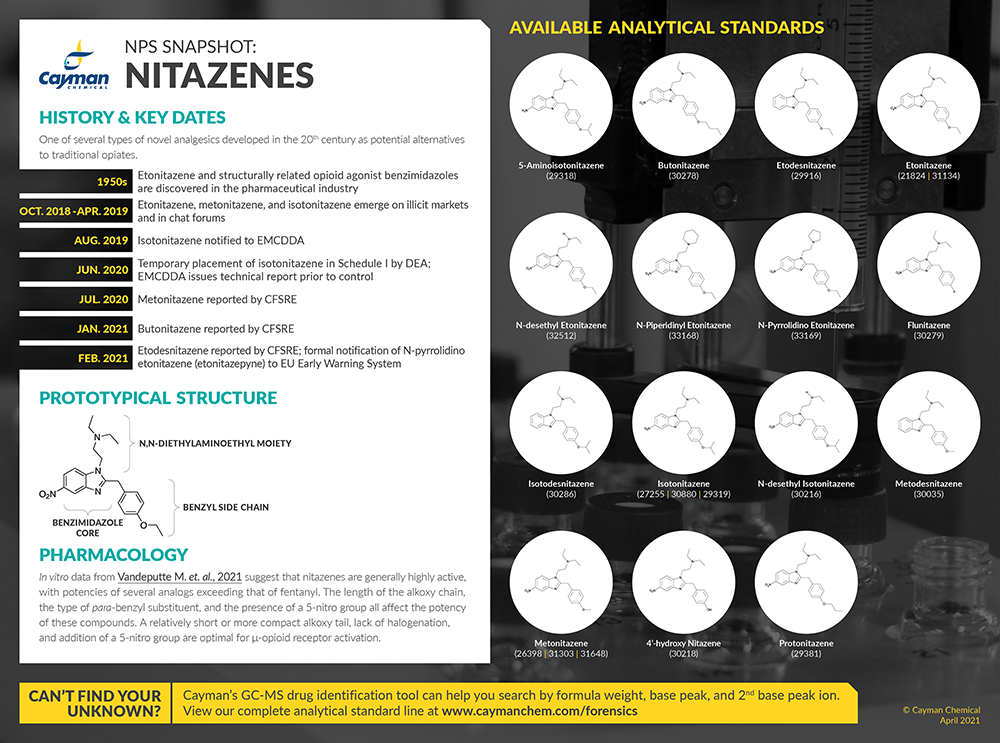
Download your Nitazene Snapshot today!
See all nitazene reference standards
Can’t find your unknown? Cayman’s GC-MS Drug library identification tool can help you search by formula weight and base peak ion.
You May Also Be Interested In
References
1. Fight against drugs: Commission initiates ban on new harmful psychoactive substance isotonitazene. In: European Commission Daily News (2020). Available from: https://ec.europa.eu/commission/presscorner/detail/en/mex_20_1552
2. Blanckaert, P., Cannaert, A., Van Uytfanghe, K., et al. Report on a novel emerging class of highly potent benzimidazole NPS opioids: Chemical and in vitro functional characterization of isotonitazene. Drug Test. Anal.12(4), 422-430 (2020).
3. Krotulski, A.J., Papsun, D.M., Kacinko, S.L., et al. Isotonitazene quantitation and metabolite discovery in authentic forensic casework. J. Anal. Toxicol.44(6), 521–530 (2020).
4. EMCDDA technical report on the new psychoactive substance N,N- diethyl-2-[[4-(1-methylethoxy)phenyl]methyl]-5-nitro-1H- benzimidazole-1-ethanamine (isotonitazene) (2020). PDF available from: https://www.emcdda.europa.eu/system/files/publications/13108/EMCDDA%20technical%20report%20on%20isotonitazene.pdf
Contact Info
Cayman Chemical1180 East Ellsworth RoadAnn Arbor, Michigan 48108 USAToll Free: (800) 364-9897(USA and Canada only)Fax: (734) 971-3640


