
News & Announcements
Kinase Inhibitors
Article from 2019-02-20
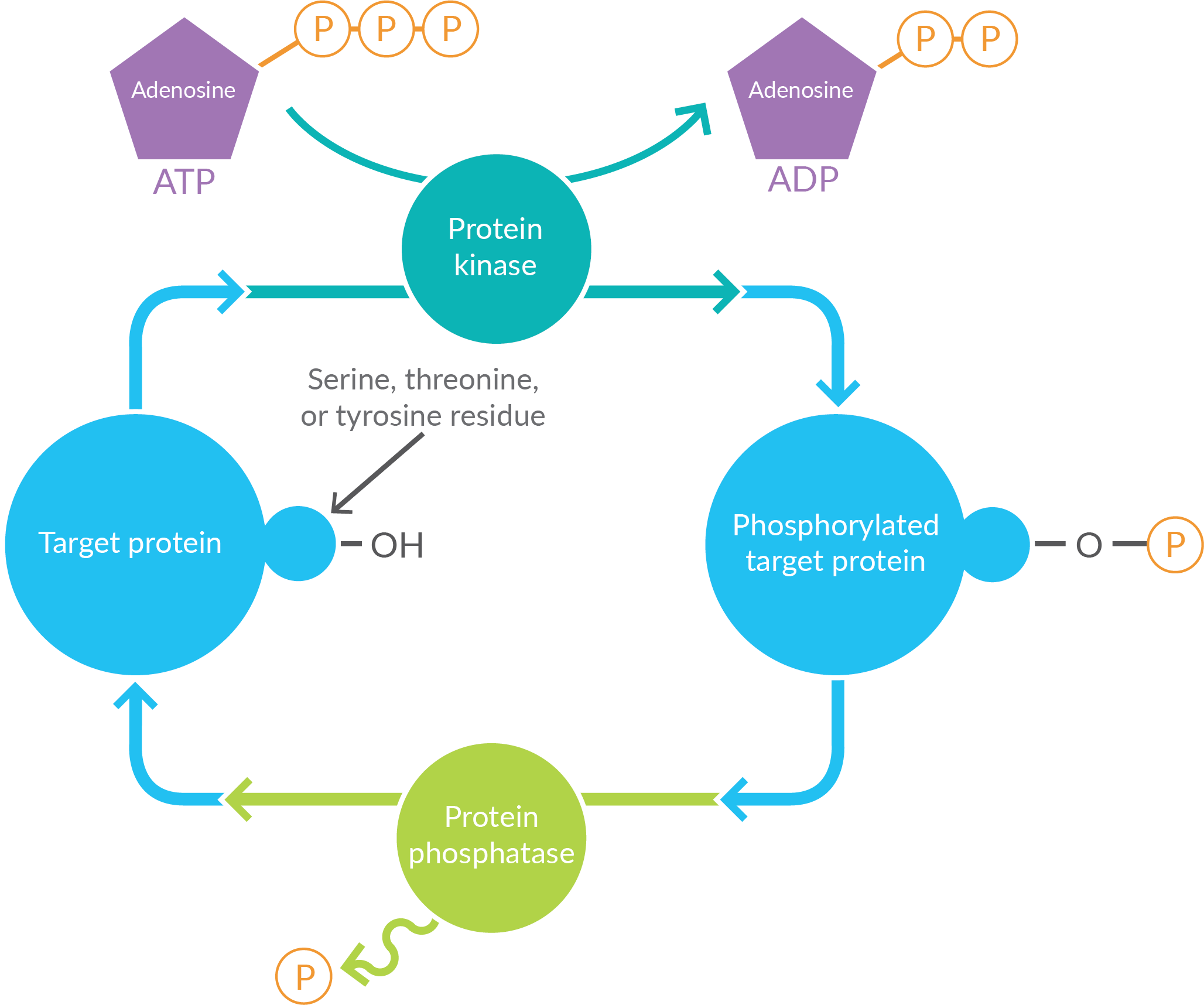
Virtually every signal transduction process responsible for cell function occurs through a series of phosphate group-transfer events driven by kinases, including those that phosphorylate proteins, lipids, and carbohydrates. Because they are so acutely involved in the regulation of biological processes, for the past several decades kinases have been investigated as targets for therapeutic intervention. Deregulation of kinase function is linked most notably to cancer, but roles have also been found in all major disease areas (e.g., immunological, inflammatory, degenerative, metabolic, cardiovascular, and infectious diseases). Researchers have identified 518 protein kinases encoded by the human genome. These enzymes phosphorylate up to one third of the proteome, yet many of these kinases remain understudied. With over 250 kinase inhibitors undergoing clinical trials and 38 kinase inhibitors approved for clinical use since 2017, the field of drug discovery persistently continues to validate novel kinase targets, overcome drug resistance, obtain target selectivity (to reduce off-target effects), and develop efficient compound screening and profiling technologies.
Inhibitors by Binding Site and Signaling Pathway Targets
Protein kinases are generally categorized by the amino acid on which they act (i.e., tyrosine, serine, threonine) and their specificity is determined by the amino acid sequence surrounding the target residue. For instance, members of the tyrosine kinase group phosphorylate proteins on tyrosine residues, whereas enzymes in all other groups phosphorylate primarily serine and threonine residues. They can also be further clustered into families and sub-families based on increasing sequence similarity between catalytic domains and categorized by biochemical function via the signaling pathway they target. Lipid and carbohydrate kinases are organized by the respective phospholipid, sphingolipid, and carbohydrate substrate molecule on which they act.
Explore Cayman’s broad selection of kinase inhibitor targets:
| Receptor Tyrosine Kinases EGFR/ErbB/HER Family Non-Receptor Tyrosine Kinases | Serine/Threonine Kinases Activin-like Kinases (ALKs) | Lipid Kinases Carbohydrate Kinases |
Use our new search tool to find more than 1,200 kinase inhibitors for use in research to understand basic kinase mechanics that influence both normal and malignant states.
Cayman’s unique kinase inhibitor library simplifies screening and hit-seeking
Kinase Screening Library (96-Well)
- Consists of two plates with ~160 selective and non-selective kinase inhibitors
- Inhibitors are provided in a 96-well Matrix™ tube rack format as 10 mM stock solutions in DMSO
- Includes inhibitors of lipid, receptor and non-receptor tyrosine, serine/threonine, and dual specificity kinases
- Targets include the ROCK, ALK, GSK3, PKC, PDGFR, VEGFR, Src, MAPK, CDK, and PI3K families, among many others
- Comprehensive Kinase Screening Library is also available containing more than 850 kinase inhibitors
Download the full list of targets (PDF)
Looking to discover novel kinase inhibitors?
Read about the tools we offer to measure the functional activity of specific kinases
Methods for Detecting Kinase Activity
- Cell Reporter Assays
- TR-FRET Assays
- Kinase Inhibitor Screening Assays
- Phospho-Specific Antibodies and Recombinant Kinases
Contact Info
Cayman Chemical1180 East Ellsworth RoadAnn Arbor, Michigan 48108 USAToll Free: (800) 364-9897(USA and Canada only)Fax: (734) 971-3640


