
News & Announcements
Meet the Expert: API Manufacturing Quality Management System
Article from 2021-03-08
Cayman's knowledge of prostaglandin chemistry is unmatched in terms of process understanding and commercial manufacturing. Our expert chemists have been leading the industry in prostaglandin synthesis for over 40 years to create commercially available eicosanoids as active pharmaceutical ingredients (APIs). Our talented team of scientists in Ann Arbor, Michigan, USA and Neratovice, Czech Republic has filed numerous patents for the complex synthesis and commercial manufacture of seven APIs with additional compounds currently under development.
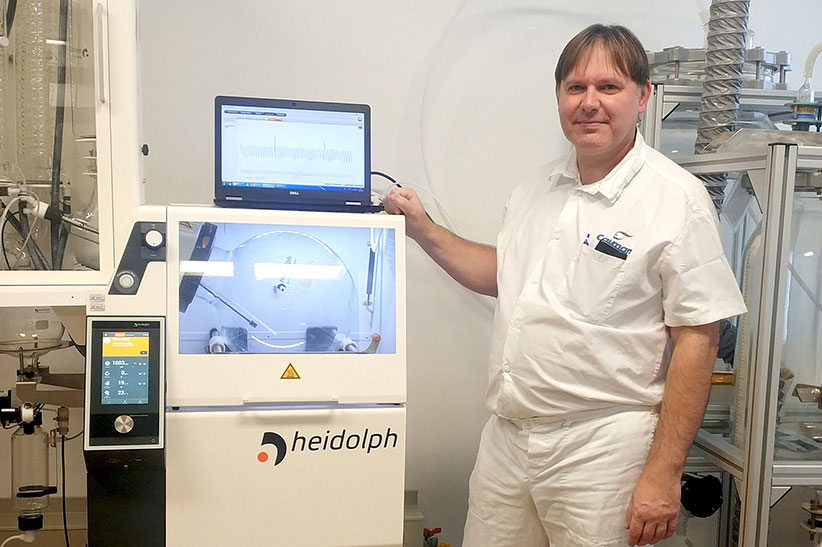
Cayman's Center of Excellence in Ann Arbor focuses primarily on the synthesis, scale-up, and registration of new API manufacturing processes. Once registration batches have been completed, the GMP portion of the process and all supporting documentation are transferred to our commercial manufacturing Center of Excellence in Neratovice. The facility at Cayman Pharma has more than 30 years of commercial prostaglandin and eicosanoid registration and manufacturing experience, is ISO certified, and has an excellent track record with customers and regulatory authorities worldwide, it is compliant with both the US FDA and EU CGMP regulations. We spoke to Jiří Kočí, a qualified technician and cleanroom caretaker at Cayman Pharma, who along with four other technical staff provide qualification and validation assurances as part of Cayman Pharma's good manufacturing process (GMP).
Tell us about the significance of your role at Cayman Pharma.
They say mistakes teach you, but in the pharmaceutical industry there is no room for error. That is why about 30 years ago the United States devised the concept of qualifications and validations to minimize the threat to the health and lives of patients. Qualification refers to activity demonstrating that equipment or auxiliary systems comply with the requirements, their use is fit for purpose, they are correctly installed, they work properly, and their operation leads to the expected results.
Validation entails obtaining evidence in the form of documentation that provides a high degree of assurance that a process will consistently provide a product corresponding to a predetermined specification. Qualification together with validation techniques and support from our technical department allow Cayman Pharma to produce its high-quality APIs. Any new product, but also any innovation, such as a manufacturing process, must first pass through our quality management system.
How does it work in practice such as when you are introducing a new product to the market?
Whether we need to provide qualification and validation assurances for new products or check for innovation and change for existing products, the first phase takes place in the research department. When our scientists are confident about the characteristics of the product and the fact that we can repeatedly produce it in the same quality, qualifications enter the scene. We select new machinery or verify the existing equipment to be certain it can ensure robust trouble-free production.
So, you test the equipment?
Yes, my task is to test and approve the production equipment before it is used in real-time production. Simply put, if, for example, an SOP (standard operating procedure) requires a reaction temperature of 55-60°C, and we do not have a device capable of ensuring this temperature is maintained, there is a need for full qualification where I participate in the creation of a user requirements specification for the equipment needed. I examine the technical offerings on the market for suitability to our needs. After purchasing a new device, I verify its correct installation at the place of future use and finally test the ability of the device to reach the operating range for the desired temperature (e.g., whether it can meet 55-60°C).
Your multidisciplinary focus is a true advantage, you are not only a chemist but also have technical knowledge.
You know, that's what suits me best about my current job. Even though I'm a trained chemist, and I've been involved in chemistry all my life, I've always been more attracted to technology, especially computers. In my current position, I can do both.
Plus, it is a position in which you are probably going to have a hard time finding formal training. The biggest teacher is practice, right?
Absolutely. For almost 30 years, I have been at Cayman Pharma working in production from the position of operator through to shift master and now a member of the current technical department. I like both chemistry and technology, and I have no problem studying and furthering my education. When you just enjoy and care about your work, no one must force you to learn new things. In the field of qualifications, this skill set is necessary. Regulations are constantly tightening, and technology is also evolving very quickly. At the beginning, I dealt with qualifications at the same time as my position as a chemist. Today, qualification processes are a full-time role.
Let's talk more about the validations that your colleague is in charge of and are inseparably linked to the qualifications.
Once the qualifications have been made, the next step is to validate the production process. The production process is carried out within the limit conditions (and at the limit conditions) to verify that it will consistently produce batches at the required quality. Validation of equipment cleaning is also an essential part of validation work.
Even "dishwashing" must be validated?
This is as important as validating your own production process. You must be sure that the proposed process for washing the production equipment will ensure that the following production batch does not become contaminated with the remnants of the previous one.
How often do these processes take place in your company?
Anytime a new product is introduced. Also, when partial changes to existing products are made, they can only be implemented based on previous qualifications and validations. Additionally, we revalidate all our final stages of production once a year to verify that we can produce our product at the same quality.
Well, I guess this keeps your department busy. How does the digitization of data that has been going on at Cayman Pharma help you?
We used to work with paper documents. Today, there is documentation on computers, which helps us a lot, but our goal is much greater digitization. When a batch is made today, it must comply with the control person's institute. In practice, this means that one worker carries out the production activity and the other checks it, especially in critical parts of the procedure. They record and sign progress in the operating sheet. In the future, the "controller" should really be software that not only can guide the operator to the correct activity and record the measured data, but immediately compare the real inputs with the expected course. This creates an electronic operating sheet–a production record that is harder to falsify than paper. That's the future of our profession.
Learn More about Cayman's API Division
MTE
Contact Info
Cayman Chemical1180 East Ellsworth RoadAnn Arbor, Michigan 48108 USAToll Free: (800) 364-9897(USA and Canada only)Fax: (734) 971-3640


