
News & Announcements
Meet the Expert: Biomarker Development
Article from 2020-02-26
Cayman’s Biomarker Development group offers a diverse suite of services in assay development and biomarker profiling. The scientific staff has decades of industry expertise in assay and methods development, sample preparation, and analysis. Our services portfolio and platforms include, but are not limited to, lipidomics, proteomics, flow cytometry, immuno- and enzymatic assays, mass spectrometry, and protein and antibody production. We sat down with Beth Hurst, Ph.D., manager of the Biomarker Development Services Group, to discuss the work that is ongoing in the Biomarker Development Group.
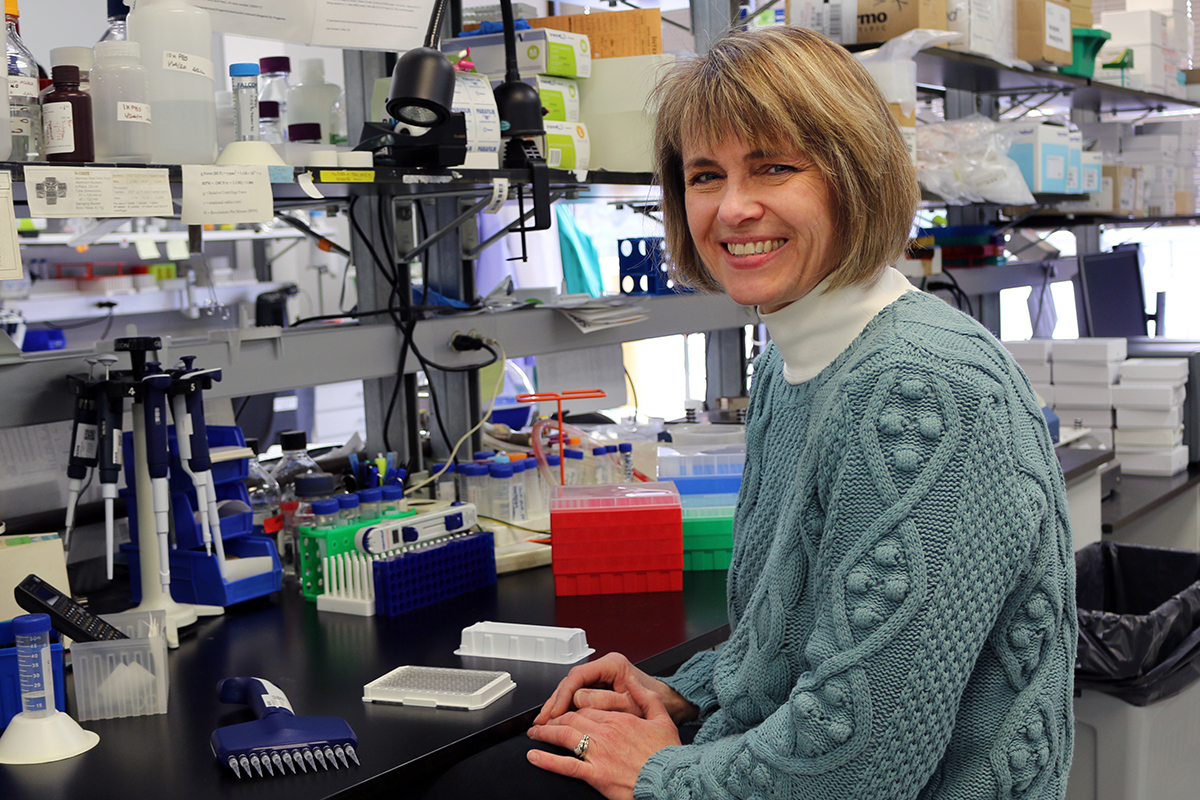
What is your background and how long have you worked in assay development?
I earned my Ph.D. in Physiology from Michigan State University studying the then newly discovered cyclooxygenase-2 (COX-2) enzyme. As part of my project, we raised antisera to a unique region of COX-2, which allowed us to gain insight into how this enzyme was regulated. It seems like ancient history now, but at the time the discovery of this enzyme was a blockbuster. Everything we learned was new and exciting, and the antisera we raised were central to our work. In the few (dozen) years since that time, I’ve had the opportunity to learn considerably more about antibodies – both their strengths and weaknesses – and how they can be used as valuable tools to study both proteins and small molecules. I spent a handful of years developing novel assays as part of Cayman’s ELISA R&D group before moving to my current position in biomarker development where I continue this same line of work.
As part of Cayman’s ELISA development group, I was tasked with taking projects from concept to completion. Preliminary steps in this process included immunogen design and preparation as well as screening sera to determine those which were appropriate to take forward into assay development. In the assay development phase, we performed matched pair antibody testing for sandwich ELISAs, optimized sensitivity, performed cross-reactivity testing, and developed sample processing protocols. We also performed spike recovery testing and validated assays in biologically relevant sample matrices to verify assay performance prior to release.
As manager of the Biomarker Development Services Group, I’ve had the opportunity to expand these skills since we often find ourselves in the position of troubleshooting existing commercial assays before using them to test client samples. We run many non-immunoassays as well, which has given me the opportunity to increase my knowledge base to include methods for many different types of assays.
A key part to the success of any assay is the quality of the biological sample. You routinely help customers troubleshoot sample collection, preparation, and storage as part of Cayman’s Sample Analysis & Screening service. What are some general tips you can share in sample handling, and how have you applied this knowledge in some unique situations?
One of the best tips that I can share is to thoroughly plan your experiment before you begin sample collection. Some analytes have special requirements (for example, it is useful to add BHT to samples being collected for assay of 8-isoprostane). If you are aware of that prior to sample collection, you can have all the tools available prior to the start of the experiment and be confident that the data obtained from these samples reflects the biology that you are studying. Our Cayman Technical Support and Services teams are great resources for customers and clients who have questions about the collection and storage of samples.
Another useful tip is to perform sample processing optimization. No one is a fan of extractions or other isolation techniques – they are time-consuming and can be “messy.” However, following an optimized protocol can make all the difference between getting reliable data and getting useless data. If you are going to put all the work into planning and performing the experiment, you should do yourself the favor of preparing the samples in such a manner that you will get high-quality data from the assay.
An example of the importance of proper sample processing is measurement of testosterone in serum. DHEA sulfate is present at huge excess relative to testosterone in serum, and although the cross reactivity of this compound with the testosterone antiserum is quite low, it will still interfere with the accurate measurement of testosterone if it is not removed prior to ELISA. Fortunately, DHEA sulfate is sparingly soluble in organic solution, so a simple liquid:liquid extraction can be used to remove this interferant.
Describe the work you are doing in Biomarker Discovery. What are some of the hurdles you are overcoming to identify and validate novel metrics?
Most of the clients coming to us for biomarker development have done preliminary discovery using a high-throughput method. We take those preliminary hits and explore them in greater detail. One of the hurdles that we face is the quality of the assays currently on the market. While some assays perform as expected, others are less reliable. Before we touch the client’s samples, we put each assay through a series of tests to demonstrate that it is performing as expected. In some instances, we can optimize the conditions to improve assay performance to a more desirable level, but there are some assays that cannot be salvaged. It can be discouraging for clients when the assay for their biomarker of interest doesn’t perform well, but it’s better to have that information up front rather than after running larger sets of precious samples. If the client wishes to proceed with a biomarker for which there are no suitable commercially available assays, we have the resources to build a fit-for-purpose assay from the ground up according to their specifications.
What types of clients come to you for biomarker discovery projects, and can you give an example of a successful project?
Most of the clients who come to us for biomarker discovery and development have already invested a fair amount of time and financial resources into their project. They often have one or more markers already in mind, but it’s not unusual for them to add additional biomarkers to their project once it is initiated. One of our long-standing clients came to us with four markers in mind initially, but the panel quickly expanded to a dozen or more markers. We sourced assays for this client, performed preliminary testing to demonstrate suitability of those assays, and then tested thousands of samples. This client is now well on the way to turning these assays into a clinical diagnostic test, and our quality manufacturing group is supplying reagents for that test.
Walk us through the steps of the development of a custom assay. How much input can a customer have to achieve an assay that suits their specific requirements?
Cayman has the ability and resources to turn a client’s idea into a fully validated assay. We collaborate among departments within Cayman to fully utilize the expertise of many different scientists who have experience in building a wide range of assays including cell-based, flow cytometric, immuno-, and enzymatic assays.
For example, we have highly skilled scientists for development of both small molecule and protein ELISAs. Our assay development team leverages the skills of our Chemistry and Bioconjugate Cores to create custom, small molecule immunogens. Our Protein and Antibody Cores have the ability to synthesize peptides and produce recombinant proteins for use as assay standards and as immunogens for raising polyclonal or monoclonal antibodies. Matched pair testing of antibodies, when appropriate, is performed using a Biacore T200 SPR analysis platform.
Once we have antibodies for the client’s target, the project can proceed in any number of directions, driven by the needs of the client. Most clients prefer to start by looking at factors that would make the assay nonfunctional for them. For example, if there is a closely related compound that must NOT interfere with the assay, we would screen the antibodies for recognition of that compound. Any antibodies recognizing this compound would be eliminated. With this approach we can quickly identify and move forward with antibodies that DO meet the client’s criteria. On the other hand, if the client needs a very sensitive assay and is not concerned as much with cross reactive compounds, we determine the rank order of sensitivity of the antibodies, discarding those which wouldn’t provide the required sensitivity.
We routinely determine the sensitivity of the assay and identify compounds that cross react with the antibodies. We check dilutional linearity and parallelism in one or more sample matrices. We can also perform spike-recovery studies and test for interfering compounds (such as hemolysis, rheumatoid factor, HAMA, etc.).
We tailor assay development to meet each client’s needs. Each project is unique – some clients need a highly validated assay, while others have less stringent criteria. We communicate with our clients frequently during assay development and find that most of our clients enjoy being included in the assay development process. Our contracts are structured so that clients can make “go/no-go” decisions at crucial points in assay development. Many clients provide scientific input throughout development, but even those who don’t provide input still get excited to hear how their project is progressing. We aren’t just providing a service to our clients. We are partnering with them to turn their vision into reality.
Learn more about our Biomarker Development Services
Related article: Learn how Cayman defines assay performance
MTE
Contact Info
Cayman Chemical1180 East Ellsworth RoadAnn Arbor, Michigan 48108 USAToll Free: (800) 364-9897(USA and Canada only)Fax: (734) 971-3640


