
News & Announcements
Meet the Experts: Quality Control
Article from 2021-06-09
Quality control enables Cayman to ensure that each of the products we sell meets our high standards. The quality assurance process we have put in place spans multiple departments, tapping into the appropriate technical specialist for each unique product type to assess that the product meets the established quality standards. Individual testing teams are established in our Chemistry, Biochemistry, GMP, ISO Quality, and Analytical Services departments. We sat down with Libby Perry, Tim Schrot, Matt Webb, Rich Bartell, Roxanne Franckowski, and Paul Kennedy—who head each respective department—to discuss their quality control process.
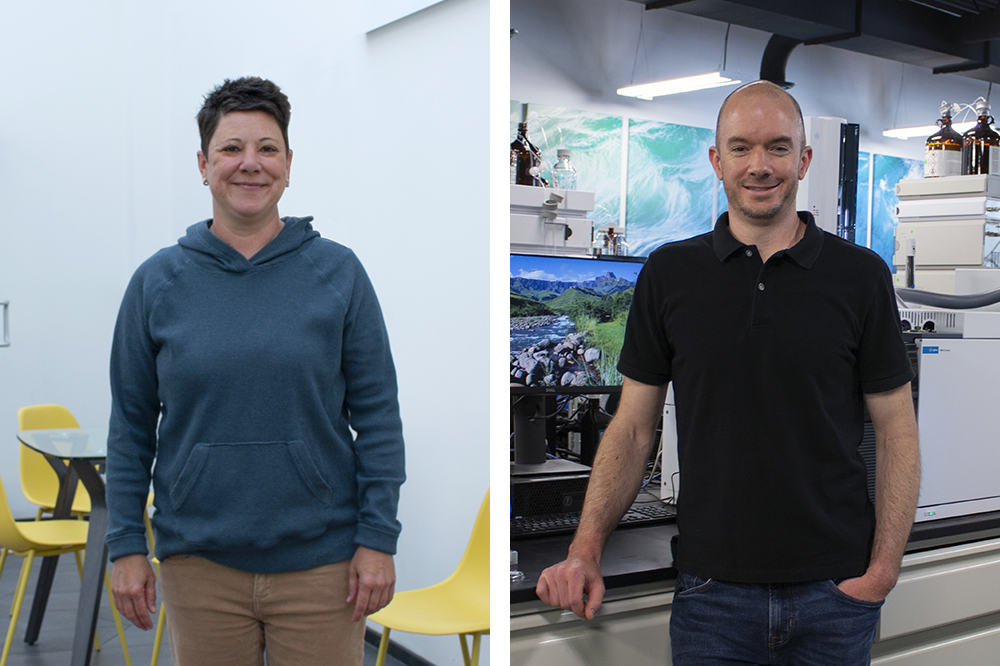
Libby Perry (Manager of Chemistry QC, left) has worked for Cayman for almost 25 years, starting in Customer Service and then working in the QC department prior to becoming the Chemistry QC Manager. She works closely with Tim Schrot (right), who after completing his bachelor’s degree in Biology joined Cayman as a Customer Service Representative before transitioning to a synthetic chemist position in Cayman’s organic chemistry lab. He served in that role for 12 years, until being promoted to his current role in quality assurance.
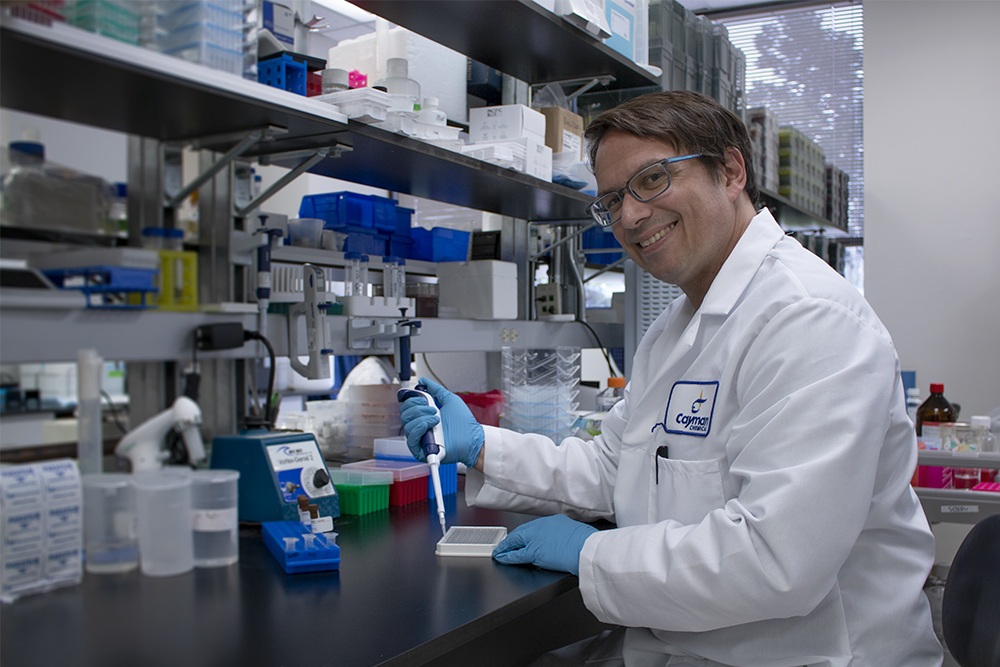
After receiving a bachelor's in Biochemistry and a master's in Biotechnology, Matt Webb (Manager of Biochemistry QC) has been working in biotechnology for ~15 years in roles ranging from bench tech and development functions through several supervisory and management positions. At Cayman, his roles include data review and establishing disposition of reagents and components as well as designing experiments to establish root cause of any irregularities seen during analyses.
Rich Bartell (Manger of GMP QC) started his career at a dairy manufacturing plant in the Midwest and moved into the pharmaceutical industry three years later. After spending six years as a QA/QC Manager for a bulk manufacturing facility, he moved out East and into preclinical and clinical drug development where he stayed for eight years before taking a position as a Quality Engineer for a major medical device manufacturer. Fortunately, his wife's career landed him back in the Midwest where he came aboard at Cayman Chemical in 2012 as the QC Manager for GMP Analytical. His experience extends for more than 25 years. Much of his day-to-day responsibilities center around approval of testing results. He also plays a role in process improvements, optimizing quality systems, and working with clients to determine the most effective or efficient paths forward for their projects. While most of his department's resources are dedicated to validation or post-validation products, they do still play a role in early-phase development work as well.
Roxanne Franckowski (Senior Manager of ISO Quality) ensures that Cayman's ISO Quality Management System (QMS) is implemented and followed to maintain compliance with ISO/IEC 17025 and ISO 17034 international standards. She reviews the quality and production documentation related to Cayman's ISO reference materials (RMs) and certified reference materials (CRMs) and signs the certificates of analysis as the certifying official. She has 25 years' experience working in testing laboratories, with 15 years of her career closely involved with quality and reference material programs.
Prior to coming to Cayman, Roxanne worked in the forensic science field in seized drug analysis for both the Drug Enforcement Administration (DEA) and Michigan State Police (MSP). During this time with the DEA, she worked in the Reference Material Program, which was responsible for obtaining, characterizing, and dispensing reference materials to federal, state, local, and foreign laboratories. It was during her time in this program that she became familiar with ISO Guide 34, which was the predecessor to the ISO 17034 standard for Reference Material Producers. Earlier in her career, she worked for various companies in the environmental field, analyzing soil and water samples for the presence and amount of volatile and semi-volatile organic compounds. Each testing laboratory she worked in has followed some accreditation standard whether it be ISO/IEC 17025 or an equivalent standard.
Paul Kennedy (Director of Analytical Services) received a Ph.D. in Organic Chemistry in 2001. He worked as a Medicinal Chemist and as a Mass Spectrometry Product Manager for an instrument company prior to working at Cayman and has been working at Cayman for 14 years as Manager of the Analytical Services group and more recently as Director of the Analytical Chemistry Division. The Analytical Services department within the division is responsible for the day-to-day analytical support of Cayman's chemistry and biochemistry teams. The group performs purifications as well as routine HPLC, MS, GC, and nuclear magnetic resonance (NMR) testing of Cayman's catalog products, assists with troubleshooting processes, and supports the quality of many of Cayman's products.
If quality control is not performed properly or overlooked, what impact can it have on research and pharmaceutical development?
Libby Perry and Tim Schrot (Chemistry): The consequences vary, but we pride ourselves in maintaining integrity and supporting our extensive product line. Ensuring the customer receives the product they are expecting is very important. Confirming chemical identity and purity before approving material for sale is an essential process. We realize our customers are using our products for important research. Cayman products are referenced in many publications and knowing our products are of the highest possible quality is a fundamental principle.
Matt Webb (Biochemistry): Poor quality control can and will lead to variability in results seen in the hands of the end user. These variabilities can slow the progress of research and undermine the integrity of data.
Rich Bartell (GMP): Quality control is an essential part of research and development in that confidence in early-stage experiments and results leads the way for further work and proper resource allocation. Providing reliable results to R&D groups assures project managers that timelines and milestones can be met.
Roxanne Franckowski (ISO Quality): Scientists involved in the analysis of forensic seized drug and toxicology exhibits and/or Cannabis testing are the primary focus of our RM and CRM product lines. For the forensic community, there are legal ramifications since our RMs and CRMs are "known" materials used to confirm the identity and/or quantity of an "unknown" component in an exhibit. If we are incorrect in our characterization of an RM or CRM, then this could cause a forensic scientist to make an error in their assessment of the exhibit. It is critical that our materials are correct because an individual's liberty is at stake.
For the Cannabis testing community, Cayman's CRMs are used in the assessment of potency of a Cannabis material. If the CRM concentrations are incorrect, then this would lead to a miscalculation of the components in the Cannabis material.
Paul Kennedy (Analytical Services): Research and development is a costly endeavor for companies and academic researchers working within strict budgets. A lot of time and effort goes into planning research studies and performing all the necessary tests needed to be successful. Researchers rely on trusted partners to supply high-quality materials that consistently meet pre-established specifications. Poor quality control of supplied materials can lead to inconsistent results, lost time, and a waste of resources. As researchers ourselves, we understand these needs and have worked for many years to establish ourselves as a trustworthy partner.
What details or specifications do you examine when testing a new product? What are the minimum testing requirements for your division?
Libby Perry and Tim Schrot (Chemistry): We confirm purity and identity by the means of various analytical testing, including HPLC, NMR, MS, IR, TLC, and UV. Each specific compound has a unique set of testing requirements. The tests performed on a given molecule will be based on the chemical structure and physical characteristics of the compound. With our research-grade products, we have a standard battery of tests that are performed, but we perform additional testing when appropriate.
Matt Webb (Biochemistry): There are several specifications and parameters that are investigated during QC work specific to the product(s) being tested such as activity, response to stimulation, IC50, signal to background, and raw signal values. We compare newly generated data to historic trending data as well as previous reagents and analytical standards when available and applicable.
Rich Bartell (GMP): Since we are GMP QC, our specifications are already set by earlier phase work. Testing requirements are based upon the intended use and delivery of the product, drug tolerance/toxicity, stability, and a host of other safety-related attributes that are required either by design or agency/authorities under which we market our products.
Roxanne Franckowski (ISO Quality): For reference materials under the ISO 17034 accreditation, candidate materials need to be assessed for homogeneity and stability. Property values must also be assessed using validated analytical methods to maintain metrological traceability. Finally, an estimation of uncertainty must be calculated.
Each candidate RM is assessed for product identification and purity. A combination of testing, including but not limited to HPLC, GCMS, FTIR, NMR, LCMS, Loss on Drying, and Residue on Ignition, is performed on each reference material. The goal is to provide forensic customers with the information required to make a proper identification. A corrected purity of the RM is determined using the chromatographic purity, and the residual solvent, water, and inorganic content.
Cayman's CRMs are provided in solution. The certified concentration of the CRMs is calculated using the RM's corrected purity. The concentration and homogeneity of the CRM is verified, and specifications are consistent with industry standards.
Paul Kennedy (Analytical Services): Minimum testing requirements are highly variable depending on the product. However, all products are tested by well-established analytical techniques for identity and purity. Chromatographic methods such as gas chromatography and liquid chromatography are commonly employed to separate impurities and test for purity. Mass spectrometry and NMR are commonly employed to determine structural identity. Cayman continuously updates its equipment and optimizes its methods to ensure trustworthy, high-quality data.
How often are products rejected because they don't meet your quality standards? What happens next?
Libby Perry and Tim Schrot (Chemistry): With any manufactured product there is the potential for quality issues, and biochemicals are no different. While it is rare, we do have instances where a product does not meet our specifications and that batch must be rejected. Typically, the material will go through a repurification and be retested. In some cases, the product will require a total resynthesis.
Matt Webb (Biochemistry): It's very rare that a product is rejected in QC, and this only happens after rigorous investigations designed to remove the operator as a variable. When there is a rejection, the batch in question is quarantined for removal, rationale for rejection is drafted, and the Production department is engaged so that a new batch can be made.
Rich Bartell (GMP): For GMP QC, once process manufacturing validation is complete and agencies approve the products, the specifications are essentially set in stone. At this stage, the methods used by GMP QC are also fully validated and when/if they don't meet any quality standards, a thorough investigation is completed per FDA guidelines. Once a root cause is determined, the appropriate corrective actions are taken including any additional retesting required or preventative measures to avoid the occurrence in the future. It is rare that any products are rejected in GMP due to the rigorous validations that occur beforehand.
Roxanne Franckowski (ISO Quality): It is infrequent that RMs and CRMs experience a failure. Effort is put into the pre-submission process to minimize QC testing failures. For candidate RMs there are procedures in place to ensure each material is well vetted prior to being submitted for characterization. Preliminary chromatographic purity and identification analyses are performed prior to being submitted to our ISO QC department. CRMs are produced using RMs, so the target analyte is well qualified prior to CRM manufacture.
If a candidate RM or CRM material fails ISO QC testing, an investigation is initiated to determine a root cause of the failure. If the failure was due to procedures not being followed, then the investigation would elevate to a non-conformance and could result in a corrective action.
Customers may be notified depending on when the failure occurred. An example of an instance such as this would be if the failure happened during a long-term stability study, resulting in a change to an expiry date.
Paul Kennedy (Analytical Services): The Analytical Services department is one of the first lines of defense for ensuring products meet Cayman's quality standards. We test starting materials, intermediates, reaction processes, and employ a wide variety of tests depending on the nature of the products being tested. We do our very best to ensure the quality of each product meets its specification and when they do not, we work closely with our chemistry and biochemistry teams to troubleshoot and resolve any issues.
How long does the process take from quality analysis to catalog introduction?
Libby Perry and Tim Schrot (Chemistry): It really depends on the product, but for research-grade products, our turnaround time is quick; around 1-2 weeks.
Matt Webb (Biochemistry): This depends heavily on the type of assay used to generate data as well as the workload at the time of request and can take anywhere from two days to two weeks.
Roxanne Franckowski (ISO Quality): The process from candidate material to catalog introduction includes vetting candidate material, validating the chromatographic method for each new candidate, quality control testing, and short-term stability testing. The time this process takes varies and is dependent on factors such as the complexity of method development and validation, the volume of materials submitted to the laboratory, and the data review necessary under a robust ISO/IEC 17025 QMS. It should be noted that repeat batches take less time because the method validation and stability testing steps have already been completed.
Paul Kennedy (Analytical Services): For routine products where we are making new batches, this process can be very quick and take as little as a few days. For new products, we may need to run several tests for an initial batch to be certain of the purity and identity of the product. Depending on these tests and the level of review required, this process could take a week or longer. The Analytical Services department runs hundreds of samples every week and so it is common to perform routine tasks in high throughput mode and then to return to things requiring more careful attention. This approach allows us to apply our high-quality standards to a growing catalog of 15,000+ products. We are also beginning to employ software tools to improve quality while reducing testing turnaround. One example is Cayman's NMR spectral database, which currently includes approximately 3,000 curated NMR spectra (1D and 2D) of catalog products. This database can be rapidly searched to compare batches of products over time.
Do existing catalog products ever get requalified? What are the circumstances that go into that?
Libby Perry and Tim Schrot (Chemistry): We do routinely requalify our products and have a formal system in place to identify specific batches for retesting. We will also perform retesting if we receive feedback from a customer about potential issues with a product they purchased.
Matt Webb (Biochemistry): Yes. When a batch of component is nearing its lifespan, it is flagged for re-analysis and the component(s) are requested from Inventory and run as if they were a new batch. If passing, the batches are re-assigned new expiration dates based on historic stability data.
Roxanne Franckowski (ISO Quality): Catalog products do get requalified because assessment of stability is a requirement of ISO 17034 accreditation. We do a series of real-time stability studies (long-term stability) to reevaluate and confirm the assigned expiry dates of the products. We use data from stability testing to determine if an expiry date may be extended. Testing for stability study samples follows a predetermined schedule, but there may be instances where additional testing is performed outside of that schedule.
Paul Kennedy (Analytical Services): When expiry dates for products are reached, we have two options: prepare new batches or requalify the existing batch to ensure it continues to meet its specifications. Timing for requalification depends on the product, but commonly, products will have a preset shelf life, for example one year. This will establish the initial expiry date for that product, and then a few months before the expiry date is reached, the products are flagged for requalification testing. If the testing passes, the expiry date may be extended (commonly in one-year intervals), and the product shelf life may be extended so that future batches of the product inherit this extended expiry dating. Note that Cayman has a very wide variety of products, and different product types each have their own established rules for requalification.
What makes Cayman's quality control different from other small biochemical manufacturers?
Libby Perry and Tim Schrot (Chemistry): Experience. Cayman has been a biochemical manufacturer for over 40 years. In that time our catalog has expanded immensely, and with that, our knowledge of the analysis required to ensure product integrity. As we grow, we are continuously evaluating and improving our processes. We are committed to helping our customers by providing high-quality tools for research.
Matt Webb (Biochemistry): Cayman incorporates a decentralized approach to its quality control, allowing the Quality Control department to interact with other departments as it works through design and implementation of quality processes, further utilizing Cayman's vast intellectual resources to the benefit of the customer.
Rich Bartell (GMP): Because GMP QC must abide by various regulating bodies, the quality control measures from other biochemical manufacturers and Cayman's do not vary greatly for the same products. However, the robust measures Cayman GMP QC takes during method development and validation, continual staff training and peer reviews, and comprehensive monitoring of method performance and results, reduces downtime related to operator errors, equipment disruptions, or anomalous results. Our expertise provides more confidence for our customers and better margins for Cayman.
Roxanne Franckowski (ISO Quality): Cayman's ISO 17034 materials also follow a similar quality control process to other accredited reference materials producers. However, the difference between Cayman and other manufacturers is our responsiveness to customers. Having been a purchaser and end user of forensic products, I have contacted other small molecule manufacturers regarding quality concerns and have been met with varying degrees of responsiveness and satisfaction. I'm proud to be part of a team that places importance on addressing our customers' quality concerns to ensure they are handled in the most appropriate way possible to achieve an outcome acceptable to the customer.
Paul Kennedy (Analytical Services): Cayman has invested very significant resources in terms of staff and equipment to ensure the quality of our products meets the specifications we have guaranteed to customers. Our staff is comprised of scientists that understand how our products are being used, and I hope our product quality meets these intended uses. We want our customers to be successful and are always willing to work with customers to support their research.
MTE
Contact Info
Cayman Chemical1180 East Ellsworth RoadAnn Arbor, Michigan 48108 USAToll Free: (800) 364-9897(USA and Canada only)Fax: (734) 971-3640


