
News & Announcements
MGM-16: Corynanthe Numbering and the Name 10-Fluoro Dihydro-7-Hydroxy Mitragynine
Featured Article from 2026-07-09
By Donna M. Iula, Ph.D. - Forensic Chemistry Division, Cayman Chemical
MGM-16 is a potent semi-synthetic opioid derived from the natural alkaloid Mitragynine. Mitragynine is a major alkaloid found in Mitragyna speciosa (kratom) and can be isolated from the plant for use as a starting material in the synthesis of semi-synthetic analogues, including MGM-16. The scientific team of Matsumoto et al. first described this molecule in a Journal of Pharmacology and Experimental Therapeutics publication in 2014.1 Figure 1 shows its structure alongside Mitragynine, 7-hydroxy Mitragynine, and dihydro-7-hydroxy Mitragynine (also known as MGM-15). The CAS number for MGM-16 is 1158901-40-6 and the formal IUPAC name is “3-ethyl-9-fluoro-1,2S,3S,4,6,7,7aS,12,12aR,12bS-decahydro-7a-hydroxy-8-methoxy-αE-(methoxymethylene)-indolo[2,3-a]quinolizine-2-acetic acid, methyl ester.” MGM-16 has also been described as “9-fluoro dihydro-7-hydroxy Mitragynine” due to the IUPAC numbering convention.2
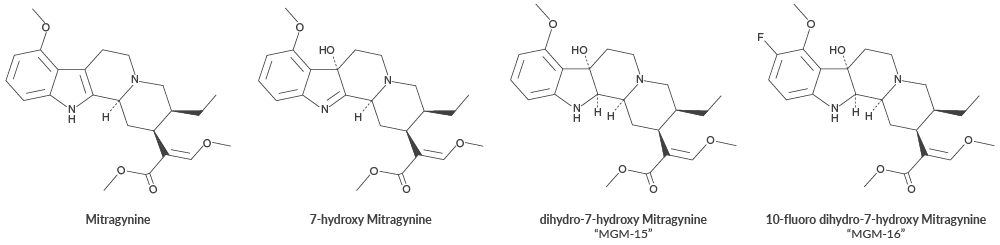
Figure 1: Structures of Mitragynine, 7-hydroxy Mitragynine, MGM-15, and MGM-16.
The numbering system used by Matsumoto and others in scientific publications for semi-synthetic Mitragynine analogues are based on the fixed numbering designation of the Corynanthe alkaloid core scaffold (Figure 2). Using this established numbering designation is advantageous as it maintains a fixed atom numbering system that remains unchanged as modifications occur to the core scaffold in contrast to the IUPAC system, where atom numbering can change as structural modifications are introduced.
Figure 2: The fixed numbering system used for the Corynanthe scaffold (left) and how it applies to Mitragynine (center) and MGM-16 (right).
The Corynanthe numbering system for the fused A-B-C ring scaffold was recently illustrated in a 2026 review article titled "Structure, bioactivity, biosynthesis, and synthesis of corynanthe alkaloids". 3 This numbering system explains why MGM-16 is named "10-fluoro dihydro-7-hydroxy Mitragynine" despite the fluorine being designated at the 9-position under IUPAC nomenclature.
An illustration of the two different naming systems is Mitragynine. Mitragynine has the common name of "9-methoxy Corynantheidine" which relates it as the methoxy analogue of the alkaloid Corynantheidine (Figure 3), even though the formal IUPAC name is "(αE,2S,3S,12bS)-3-ethyl-1,2,3,4,6,7,12,12b-octahydro-8-methoxy-α-(methoxymethylene)-indolo[2,3-a]quinolizine-2-acetic acid, methyl ester". According to the IUPAC convention, the methoxy substituent on the A ring system of Mitragynine is at the 8-position, whereas it is designated at the 9-position using the Corynanthe naming system.
Figure 3: Corynantheidine (left) and Mitragynine (right).
In conclusion, Cayman Chemical's reference standard for 10-fluoro dihydro-7-hydroxy Mitragynine (MGM-16) utilizes the Corynanthe scaffold numbering system in designating the fluoro substituent at the 10 position.4 Equally correct is the formal IUPAC name as "3-ethyl-9-fluoro-1,2S,3S,4,6,7,7aS,12,12aR,12bS-decahydro-7a-hydroxy-8-methoxy-αE-(methoxymethylene)-indolo[2,3-a]quinolizine-2-acetic acid, methyl ester," listing the fluorine in the 9-position. Keep in mind that neither designation is right nor wrong; rather, they represent two different naming systems in action.
Lastly, it is important to note that some regulatory announcements have dropped the "dihydro" portion of the name in referring to synonyms of MGM-16 and sometimes they simply refer to it as "the 9-fluoro derivative of 7-hydroxy Mitragynine" which is technically incorrect. MGM-16 is the fluorinated version of "dihydro-7-hydroxy Mitragynine" (also known as MGM-15) in which the C2-C7 double bond is reduced. As regulations appear at the local and federal levels, it is important to keep these nuances in mind and always refer to the structure and/or CAS number for confirmation.
To cite this article: Iula, D.M. MGM-16 Nomenclature: Corynanthe Numbering and the Name 10-Fluoro Dihydro-7-Hydroxy Mitragynine. Cayman Chemical (July 2026).
References:
1. Matsumoto, K., Narita, M., Muramatsu, N., et al. Orally active opioid μ/δ dual agonist MGM-16, a derivative of the indole alkaloid mitragynine, exhibits potent antiallodynic effect on neuropathic pain in mice. J. Pharmacol. Exp. Ther. 348(3), 383-392 (2014).
2. DEA Federal Register: https://www.federalregister.gov/documents/2026/07/06/2026-13581/schedules-of-controlled-substances-temporary-placement-of-mitragynine-pseudoindoxyl-mgm-15-and
3. Liu, C., Tong, M., Otsuka, K., et al. Structure, bioactivity, biosynthesis, and synthesis of corynanthe alkaloids. Nat. Prod. Rep. 43(4): 746–778 (2026).
4. Cayman Reference Standard: https://www.caymanchem.com/product/43911/10-fluoro-dihydro-7-hydroxy-mitragynine
Contact Info
Cayman Chemical1180 East Ellsworth RoadAnn Arbor, Michigan 48108 USAToll Free: (800) 364-9897(USA and Canada only)Fax: (734) 971-3640


