
News & Announcements
Sleuthing the Unknown
Sleuthing the Unknown
Article from 2017-08-23
Cayman’s pursuit to identify an unknown sample: methoxyacetyl fentanyl
When an unidentified fentanyl analog appeared related to four separate overdose cases in Alabama, Dr. Rachel Beck, a toxicologist at the University of Alabama at Birmingham who provides forensic services to the Jefferson County Coroner and Medical Examiner’s Office, began contacting colleagues across the country. Everyone seemed stumped by what this out-of-the-ordinary opioid could be. Her mass spectrometer was equipped to scan multiple GC-MS spectral databases, including Cayman’s Spectral Library, but her compound was too novel to strike a hit. After drawing blanks from her usual go-to resources, Dr. Beck contacted Cayman’s forensic scientists to tap into their expertise to help solve the unknown by deciphering the available GC-MS data.
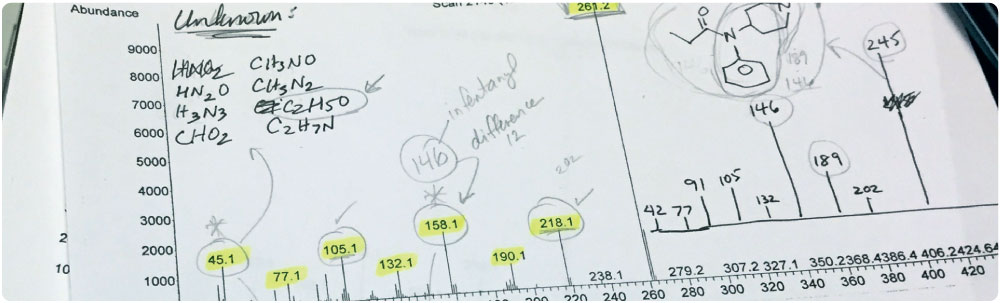
Examining Base Peak MW
The 261 base peak of this unknown was quite similar to that of fentanyl with a mass difference of +16 amu, and it displayed a fragmentation pattern similar to that of fentanyl. Para-fluoro acrylfentanyl, which also has a base peak of 261, was suspected to be the probable match since acrylfentanyl was being observed in many illicit samples at that time. A +16 amu mass difference between fentanyl and the unknown could be accounted for by the subtraction of three hydrogen atoms and the addition of a fluorine atom to the base fentanyl structure. Para-fluoro acrylfentanyl was quickly synthesized and sent to Dr. Beck for confirmation. Unfortunately, the retention time of para-fluoro acrylfentanyl was off by 0.3 minutes. Also, the m/z and response of some smaller fragments were not fitting the pattern of the mystery compound. It was a very close analog, but not an exact match. When six additional overdose cases related to this same unknown were documented, the identification of this compound became an even more pressing concern.
Deciphering Minor Fragments
Determined to uncover the identity of the molecule, Dr. Donna Iula, the director of Cayman’s Forensic Chemistry division, persisted to investigate other substitution options. Knowing now that para-fluoro acrylfentanyl was not a match, she compared the spectra of the mystery compound to that of para-fluoro acrylfentanyl and other closely related analogs, deciphering many of the minor fragments for clues. Focusing on the smallest minor fragment (45) of the unknown compound, Dr. Iula consulted a mass spec table from her old grad school spectroscopy textbook to get hints as to what a mass of 45 might represent. Was it HN2O+? H3N3+? CHO2+? CH3NO+? CH3N2+? C2H5O+? C2H7N+? C2H5O+ stood out as a potential option for the fragment given what she knew about the structure-relationship studies around fentanyl. The addition of an oxygen to the amide side chain would account for the mass difference of +16 amu. Also, precedent indicated that an oxygen had been placed within the amide side chain of ocfentanil.
Substituting C2H5O+ on Fentanyl
Coincidently, Dr. Iula’s laboratory had just recently synthesized the C2H5O+ substitution on fentanyl, methoxyacetyl fentanyl, after seeing chatter surrounding it on an internet forum and notified Dr. Beck that it was available for immediate analysis. This time the GC-MS data matched. Dr. Iula’s intuition and perseverance had paid off. Dr. Beck was able to confirm the use of methoxyacetyl fentanyl in all ten cases. The mystery was solved!
Need help deciphering your unknown? Send your data to sales@caymanchem.com.
Contact Info
Cayman Chemical1180 East Ellsworth RoadAnn Arbor, Michigan 48108 USAToll Free: (800) 364-9897(USA and Canada only)Fax: (734) 971-3640


