
News & Announcements
Sphingosine-1-Phosphate and Ceramide-1-Phosphate
Sphingosine-1-Phosphate and Ceramide-1-Phosphate
Article from 2016-01-04
This article was originally published in the January 2016 edition of Matreya’s Newsletter for Glyco/Sphingolipid Research (PDF).
Sphingolipids are ubiquitous components of all eukaryotic cells that have important and far-reaching biological effects. Among the many different sphingolipid species, phosphorylated sphingolipids demonstrate vital and specific cellular functions. Sphingosine-1-phosphate (S1P) and ceramide-1-phosphate (C1P) are two bioactive sphingolipids that have key roles in regulating many important physiological and pathological functions.
Sphingosine-1-Phosphate
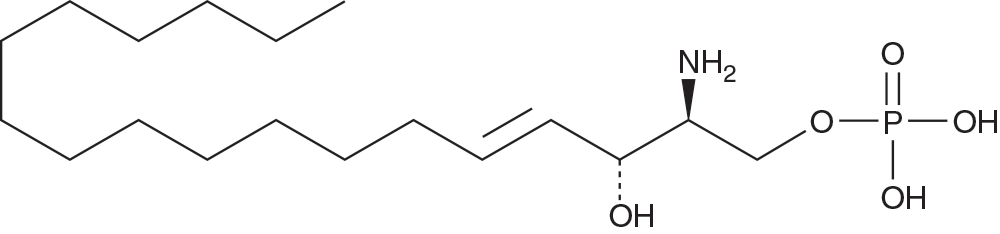
S1P has important signaling functions both intra- and intercellularly and is present at low concentrations in cells. It can promote cellular division, regulate calcium mobilization and cell growth, and inhibit apoptosis.1 S1P is involved in regulating the proliferation, survival, differentiation, and migration of many types of stem cells, especially in the development of both the vascular and nervous systems. During the metabolism of S1P, sphingosine is phosphorylated by sphingosine kinase. Unlike most other sphingolipids, it does not form lipid rafts in membranes and is found in low nanomolar amounts in cells. However, in plasma, it can reach a much higher concentration and is stored in relatively high concentrations in human platelets and erythrocytes. S1P exerts its extracellular effects by acting as a ligand for specific receptors. These ligand-receptor interactions are important for the growth of new blood vessels, vascular maturation, cardiac development and immunity, the inflammatory process, and for directed cell movement.2 S1P is abundant in some cancers, probably due to its role in cell division and proliferation, and is therefore undergoing much scrutiny in an attempt to find therapeutic interventions such as inhibiting its biosynthesis.
Ceramide-1-Phosphate
C1P is generated by the phosphorylation of ceramide by the enzyme ceramide kinase. C1P is a novel second messenger that demonstrates important cellular functions such as influencing phagocytosis, potassium channel function, inflammatory responses, cell survival, and tumorigenesis.3 The first reported biological action of C1P was its ability to stimulate DNA synthesis and cell division. C1P is mitogenic for both fibroblasts and macrophages. The mitogenic effect of C1P is dependent on its intracellular ability to stimulate reactive oxygen species production in macrophages via NADPH oxidase. This enzyme is downstream of PKCα and cPLA2α in this pathway.4,5 Another important function of C1P is its promotion of cell survival. C1P stimulates the PI3K/PKB pathway, a major mechanism whereby growth factors promote cell survival. It is probable that C1P blocks apoptosis by stimulating the PI3K/PKB/NF-κB pathway, thereby maintaining the production of anti-apoptotic Bcl-xL. Based on these and previous findings, it has been proposed that the inhibition of acid sphingomyelinase and the subsequent decrease in ceramide levels would allow cell signaling through stimulation of the PI3K/PKB pathway to promote cell survival.6
To help you study the distinct aspects of these bioactive sphingolipids, Cayman carries many different standards as well as S1P receptor agonists and antagonists.
Sphinganine-1-phosphate (d18:0)
Sphingosine-1-phosphate (d18:1)
Sphingosine-1-phosphate-d7 (d18:1)
Sphingosine-1-phosphate (d18:1) Alkyne
Sphingosine-1-phosphate (d18:1(14Z))
Sphingosine-1-phosphate (d16:1)
Sphingosine-1-phosphate (d17:1)
C16 Ceramide-1-phosphate (d18:1/16:0) (ammonium salt)
C8 Ceramide-1-phosphate (d18:1/8:0)
C18 Ceramide-1-phosphate-d3 (d18:1/18:0-d3)
You May Also Be Interested In
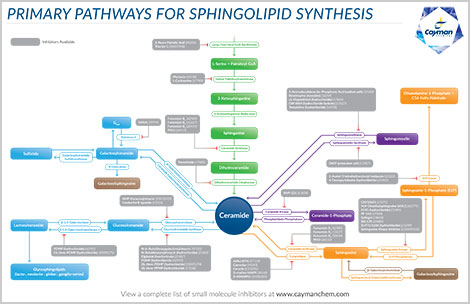
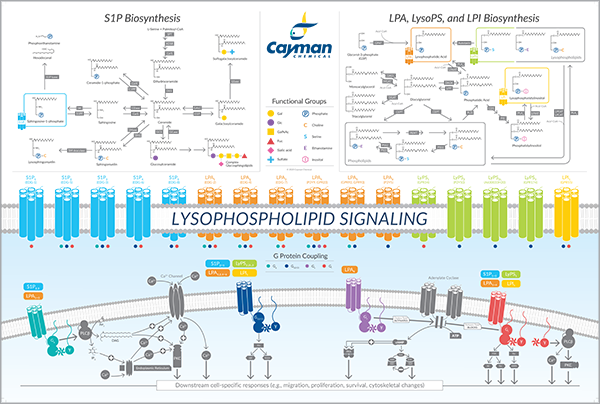
| Sphingolipid Standards and Research Tools | Lysophospholipid Signaling | |
 |  | |
References
1. Maceyka, M., Milstien, S., and Spiegel, S. Sphingosine-1-phosphate: The Swiss army knife of sphingolipid signaling. J. Lipid Res. 50(Suppl), S272-S276 (2009).
2. Nofer, J.-R. High-density lipoprotein, sphingosine 1-phosphate, and atherosclerosis. J. Clin. Lipidol. 2(1), 4-11 (2008).
3. Kooijman, E.E., Vaknin, D., Bu, W., et al. Structure of ceramide-1-phosphate at the air-water solution interface in the absence and presence of Ca2+. Biophys. J. 96(6), 2204-2215 (2009).
4. Stahelin, R.V., Subramanian, P., Vora, M., et al. Ceramide-1-phosphate binds group IVA cytosolic phospholipase a2 via a novel site in the C2 domain. J. Biol. Chem. 282(28), 20467-20474 (2007).
5. Arana, L., Gangoiti, P., Ouro, A., et al. Generation of reactive oxygen species (ROS) is a key factor for stimulation of macrophage proliferation by ceramide 1-phosphate. Exp. Cell Res. 318(4), 350-360 (2012).
6. Gómez-Muñoz, A., Kong, J.Y., Parhar, K., et al. Ceramide‐1‐phosphate promotes cell survival through activation of the phosphatidylinositol 3‐kinase/protein kinase B pathway. FEBS Lett. 579(17), 3744-3750 (2005).
Contact Info
Cayman Chemical1180 East Ellsworth RoadAnn Arbor, Michigan 48108 USAToll Free: (800) 364-9897(USA and Canada only)Fax: (734) 971-3640


