
News & Announcements
Stearidonic Acid
Stearidonic Acid
Article from 2016-06-06
This article was originally published in the June 2016 edition of Matreya’s Newsletter for Glyco/Sphingolipid Research (PDF).
Stearidonic acid is a C18:4 ω-3 fatty acid that is present in various edible oils and is believed to be a dietary precursor to eicosapentaenoic acid (EPA) and docosahexaenoic acid (DHA).1 Stearidonic acid from plant oil is a dietary alternative to directly consuming EPA and DHA, both of which demonstrate important health benefits and are found mainly in marine oils. Stearidonic acid has been referred to as a proeicosapentaenoic acid.2
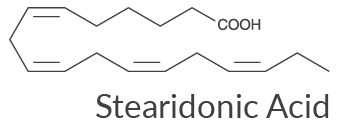
Stearidonic acid itself has numerous health benefits in humans. It reduces serum triglyceride levels and decreases the production of cytokines, adhesion molecules, and C-reactive protein. It also can induce cell cycle arrest and apoptosis of certain tumors. Stearidonic acid inhibits platelet aggregation in a manner similar to EPA making it useful in the prevention and treatment of various chronic and acute diseases.3 Conjugated stearidonic acid can be produced by bifidobacteria and propionibacteria from stearidonic acid, suggesting an as yet unexplored pathway of stearidonic acid in mammals through intestinal microbes.4 Stearidonic acid-containing lipids are of great interest in a number of areas such as in fortified foods, dietary supplements, medicated foods, pharmaceuticals, and personal care products.
Available Stearidonic Acid Formulations
References
1. Harris, W.S., DiRienzo, M.A., Sands, S.A., et al. Stearidonic acid increases the red blood cell and heart eicosapentaenoic acid content in dogs. Lipids 42(4), 325-333 (2007).
2. Harris, W.S. Stearidonic acid as a 'pro-eicosapentaenoic acid'. Curr. Opin. Lipidol. 23(1), 30-34 (2012).
3. Whelan, J. Dietary stearidonic acid is a long chain (n-3) polyunsaturated fatty acid with potential health benefits. J. Nutr. 139(1), 5-10 (2009).
4. Hennessy, A.A., Barrett, E., Ross, R.P., et al. The production of conjugated α-linolenic, γ-linolenic and stearidonic acids by strains of bifidobacteria and propionibacteria. Lipids 47(3), 313-327 (2012).
Contact Info
Cayman Chemical1180 East Ellsworth RoadAnn Arbor, Michigan 48108 USAToll Free: (800) 364-9897(USA and Canada only)Fax: (734) 971-3640


