
News & Announcements
Sterculic Acid and its Methyl Ester Inhibit Toxoplasma Gondii
Article from 2018-02-01
This article was originally published in the February 2018 edition of Matreya’s Newsletter for Glyco/Sphingolipid Research (PDF).
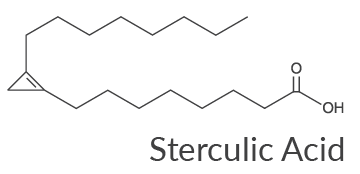
Sterculic acid is a monounsaturated fatty acid containing a cyclopropene ring, which gives it specific and unusual physiological properties. The major sources of sterculic acid are the seed oils of various plants, including the java olive tree (Sterculia foetida), cotton (Gossypium species), and silk cotton tree (Bombax munguba). Cyclopropenoid fatty acids have been reported to have several deleterious effects on mammals, such as carcinogenicity and acute and chronic toxicity.1,2 Because of the harmful effects of cyclopropenoids, cottonseed oil (a major world-wide edible oil that contains around 1% of these fatty acids) is required to be heat treated and hydrogenated before consumption. Sterculia foetida seeds have been used in traditional Chinese medicine as an antiparasitic drug, and recent research has found that sterculic acid and its methyl ester analog have a significant inhibitory effect towards the wide-spread parasite Toxoplasma gondii.3 Oil from Sterculia foetida has also been shown to have significant insecticide and possible anti-fungal properties, making it a potentially useful alternative to more environmentally toxic synthetic compounds.4,5 Cyclopropenoids, such as sterculic acid, inhibit stearoyl-coenzyme A desaturase (∆9 desaturase), preventing the conversion of stearic acid to oleic acid and potentially causing significant health problems for organisms that consume them.
∆9 Desaturase is an endoplasmic reticulum enzyme found in a wide number of organisms that catalyzes the insertion of a double bond into the cis-∆9 position of various fatty acyl-CoAs. The most common substrates are palmitic acid (C16:0) and stearic acid (C18:0), which are converted to palmitoleic acid (C16:1) and oleic acid (C18:1), respectively. In mammalian organisms, ∆9 desaturase has a role in modulating metabolic and signaling processes involved in cellular proliferation, survival, and malignant tumor generation.
The presence of ∆9 desaturases in several parasitic organisms has been identified, and the desaturation of palmitic acid and stearic acid noted. Since ∆9 desaturase is likely to be an essential enzyme for these parasites, it is probable that the antiparasitic properties of sterculic acid and its methyl ester arise from their inhibition of this enzyme. Pan Hao et al. have recently demonstrated that sterculic acid and methyl sterculate are effective in inhibiting T. gondii growth in vitro, suggesting that these compounds target ∆9 desaturase in the parasite and could therefore be effective agents for the treatment of toxoplasmosis.3
Available Sterculic Acid Variants
cis-9,10-Methyleneoctadecanoic Acid
cis-9,10-Methyleneoctadecanoic Acid methyl ester
References
1. Bao, X., Thelen, J.J., Bonaventure, G., et al. Characterization of cyclopropane fatty-acid synthase from Sterculia foetida. J. Biol. Chem.278(15), 12846-12853 (2003).
2. Fehling, E., Schönwiese, S., Klein, E., et al. Preparation of malvalic and sterculic acid methyl esters from Bombax munguba and Sterculia foetida seed oils. J. Am. Oil Chem. Soc.75(12), 1757-1760 (1998).
3. Hao, P., Alaraj, I.Q., Dulayymi, J.R., et al. Sterculic acid and its analogues are potent inhibitors of Toxoplasma gondii. Korean J. Parasitol.54(2), 139-145 (2016).
4. Rani, P. and Rajasekharreddy, P. Toxic and antifeedant activities of Sterculia Foetida (L.) seed crude extract against Spodoptera litura (F.) and Achaea Janata (L.). J. Biopest.2(2), 161-164 (2009).
5. Schmid, K.M. and Patterson, G.W. Effects of cyclopropenoid fatty acids on fungal growth and lipid composition. Lipids 23(3), 248-252 (1988).
Contact Info
Cayman Chemical1180 East Ellsworth RoadAnn Arbor, Michigan 48108 USAToll Free: (800) 364-9897(USA and Canada only)Fax: (734) 971-3640


