
News & Announcements
The Mechanism of Isoprostane Formation
Article from 2018-09-24
Isoprostane formation is only one possible consequence of the general process of lipid peroxidation. The minimum requirement to generate an isoprostane is a polyunsaturated fatty acid (PUFA) with three contiguous, methylene-interrupted double bonds. Because there are dozens of naturally occurring PUFAs that meet this requirement, a bewildering array of isoprostane families and regioisomers are possible—the most well-known of which is 8-iso prostaglandin F2α (iPF2α-III or 8-isoprostane). Here we take you step-by-step through each stage of free radical attack on a generic PUFA and point out where other markers of peroxidation are produced. Note that an alternate, dioxetane mechanism for isoprostane formation has also been postulated, but is not discussed here.
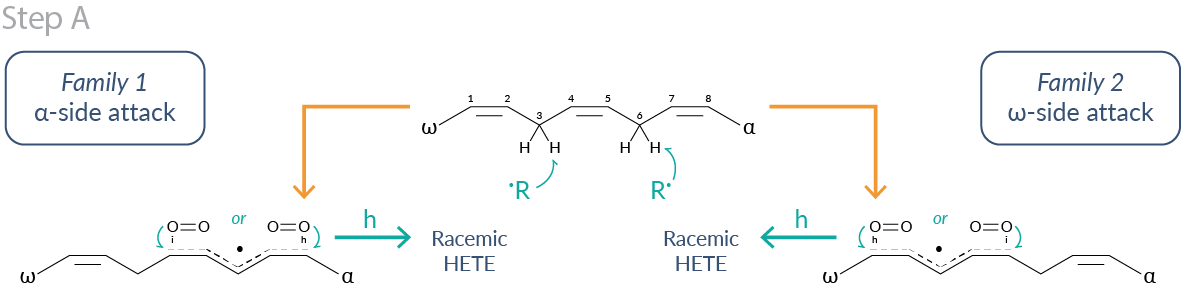
Step A
Peroxidative damage starts with the abstraction of a methylene proton by the attacking radical, •R. This produces a bis-allylic radical within the fatty acid triene—leaving an undisturbed double bond at either the α or the ω end of the chain. The bis-allylic radical reacts immediately with molecular oxygen—and again, this reaction can occur in two locations. Reaction at the external end of the delocalized radical (route h) will result in a HETE, not an isoprostane.
Step B
When the initial radical reacts with molecular oxygen internally, at either the carbon 4 or 5 (route i) of the starting triene, the resulting fatty acid peroxyl radical is set up for isoprostane formation. Here again, however, its fate is not yet sealed. Antioxidant quenching of the radical will again give a racemic HETE. β-Cleavage will break the carbon chain and produce a short chain aldehyde, such as 4-hydroxy nonenal. The third possibility is for the radical to react internally with the neighboring unconjugated double bond, producing the key cyclic radical-peroxides 1a and 2a.
Step C
In 1a and 2a, these short-lived intermediates have been drawn to show the two critical π-orbitals, which must combine to form a new σ-bond, joining the α and ω chain, thus forming the cyclopentane ring. For regioisomer 1a, the two possible orientations 1b-syn and 1b-anti are also shown, so that one can picture the inward rotation of the π-orbitals. The small cyan arrows each indicate the movement of a single electron. Note that a new carbon radical is formed 3 carbon atoms down the chain from the cyclizing center, and this radical reacts with a second molecule of molecular oxygen. The capacity for internal reaction has now been exhausted, and the resulting set of four endoperoxy-peroxyl radicals is quenched and reduced by cellular antioxidants. This gives two families of isoprostanes for each triene, with four isomers (and their enantiomers) in each family (see example in last figure), for a total of 8 x 2 or 16 isoprostanes for every unique triene fatty acid. Mathematically, 16 more isomers with trans-side chains are possible, but for the reasons outlined above, these are practically non-existent. The α and ω side chains are always syn—that is, crowded together next to each other, on the same face of the cyclopentane ring.
For Example: Arachidonic Acid-Derived Isoprostanes
The two possible triene units A & B of arachidonic acid, which are capable of isoprostane formation are overlined in the figure below. Radical formation at C-7 and C-13 will give only type VI and type III isoprostanes, respectively. A radical at C-10 can react “upstream” to give a type V isoprostane or “downstream” to give a type IV isoprostane. Each family member shown exists as a mixture of eight isomers, less than the theoretical maximum of 32, because C-9, C-11, C-8, and C-12 are not fully independent of one another.
Free Radical Peroxidation Markers from Cayman
Over the past several decades, Cayman has made important strides in the expansion of the isoprostane field. 8-Isoprostane ELISAs and deuterated internal standards for 8-iso PGF2α (iPF2α-III) were introduced by Cayman in 1992, leading to a proliferation of articles about its biology and analysis. We provided the first commercially available unlabeled and deuterated standards for the isoprostanes in type IV, V, and VI families. We also introduced iPF1 isoprostanes from α-linolenic acid in plants, as well as iPF3 and iPF4 isoprostanes derived from eicosapentaenoic acid and docosahexaenoic acid.
View All Isoprostanes
Contact Info
Cayman Chemical1180 East Ellsworth RoadAnn Arbor, Michigan 48108 USAToll Free: (800) 364-9897(USA and Canada only)Fax: (734) 971-3640


