
News & Announcements
Utopioids
Article from 2018-07-12
U-type opioids and their metabolites have found a new name as utopioids here at Cayman Chemical. We sat down to talk about the new terminology with Nathan Layle, the scientist in Cayman’s Forensic Chemistry department who coined the term.
How do you define a Utopioid?
Utopioids are characterized by a trans-cyclohexanediamine moiety and their substituted phenyl ring, linked together by an amide carbonyl group and sometimes bridged with an additional methylene spacer. Many of these compounds are designated by their U-name, but not all of them have a specific U-number. Two examples are provided below:
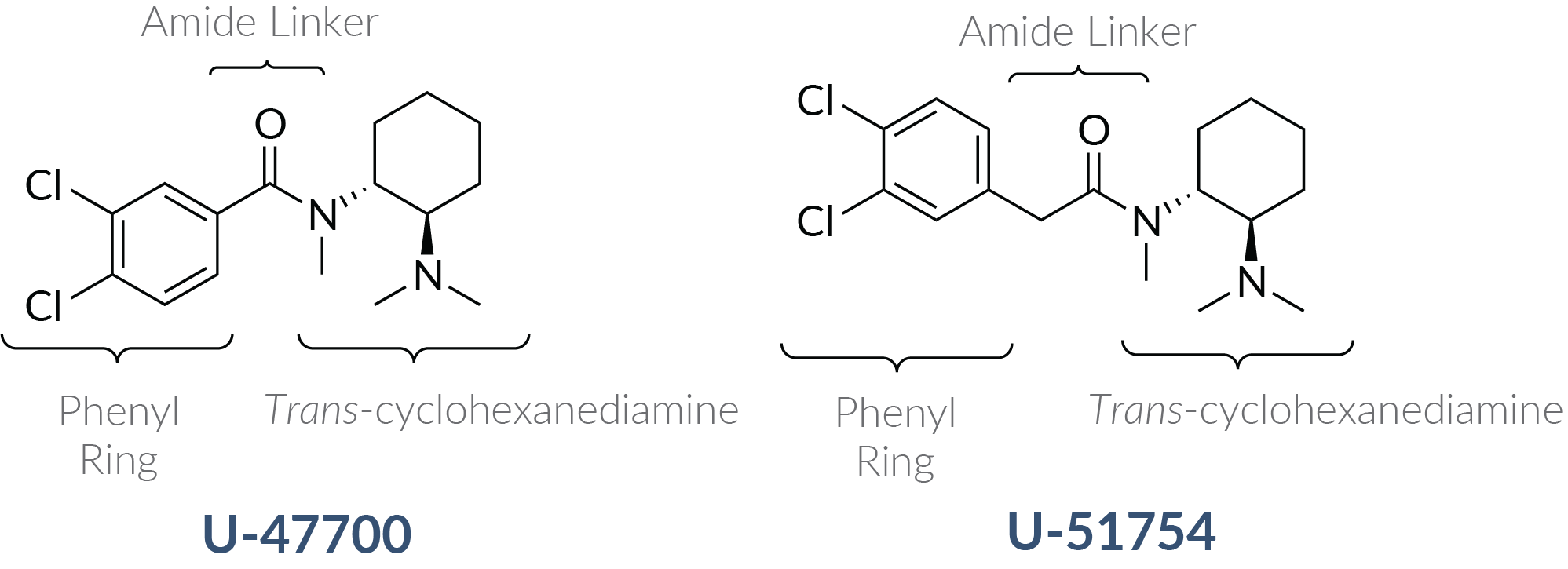
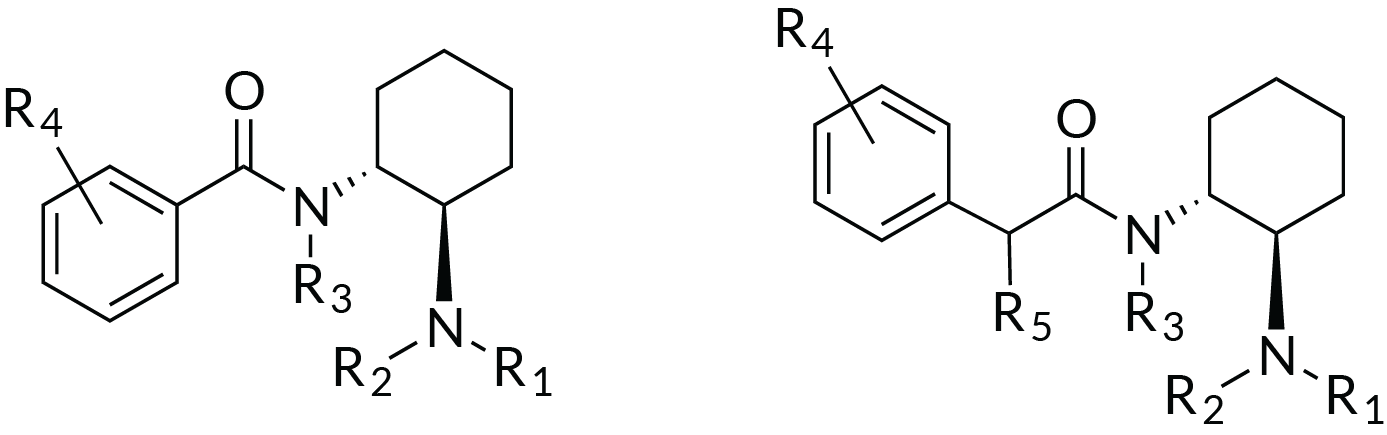
Generic structures for the two predominant U-type opioids, based on U-47700 (left) and U-51754 (right), are shown below. The groups R1-R3 and R5 denote cyclic or acyclic alkyl group substitutions, and the R4 denotes one or more substitutions on the phenyl ring (halides, alkoxy groups, alkyl/aryl groups, etc.).
Briefly recount the history of these compounds: The original reason for development, known potency, sale as designer drugs, and placement into Schedule I of the Controlled Substances Act as a public health and safety threat.
This class of compounds was developed by the Upjohn Company in the late 1970s for their analgesic properties with the hope of only low to moderate apparent physical dependence liability. U-47700 was designed as a structural isomer of the earlier opioid AH 7921 and was found to have 7.5 times the potency of morphine in animal models.1 Although it never received FDA approval, it became a lead compound in the development of selective κ-opioid receptor ligands such as U-50488.2
The analogs that are currently being trafficked are readily found in the early patent literature, and include U-47700, U-49900, and U-50488.3 Although typically not as potent as fentanyl and related analogs, they have still been associated with adverse effects, including respiratory depression, cyanosis, and tachycardia. On the illicit market, U-47700 can be found pure or mixed with other components such as fentanyl. In the southern US, U-47700 has also appeared in a dangerous opioid cocktail called Grey Death.4 The US Drug Enforcement Administration placed U-47700 into Schedule I of the Controlled Substances Act in November 2016 after confirming at least 46 overdose fatalities in six states.
Explain the circumstances surrounding the need to distinguish U-compounds from fentanyls, opiates, and other types of opioids. What differentiates a utopioid from other opioids?
The need to distinguish U-compounds from other opioids/opiates stems from the fact that novel synthetic opioids continue to emerge on research chemical websites, on the streets, and on the Dark Web. While many of these opioids can be found in the literature dating back several decades, clandestine labs are only recently exploring those sources for ideas on what to make. If new analogs appear, it will be important to be able to easily classify them for reporting, tracking, and trending purposes.
The structural features of utopioids are distinct from fentanyl analogs, opiates, and other synthetic opioids, and are deserving of their own classification as they become more prevalent. Utopioids are also unique because many of them were designed to target specific opioid receptors.
How many known compounds fall into the utopioid category? Are utopioid variations emerging at a similar pace as fentanyl analogs?
Cayman offers over 20 utopioids in our catalog. This includes parent compounds, metabolites, internal standards, and certified reference materials to aid in utopioid identification during drug seizures and confirmation in overdose cases.
In 2016, there was only one utopioid (U-47700) included in the DEA Annual Emerging Threat Report.5 In contrast, the 2017 report identified two additional U-type opioids: U-48800 and U-49900.6 While not captured on the DEA Emerging threat report, we are aware of additional analogs appearing across the country such as 3,4-methylenedioxy U-47700, isopropyl U-47700, and U-51754. As this threat continues to emerge, crime laboratories can incorporate Cayman’s utopioid analytical standards into screening methods as part of their routine analysis. Cayman scientists can also help analyze your GC-MS spectra to identify previously unknown utopioids and quickly synthesize the necessary reference standard.
What benefits do you hope the adoption of this naming convention will provide to the forensic research community?
With the recent passing of DEA Drug Code 9850, the increased control over many fentanyl analogs may lead clandestine labs to produce other opioids that are not yet regulated. In the last five years or so there has already been an increase in the number of U-compounds being found in street drugs. Placing them in a distinct chemical class creates a new standard for naming and will help categorize future analogs that are structurally related. Characterizing U-type opioids in this way will also aid forensic chemists seeking to expand their in-house libraries with this compound class. To this end, we have created a separate searchable category on the Cayman website so that forensic scientists looking for other analogs of utopioids can easily filter by the utopioid name. For more information on what is currently known about many of the utopioids, including toxicology, user-reported effects, opioid symptoms, etc., I suggest reading the mini review noted in reference number seven below.
Discover More with Cayman
If you are having trouble identifying or finding a utopioid of interest, please contact our technical support department at techserv@caymanchem.com. Cayman can also provide assistance in the identification of unknown compounds and provides other tools on our Forensic Science Products page such as our Spectral Library, GC-MS Search Tool, and GC-MS Interpretation Guide to help chemists identify novel analogs.
References
1. Alzghari, S.K., Fleming, S.W., Rambaran, K.A., et al. U-47700: An emerging threat. Cureus 9(10), e1791 (2017).
2. Zhao, S., Totleben, M.J., Mizsak, S.A., et al. Phenanthridone analogs of the opiate agonist U-47,700 in the trans-1,2-diaminocyclohexane benzamide series. Heterocycles 52(1), 325-332 (2000).
3. Szmuszkovicz, J. 2-Aminocycloaliphatic amide compounds, US4145435 (1979).
4. Nedelman, M. (2017). 'Grey death': The powerful street drug that's puzzling authorities. CNN. Retrieved from: https://www.cnn.com/2017/05/12/health/grey-death-opioid-drug/index.html
5. DEA Emerging Threat Report (2016). Retrieved from: https://ndews.umd.edu/sites/ndews.umd.edu/files/emerging-threat-report-2016-annual.pdf
6. DEA Emerging Threat Report (2017). Retrieved from: https://ndews.umd.edu/sites/ndews.umd.edu/files/dea-emerging-threat-report-2017-annual.pdf
7. Solimini, R., Pichini, S., Pacifici, R., et al. Pharmacotoxicology of non-fentanyl derived new synthetic opioids. Front. Pharm. 9:654 (2018).
Contact Info
Cayman Chemical1180 East Ellsworth RoadAnn Arbor, Michigan 48108 USAToll Free: (800) 364-9897(USA and Canada only)Fax: (734) 971-3640


