
News & Announcements
What Do We Know about the Metabolism of the New Fentanyl Derivatives?
What Do We Know about the Metabolism of the New Fentanyl Derivatives?
Article from 2017-08-23
By: Donna M. Iula, Ph.D
The metabolism of the pharmaceutical opioid fentanyl has been well studied, but less is known about the metabolism of the newer fentanyl-like compounds that have recently emerged on the scene (i.e., ‘designer fentanyls,’ ‘fentalogs,’ or ‘fentanyl derivatives’).1-5 Herein we present a brief discussion of what is known about the metabolism of fentanyl and other fentanyl-like opioids. Based on what is currently known, a predictive pattern is evident that can aid in detecting novel fentanyl-like compounds in clinical and post-mortem cases.
Fentanyl is heavily and rapidly metabolized in the liver (‘first-pass metabolism’) by cytochrome P450 enzymes to several metabolites collectively referred to as phase I metabolites (Figure 1). The role of first-pass metabolism is to convert drugs to less lipophilic molecules that are more easily excretable. First-pass metabolites then undergo what is referred to as ‘second-pass metabolism’, which inactivates the phase I metabolites. Many of these phase II metabolites are in the form of glucuronide or sulfate bioconjugates that are even further hydrophilic. In human plasma, identification of unmetabolized fentanyl is readily possible, whereas in urine, the concentration of fentanyl metabolites often greatly exceeds that of the parent drug. In general, when analyzing urine samples, non-hydrolyzed samples will show the phase II glucuronidation and sulfation products, while hydrolyzed urine samples will only detect the phase I metabolites.
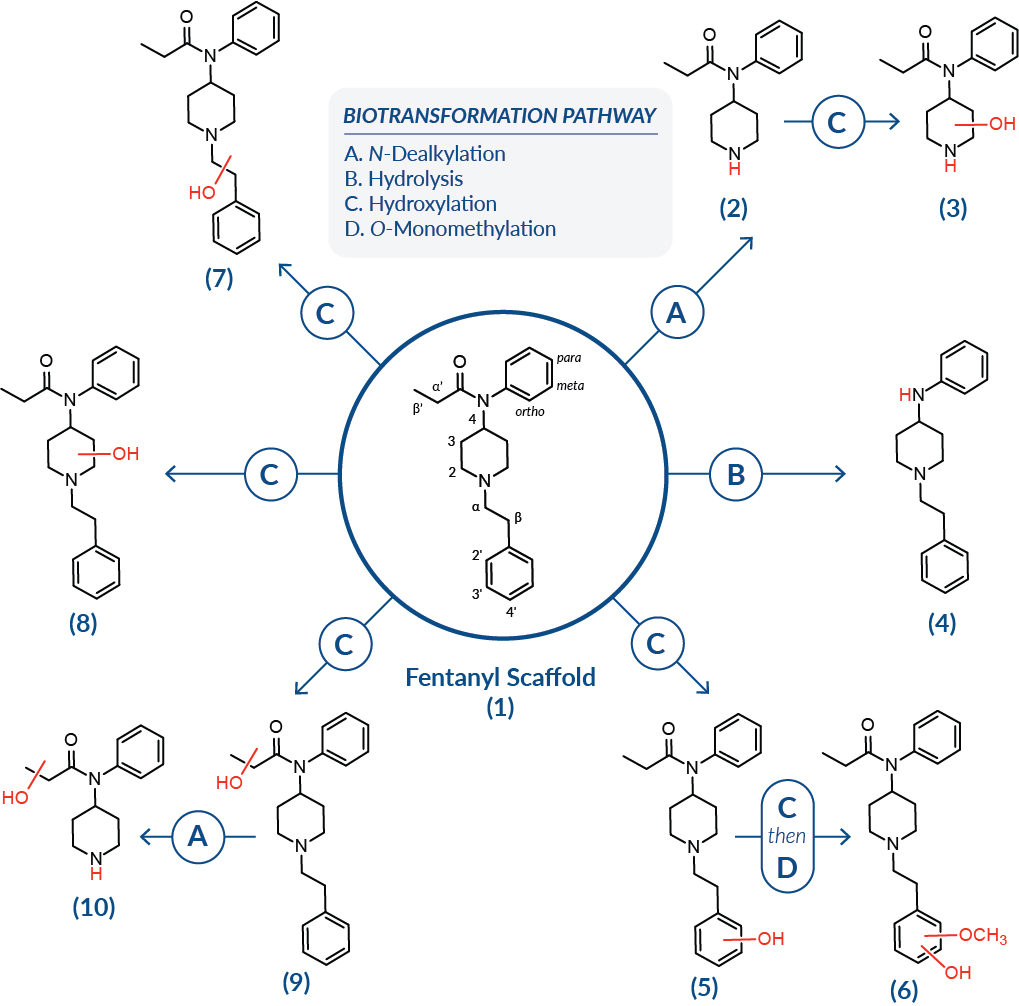
Figure 1. The major proposed routes of metabolism for fentanyl and designer fentanyls.
The major route of fentanyl metabolism is via oxidative N-dealkylation to the inactive desphenethyl metabolite norfentanyl (2). Another known (but minor) human metabolite is despropionyl fentanyl (4), which is also known as 4-ANPP. This amide hydrolysis metabolite can coincidentally be formed as a metabolic product of several different fentanyl analogs, so its presence isn’t particularly diagnostic. It is also a precursor contaminant found in seized illicit fentanyl and fentanyl analog powders, further adding to the complexity of identifying it in urine analysis. There are numerous hydroxylated compounds that are typically less abundant (3, 5, 7, 8, 9, and 10). It has been reported, for example, that hydroxylation can occur on the ethyl linker of the phenethyl moiety (either at the α or β position), at the 2 or 3 position on the piperidine ring, along the amide alkyl chain, or on the phenyl ring of the phenethyl moiety. Some of these hydroxylated metabolites, such as 4’-hydroxy fentanyl (5), are potentially bioactive, but most are believed to be inactive. Hydroxy fentanyls like 5 can be further biotransformed via a second hydroxylation to afford a catechol that is then O-monomethylated to yield metabolite 6. This methylation conjugation reaction is presumably catalyzed by the enzyme catechol-O-methyltransferase and is believed to occur at the 3’ position. This is technically a phase II metabolic product, but it is detected in both hydrolyzed and non-hydrolyzed urine specimens due to its stability. Norfentanyl (2) is also further oxidized (Figure 1). Keep in mind that most of the metabolites depicted in Figure 1 can potentially undergo further transformations to yield additional metabolites and often the exact positioning of the hydroxyl group is unknown.
Figure 2. Major human metabolites of butyryl fentanyl.
Biotransformation studies on several fentanyl derivatives such as acetyl fentanyl,6,7 furanyl fentanyl,7,8para-fluoroisobutyryl fentanyl (FIBF),7 3-methyl fentanyl,9 isofentanyl,9 α-methyl fentanyl,10 butyryl fentanyl,11 acrylfentanyl,7,12 and carfentanil13,14 have been reported. While in vivo and in vitro studies utilizing human liver hepatocytes or microsomes can identify up to 32 primary and secondary metabolites for a particular fentanyl derivative, actual human urine specimens typically show the number to be far less. For the sake of simplicity, only phase I metabolites will be discussed in this review of the literature. What has been documented for fentanyl metabolism typically translates to the new designer fentanyls. The various pathways described in Figure 1 are followed to varying degrees. For example, while screening for designer fentanyl metabolites in urine specimens, one can expect to find the N-dealkylation metabolite to typically predominate. Notable exceptions, however, are butyryl fentanyl and furanyl fentanyl. In those cases, the oxidative N-dealkylation metabolic pathway and subsequent hydroxylation do not dominate. While butyryl fentanyl (11, Figure 2) is only one carbon longer than fentanyl, unexpectedly, the added lipophilicity is enough to steer metabolism to the butanamide side chain. Here, both the hydroxylation metabolite (12, Figure 2) and its secondary oxidation product (13, Figure 2), the corresponding carboxylic acid, are both dominant metabolites (Figure 2). The expected desphenethyl nor-metabolite that occurs with most fentanyl derivatives is actually present in very low abundance in furanyl fentanyl cases. The metabolism of furanyl fentanyl (14, Figure 3), which differs substantially from fentanyl in that the ethyl chain of the propanamide is replaced with an aromatic heterocyclic furan moiety, does not follow the typical fentanyl metabolic routes either. As described in two recent studies, it was observed that the furanyl ring system is heavily targeted for metabolism.7,8 Like butyryl fentanyl, the corresponding typical N-dealkylated normetabolite is present in very low concentrations (if at all) in urine samples. Instead, metabolite 4-ANPP (4) is detected along with a unique dihydrodiol (15, Figure 3).
Figure 3. A unique human phase I metabolite of furanyl fentanyl.
In summary, if a novel fentanyl derivative is very close in structure to fentanyl itself, the corresponding ‘nor-fentanyl’ metabolite (2) is typically one of the major breakdown products. The other structures illustrated in Figure 1 are often present but will differ in relative abundance. Examples of analogs following this path include FIBF, 3-methyl fentanyl, acetyl fentanyl, α-methyl fentanyl, and acrylfentanyl. However, if the acyl alkyl chain is longer, such as in butyryl fentanyl, the majority of the metabolism will occur at this lipophilic site. When unique ring systems are present, such as in furanyl fentanyl, extensive metabolism of that ring system occurs in preference to N-dealkylation.
A phenomenon frustrating to forensic and clinical toxicologists is that given the strong structural similarity among emerging designer fentanyls, many are coincidentally biotransformed to the exact same molecule. This fact can make pinpointing the specific parent drug in a case difficult. The ability to identify minor metabolites that are unique to the parent drug is therefore of considerable importance. Cayman offers many of these major and minor metabolites. If you cannot find a particular compound, our skilled scientists can propose the synthesis of any phase I or phase II metabolite you might be interested in studying.
References
1. Labroo, R.B., Paine, M.F., Thummel, K.E., et al. Drug Metab. Dispos.25(9), 1072-1080 (1997).
2. Goromaru, T., Matsuura, H., Yoshimura, N., et al. Anesthesiology61(1), 73-77 (1984).
3. Guitton, J., Désage, M., Alamercery, S., et al. J. Chromatogr. B693(1), 59-70 (1997).
4. Mahlke, N.S., Ziesenitz, V., Mikus, G., et al. Int. J. Legal Med.128(5), 771-778 (2014).
5. Poklis, A. and Backer, R. J. Anal. Toxicol.28(6), 422-425 (2004).
6. Melent’ev, A.B., Kataev, S.S., and Dvorskaya, O.N. J. Anal. Chem.70(2), 240-248 (2015).
7. Watanabe, S., Vikingsson, S., Roman, M., et al. AAPSJ. (2017).
8. Goggin, M.M., Nguyen, A., and Janis, G.C. J. Anal. Toxicol.41(5), 367-375 (2016).
9. Meyer, M.R., Dinger, J., Schwaninger, A.E., et al. Anal. Bioanal. Chem.402(3), 1249-1255 (2012).
10. Sato, S., Suzuki, S., Lee, X-P., et al. Forensic Sci. Int. 195(1-3), 68-72 (2010).
11. Steuer, A.E., Williner, E., Staeheli, S., et al. Drug Testing and Anal. (2016).
12. Ujvary, I., Jorge, R., Christie, R., et al. Forensic Toxicol. doi: (2017).
13. Wang, J. and Bernert, J.T. J. Anal. Toxicol.30(5), 335-341 (2006).
14. Feasel, M.G., Wohlfarth, A., Nilles, J.M., et al. AAPS J. (2016).
Contact Info
Cayman Chemical1180 East Ellsworth RoadAnn Arbor, Michigan 48108 USAToll Free: (800) 364-9897(USA and Canada only)Fax: (734) 971-3640


