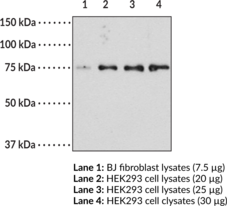
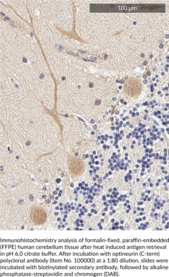
Immunogen: Synthetic peptide from C-terminal region of human optineurin • Uniprot Accession No: Q96CV9 • Applications: IHC, WB • Host: Rabbit • Storage Buffer: PBS, pH 7.2 with 50% glycerol and 0.02% sodium azide
Technical Support & Resources

Visit our FAQ

Contact Us

Toll Free Phone (USA and Canada Only): (888) 526-5351
Direct Phone: (734) 975-3888

Request Technical Support

Technical Support Request

To streamline the process attach the appropriate questionnaire to your inquiry.

Download IHC QuestionnaireDownload WB Questionnaire

View Our Privacy Statement for details on how we use and protect your data. In addition, this site is protected by hCaptcha and its Privacy Policy and Terms of Service apply.

Optineurin (C-Term) Polyclonal Antibody

Item No. 100000

Technical Information
Synonyms
  • FIP-2
  • NRP
Immunogen
Synthetic peptide from C-terminal region of human optineurin
500 µl peptide affinity-purified polyclonal antibody
Storage Buffer
PBS, pH 7.2 with 50% glycerol and 0.02% sodium azide
Host
Rabbit
Isotype
IgG
Applications
IHC, WB
Species Reactivity
(+) Human optineurin(+) Mouse optineurin(+) Rat optineurin
UniProt Accession №
Q96CV9
Origin
Animal/Rabbit
Shipping & Storage Information
Storage
-20°C
Shipping
Wet ice in continental US; may vary elsewhere
Recommended Products

Certificates of Analysis & Batch Specific Data

Provide batch numbers separated by commas to download or request available product inserts, QC sheets, certificates of analysis, data packs, and GC-MS data.

    Add

    Product Description

    Optineurin, originally named FIP-2, is a 74 kDa protein implicated in signal transduction of the tumor necrosis factor (TNF) pathway as well as membrane traffic regulation and cellular morphogenesis. Optineurin protein is also involved in apoptosis, although the exact role is currently unknown. Increased apoptosis of trabecular meshwork cells is a factor in the pathogenesis of glaucoma and mutations in the optineurin gene have been correlated with the some types of the disease. Cayman Chemical is a leading provider of prostaglandin analogs, such as latanoprost and fluprostenol, currently utilized for lowering the intraocular pressure (IOP) associated with glaucoma. Our optineurin polyclonal antibody is another research tool useful for delineating the physiology of the disease.

    WARNING This product is not for human or veterinary use.

    References & Product Citations
    Product Citations

    Falcon, B., Noad, J., McMahon, H., et alGalectin-8-mediated selective autophagy protects against seeded tau aggregation. The Journal of Biological Chemisty 293(7), 2438-2451 (2018).

    Silva, I.A.L., Conceiçao, I., Gagnon, E., et alMolecular effect of an OPTN common variant associated to Paget’s disease of bone. PLoS One 13(5), e0197543 (2018).

    Paulus, J.D., and Link, B.A. Loss of optineurin in vivo results in elevated cell death and alters axonal trafficking dynamics. PLoS One 9(10), e109922 (2014).

    Newman, A.C., Scholefield, C.L., Kemp, A.J., et alTBK1 kinase addiction in lung cancer cells is mediated via autophagy of Tax1bp1/Ndp52 and non-canonical NF-kB signalling. PLoS One 7(11), e50672 (2012).

    Journo, C., Filipe, J., About, F., et alNRP/optineurin cooperates with TAX1BP1 to potentiate the activation of NF-kappaB by human T-lymphotropic virus Type 1 tax protein. PLoS Pathog. 5(7), e1000521 (2009).