
Technical Support & Resources
Visit our FAQ
Contact Us
Toll Free Phone (USA and Canada Only): (888) 526-5351
Direct Phone: (734) 975-3888
Product Categories
Technical Information
- Acyl-
coenzyme A:Cholesterol Acyltransferase- 2 - Cholesterol Acyltransferase 2
- Sterol O-
Acyltransferase 2
Shipping & Storage Information
Recommended Products
Certificates of Analysis & Batch Specific Data
Provide batch numbers separated by commas to download or request available product inserts, QC sheets, certificates of analysis, data packs, and GC-MS data.
Lipid Resource Center
Discover Products & Resources for Lipid Research
- High-purity lipid standards
- Lipid roles in biology
- Lipids in health & disease
- Lipids for pharmaceutical development
- Protocols, advice, & resources
Product Description
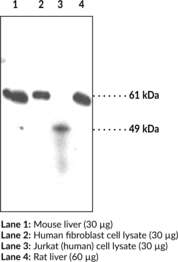
Sterol O-acyltransferase 2 (SOAT-2), also known as acyl-coenzyme A:cholesterol acyltransferase-2 (ACAT-2), is an enzyme encoded by ACAT2 in humans that catalyzes the intracellular formation of cholesterol esters from cholesterol and long-chain fatty acyl-coenzyme A.1 It is constitutively expressed in the liver and small intestine and localized to the rough endoplasmic reticulum where it preferentially utilizes oleic acid (Item Nos. 90260 | 24659) or palmitic acid (Item No. 10006627) as fatty acid substrates for the synthesis of cholesterol esters, which are stored intracellularly or packaged into chylomicrons or VLDL and secreted into the blood stream. SOAT-2/ACAT-2 protein levels are increased in macrophages under various pathological conditions, including atherosclerosis.2 SOAT-2/ACAT-2 activity and protein levels are increased by cholesterol in vitro and in vivo, and ACAT2 expression is increased by the transcription factors hepatocyte nuclear factor 1-α (HNF-1-α) and HNF-4-α in Caco-2 cells and human liver, respectively.1 Genome-wide deletion of Acat2 reduces intestinal cholesterol absorption and decreases hepatic, but not plasma, total cholesterol levels in mice fed a high-cholesterol diet.3 Liver ACAT2 activity is negatively correlated with plasma HDL-C and ApoA1 in normolipidemic patients.4 Cayman's SOAT-2/ACAT-2 Polyclonal Antibody can be used for immunofluorescence (IF), immunohistochemistry (IHC), and Western blot (WB) applications. The antibody recognizes the N-terminal region of SOAT-2/ACAT-2 at approximately 60 kDa from human, mouse, ovine, porcine, and rat samples.
WARNING This product is not for human or veterinary use.
References & Product Citations
1. Cholesteryl esters and ACAT. Eur. J. Lipid Sci. Technol. 114(6), 624-633 (2012).
2. Acyl-
3. ACAT2 deficiency limits cholesterol absorption in the cholesterol-
4. ACAT2 and human hepatic cholesterol metabolism: identification of important gender-
Modulatory role of PYY in transport and metabolism of cholesterol in intestinal epithelial cells. Plos One 7(7), e40992 (2012).
A selective ACAT-
Contact Info
Cayman Chemical1180 East Ellsworth RoadAnn Arbor, Michigan 48108 USAToll Free: (800) 364-9897(USA and Canada only)Fax: (734) 971-3640


