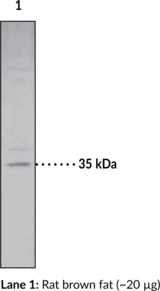
For immunochemical detection of MAGL
Related Products
Technical Support & Resources

Visit our FAQ

Contact Us

Toll Free Phone (USA and Canada Only): (888) 526-5351
Direct Phone: (734) 975-3888

Request Technical Support

Technical Support Request

To streamline the process attach the appropriate questionnaire to your inquiry.

Download IHC QuestionnaireDownload WB Questionnaire

View Our Privacy Statement for details on how we use and protect your data. In addition, this site is protected by hCaptcha and its Privacy Policy and Terms of Service apply.

Monoacylglycerol Lipase Polyclonal Antibody

Item No. 100035

Technical Information
Synonyms
  • HU-K5
  • Lysophospholipase homolog
  • MAGL
  • MGL
  • MGLL
Immunogen
Synthetic peptide from human MAGL
500 μl of peptide affinity-purified polyclonal antibody
Storage Buffer
PBS, pH 7.2, with 50% glycerol and 0.02% sodium azide
Host
Rabbit
Applications
IHC (formalin-fixed paraffin-embedded tissue) and WB
Species Reactivity
(+) Human(+) Bovine(+) Mouse(+) Rat
UniProt Accession №
Q99685
Origin
Animal/Rabbit
Shipping & Storage Information
Storage
-20°C
Shipping
Wet ice in continental US; may vary elsewhere
Recommended Products

Certificates of Analysis & Batch Specific Data

Provide batch numbers separated by commas to download or request available product inserts, QC sheets, certificates of analysis, data packs, and GC-MS data.

    Add

    Lipid Resource Center
    Discover Products & Resources for Lipid Research
    • High-purity lipid standards
    • Lipid roles in biology
    • Lipids in health & disease
    • Lipids for pharmaceutical development
    • Protocols, advice, & resources
    EXPLORE NOW
    Product Description

    Endocannabinoids, such as arachidonoyl ethanolamide (AEA) and 2-Arachidonoyl glycerol (2-AG), function as short-range modulators of cell and synaptic activity. Monoacylglycerol lipase (MAGL) hydrolyzes 2-AG to terminate its biological actions and works consecutively with hormone-sensitive lipase (HSL) to mobilize fatty acids from the triglyceride stores of adipocytes.1,2 MAGL has a molecular weight of ~33 kDa and exhibits a high degree of homology among human, mouse, and rat at the amino acid level.1,2,3,4 The enzyme is expressed in a variety of tissues with most abundant expression in skeletal muscle and adipose tissue, suggesting a role of MAGL in monoglyceride hydrolysis in diverse tissues. Cayman Chemical’s MAGL polyclonal antibody can be used for western blot and immunohistochemical (formalin-fixed paraffin-embedded tissue) analysis for MAGL on samples of human, mouse, rat, and bovine origin. Other applications for use of this antibody have not yet been tested.

    WARNING This product is not for human or veterinary use.

    References & Product Citations
    Product Description References

    1. Dinh, T.P., Carpenter, D., Leslie, F.M., et alBrain monoglyceride lipase participating in endocannabinoid inactivation. Proc. Natl. Acad. Sci. USA 99(16), 10819-10824 (2002).

    2. Karlsson, M., Reue, K., Xia, Y.R., et alExon-intron organization and chromosomal localization of the mouse monoglyceride lipase gene. Gene 272(1-2), 11-18 (2001).

    3. Karlsson, M., Contreras, J.A., Hellman, U., et alcDNA cloning, tissue distribution, and identification of the catalytic triad of monoglyceride lipase. Evolutionary relationship to esterases, lysophospholipases, and haloperoxidases. The Journal of Biological Chemisty 272(43), 27218-27223 (1997).

    4. Dinh, T.P., Freund, T.F., and Piomelli, D. A role for monoglyceride lipase in 2-arachidonoylglycerol inactivation. Chem. Phys. Lipids 121(1-2), 149-158 (2002).

    Product Citations

    Maccarone, R., Rapino, C., Zerti, D., et alModulation of type-1 and type-2 cannabinoid receptors by saffron in a rat model of retinal neurodegeneration. PLoS One 11(11), e0166827 (2016).

    Marquéz, L., Suarez, J., Iglesias, M., et alUlcerative colitis induces changes on the expression of the endocannabinoid system in the human colonic tissue. PLoS One 4(9), e6893 (2009).