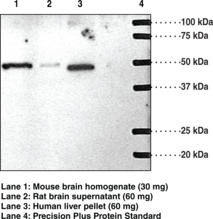
For immunochemical analysis of S1P1
Technical Support & Resources

Visit our FAQ

Contact Us

Toll Free Phone (USA and Canada Only): (888) 526-5351
Direct Phone: (734) 975-3888

Request Technical Support

Technical Support Request

To streamline the process attach the appropriate questionnaire to your inquiry.

Download IHC QuestionnaireDownload WB Questionnaire

View Our Privacy Statement for details on how we use and protect your data. In addition, this site is protected by hCaptcha and its Privacy Policy and Terms of Service apply.

S1P1 Polyclonal Antibody

Item No. 10005228

Technical Information
Synonyms
  • EDG-1
  • S1PR1
  • Sphingosine-1-phosphate Receptor 1
Immunogen
Peptide from an internal cytoplasmic region of human S1P1
500 µl of peptide affinity-purified polyclonal antibody
Storage Buffer
PBS, pH 7.2, with 50% glycerol and 0.02% sodium azide
Host
Rabbit
Applications
IF, IHC, and WB
Species Reactivity
(+) Human S1P1(+) Mouse S1P1(+) Porcine S1P1(+) Rat S1P1
UniProt Accession №
P21453
Origin
Animal/Rabbit
Shipping & Storage Information
Storage
-20°C
Shipping
Wet ice in continental US; may vary elsewhere
Recommended Products

Certificates of Analysis & Batch Specific Data

Provide batch numbers separated by commas to download or request available product inserts, QC sheets, certificates of analysis, data packs, and GC-MS data.

    Add

    Lipid Resource Center
    Discover Products & Resources for Lipid Research
    • High-purity lipid standards
    • Lipid roles in biology
    • Lipids in health & disease
    • Lipids for pharmaceutical development
    • Protocols, advice, & resources
    EXPLORE NOW
    Product Description

    Sphingosine-1-phosphate (S1P) exerts its activity by binding to five distinct G-protein-coupled receptors, S1P1/EDG-1, S1P2/EDG-5, S1P3/EDG-3, S1P4/EDG-6, and S1P5/EDG-8.1,2 S1P1 primarily couples with pertussis toxin-sensitive Gi/o proteins to mediate S1P-induced cell proliferation, survival, migration, cytoskeletal organization, and morphogenesis.1,2,3 Expression of S1P1 is abundant in embryological vasculature and is ubiquitously expressed in adult cells suggesting diverse physiological functions of this receptor.2 The human and mouse S1P1 receptors have 382 amino acids with an estimated molecular weight of 43 kDa. Glycosylation at the N-terminal extracellular domain may cause the protein to migrate at a higher position in SDS-PAGE.4 Cayman’s S1P1 Polyclonal Antibody detects the receptor at 47 kDa by WB analysis. The antibody can also be used for IF and IHC to study expression patterns of this protein.

    WARNING This product is not for human or veterinary use.

    References & Product Citations
    Product Description References

    1. Takuwa, Y., Takuwa, N., and Sugimoto, N. The Edg family G protein-coupled receptors for lysophospholipids: Their signaling properties and biological activities. J. Biochem. 131(6), 767-771 (2002).

    2. Ishii, I., Fukushima, N., Ye, X., et alLysophospholipid receptors: Signaling and biology. Annu. Rev. Biochem. 73, 321-354 (2004).

    3. Kluk, M.J., and Hla, T. Signaling of sphingosine-1-phosphate via the S1P/EDG-family of G-protein-coupled receptors. Biochim. Biophys. Acta 1582(1-3), 72-80 (2002).

    4. Kohno, T., Wada, A., and Igarashi, Y. N-glycans of sphingosine 1-phosphate receptor Edg-1 regulate ligand-induced receptor internalization. The FASEB Journal 16, 983-992 (2002).

    Product Citations

    El-Asrar, A.M.A., Nawaz, M.I., Mohammad, G., et alExpression of bioactive lysophospholipids and processing enzymes in the vitreous from patients with proliferative diabetic retinopathy. Lipids Health Dis. 13(187), (2014).