
Technical Support & Resources
Visit our FAQ
Contact Us
Toll Free Phone (USA and Canada Only): (888) 526-5351
Direct Phone: (734) 975-3888
Product Categories
Application
IP Receptor (human) Polyclonal Antibody
Item No. 10005518
Technical Information
- PGI2 Receptor
- Prostacyclin Receptor
- Prostaglandin I2 Receptor
Shipping & Storage Information
Recommended Products
Certificates of Analysis & Batch Specific Data
Provide batch numbers separated by commas to download or request available product inserts, QC sheets, certificates of analysis, data packs, and GC-MS data.
Lipid Resource Center
Discover Products & Resources for Lipid Research
- High-purity lipid standards
- Lipid roles in biology
- Lipids in health & disease
- Lipids for pharmaceutical development
- Protocols, advice, & resources
Product Description
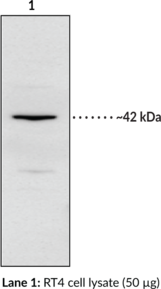
The IP Receptor is a class A rhodopsin-like G protein-coupled receptor that mediates the actions of prostaglandin I2 (PGI2).1 The C-terminal intracellular tail of the IP receptor undergoes isoprenylation and palmitoylation that results in anchoring of the tail to the plasma membrane. The IP receptor is expressed in platelets and vascular smooth muscle cells and in the aorta, lungs, heart, and kidneys.1,2 It signals through G proteins in a cell type- and expression-dependent manner and is involved in cardiovascular, inflammatory, and immune functions, as well as the pain response.1,3,4,5,6 An arginine-to-cysteine mutation at position 212 in the IP receptor inhibits its ability to activate adenylyl cyclase, which leads to increased platelet aggregation ex vivo and increases disease severity and the incidence of cardiovascular events in patients with a high risk of cardiovascular disease.7 The human IP receptor is N-terminally truncated by 28 amino acids compared with the murine receptor.2,8 Cayman’s IP Receptor (human) Polyclonal Antibody can be used for Western blot (WB). The antibody recognizes the IP receptor at approximately 42 kDa from human and mouse samples.
WARNING This product is not for human or veterinary use.
References & Product Citations
1. Human prostacyclin receptor structure and function from naturally-
2. Molecular cloning of human prostacyclin receptor cDNA and its gene expression in the cardiovascular system. Circulation 90, 1643-1647 (1994).
3. Role of prostacyclin in the cardiovascular response to thromboxane A2. Science 296(5567), 539-541 (2002).
4. Protective effect of prostaglandin I2 analogs on ischemic delayed neuronal damage in gerbils. Biochem. Biophys. Res. Commun. 265(2), 301-304 (1999).
5. Prostaglandin I2 and T regulatory cell function: Broader impacts. DNA Cell Biol. 40(10), 1231-1234 (2021).
6. Altered pain perception and inflammatory response in mice lacking prostacyclin receptor. Nature 388(6643), 678-682 (1997).
7. Acceleration of cardiovascular disease by a dysfunctional prostacyclin receptor mutation: Potential implications for cyclooxygenase-
8. cDNA cloning of a mouse prostacyclin receptor. Multiple signaling pathways and expression in thymic medulla. The Journal of Biological Chemisty 269, 9986-9992 (1994).
Contact Info
Cayman Chemical1180 East Ellsworth RoadAnn Arbor, Michigan 48108 USAToll Free: (800) 364-9897(USA and Canada only)Fax: (734) 971-3640


