
Technical Support & Resources
Visit our FAQ
Contact Us
Toll Free Phone (USA and Canada Only): (888) 526-5351
Direct Phone: (734) 975-3888
Product Categories
Research Area
Technical Information
- 5,5-
Dimethyl- 1- Pyrroline- N- Oxide Nitrone Adduct
Shipping & Storage Information
Recommended Products
Certificates of Analysis & Batch Specific Data
Provide batch numbers separated by commas to download or request available product inserts, QC sheets, certificates of analysis, data packs, and GC-MS data.
Product Description
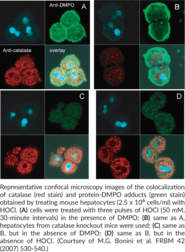
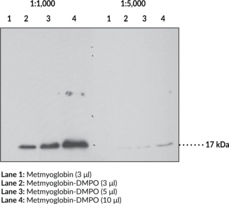
DMPO is a spin trap that reacts with oxygen-, nitrogen-, sulfur-, and carbon-centered radicals.1,2,3 It also reacts with DNA base- and amino acid-derived radicals to form DNA- and protein-DMPO nitroxone adducts, respectively, which rapidly decay to form DMPO-nitrone adducts.4 DMPO-nitrone adducts were previously detected using electron paramagnetic resonance (EPR), however, immunochemical detection allows a higher level of sensitivity and throughput with greatly reduced sample consumption.4,5,6 Cayman’s DMPO Nitrone Adduct Polyclonal Antiserum can be used for Western blot, immunocytochemistry, and ELISA applications. The antiserum recognizes various DMPO-nitrone adducts, including DNA and protein species. This material was produced using unpurified rabbit serum directed against an ovalbumin-DMPO conjugate and its use may result in off-target reactivity to similar protein epitopes as those found within the antigen.
WARNING This product is not for human or veterinary use.
References & Product Citations
1. Fatty acid radical formation in rats administered oxidized fatty acids: In vivo spin trapping investigation. Arch. Biochem. Biophys. 299(2), 361-367 (1992).
2. Spin trapping of O-
3. Detection of thiyl radical adducts formed during hydroxyl radical-
4. Imaging free radicals in organelles, cells, tissue, and in vivo with immuno-
5. Immunochemical detection of hemoglobin-
6. In vivo and in situ detection of macromolecular free radicals using immuno-
Contact Info
Cayman Chemical1180 East Ellsworth RoadAnn Arbor, Michigan 48108 USAToll Free: (800) 364-9897(USA and Canada only)Fax: (734) 971-3640


