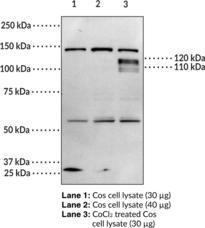
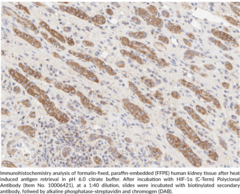
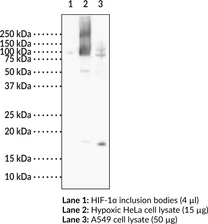
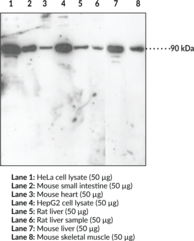
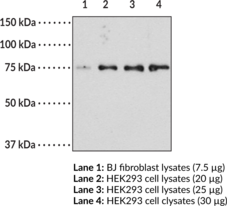
For immunochemical detection of HIF-
Technical Support & Resources

Visit our FAQ

Contact Us

Toll Free Phone (USA and Canada Only): (888) 526-5351
Direct Phone: (734) 975-3888

Request Technical Support

Technical Support Request

To streamline the process attach the appropriate questionnaire to your inquiry.

Download IHC QuestionnaireDownload WB Questionnaire

View Our Privacy Statement for details on how we use and protect your data. In addition, this site is protected by hCaptcha and its Privacy Policy and Terms of Service apply.

HIF-1α (C-Term) Polyclonal Antibody

Item No. 10006421

Technical Information
Synonyms
  • ARNT-interacting Protein
  • Hypoxia-Inducible Factor 1α
Immunogen
Peptide from the C-terminal region of human HIF-1α
500 µl of peptide affinity-purified polyclonal antibody
Storage Buffer
PBS, pH 7.2, with 50% glycerol and 0.02% sodium azide
Host
Rabbit
Applications
IHC and WB
Species Reactivity
(+) Human(+) Mouse(+) Simian
UniProt Accession №
Q16665
Origin
Animal/Rabbit
Shipping & Storage Information
Storage
-20°C
Shipping
Wet ice in continental US; may vary elsewhere
Recommended Products

Certificates of Analysis & Batch Specific Data

Provide batch numbers separated by commas to download or request available product inserts, QC sheets, certificates of analysis, data packs, and GC-MS data.

    Add

    Cayman Chemical
    Visit Our Cancer Resource Center
    Find Tools & Resources to Study the Hallmarks of Cancer
    • Cancer cell signaling & regulation
    • Cancer metabolism
    • Tumor microenvironment
    EXPLORE NOW
    Product Description

    Hypoxia-inducible factor-1α (HIF-1α) is a transcription factor that accumulates under low-oxygen conditions.1,2 Following hypoxic stimulus and cytoplasmic accumulation, HIF-1α migrates to the nucleus where with other transcription factors, it drives the production of stress-adaptive proteins. This response is essential for maintenance of normal oxidative physiology, however overexpression in cancer cells promotes tumor survival.2,3,4,5,6 HIF-1α is an endothelial PAS domain protein 1 (EPAS-1) family member with phosphorylation dependent activities.7,8 Cayman Chemical’s HIF-1α polyclonal antibody can be used for WB analysis for HIF-1α on samples from human, mouse, and simian. It is not suitable for ICC or IP. Other applications for use of this antibody have not yet been tested.

    WARNING This product is not for human or veterinary use.

    References & Product Citations
    Product Description References

    1. Wenger, R.H. Cellular adaptation to hypoxia: O2-sensing protein hydroxylases, hypoxia-inducible transcription factors, and O2 regulated gene expression. The FASEB Journal 16(10), 1151-1162 (2002).

    2. Wang, G.L., Jiang, B.H., Rue, E.A., et alHypoxia-inducible factor 1 is a basic-helix-loop-helix-PAS heterodimer regulated by cellular O2 tension. Proc. Natl. Acad. Sci. USA 92(12), 5510-5514 (1995).

    3. Talks, K.L., Turley, H., Gatter, K.C., et alThe expression and distribution of the hypoxia-inducible factors HIF-1α and HIF-2α in normal human tissues, cancers, and tumor-associated macrophages. Am. J. Pathol. 157(2), 411-421 (2000).

    4. Koukourakis, M.I., Giatromanolaki, A., Skarlatos, J., et alHypoxia inducible factor (HIF-1α and HIF-2α) expression in early esophageal cancer and response to photodynamic therapy and radiotherapy. Cancer Res. 61(5), 1830-1832 (2001).

    5. Blancher, C., Moore, J.W., Talks, K.L., et alRelationship of hypoxia-inducible factor (HIF)-1α and HIF-2α expression to vascular endothelial growth factor induction and hypoxia survival in human breast cancer cell lines. Cancer Res. 60(24), 7106-7113 (2000).

    6. Ambrosin, G., Nath, A.K., Sierra-Honigmann, M.R., et alTranscriptional activation of the human leptin gene in response to hypoxia. Involvement of hypoxia-inducible factor 1. The Journal of Biological Chemisty 277(37), 34601-34609 (2002).

    7. Richard, D.E., Berra, E., Gothié, E., et alp42/p44 Mitogen-activated protein kinases phosphorylate hypoxia-inducible factor 1α (HIF-1α) and enhance the transcriptional activity of HIF-1. The Journal of Biological Chemisty 274(46), 32631-32637 (1999).

    8. Liu, X.H., Kirschenbaum, A., Lu, M., et alProstaglandin E2 induces hypoxia-inducible factor-1α stabilization and nuclear localization in a human prostate cancer cell line. The Journal of Biological Chemisty 277(51), 50081-50086 (2002).

    Product Citations

    Soriano-Castell, D., Currais, A., and Maher, P. Defining a pharmacological inhibitor fingerprint for oxytosis/ferroptosis. Free Radic. Biol. Med. S0891-5849(21), (2021).

    Lin, N., Shay, J.E.S., Xie, H., et alMyeloid cell hypoxia-inducible factors promote resolution of inflammation in experimental colitis. Front. Immunol. 9(2565), (2018).

    Kelsey, I., Zbinden, M., Byles, V., et almTORC1 suppresses PIM3 expression via miR-33 encoded by the SREBP loci. Sci. Rep. 7(1), 16112 (2017).

    Backer, V., Cheung, F.-Y., Siveke, J.T., et alKnockdown of myeloid cell hypoxia-inducible factor-1α ameliorates the acute pathology in DSS-induced colitis. PLoS One 12(12), e0190074 (2017).

    Serrano-Pozo, A., Sanchez-Garcia, M.A., Heras-Garvin, A., et alAcute and chronic sustained hypoxia do not substantially regulate amyloid-b peptide generation in vivo. PLoS One 12(1), e0170345 (2017).

    Nakazawa, H., Ikeda, K., Shinozaki, S., et alBurn-induced muscle metabolic derangements and mitochondrial dysfunction are associated with activation of HIF-1a and mTORC1: Role of protein farnesylation. Sci. Rep. 7(6618), (2017).

    Kim, Y., Nam, H.J., Lee, J., et alMethylation-dependent regulation of HIF-1a stability restricts retinal and tumour angiogenesis. Nat. Commun. 7, 10347 (2016).

    Lajko, M., Cardona, H.J., Taylor, J.M., et alHyperoxia-induced proliferative retinopathy: Early interruption of retinal vascular development with severe and irreversible neurovscular disruption. PLoS One 2016, e0166886 (2016).

    Chou, T.-F., Chuang, Y.-T., Hsieh, W.-C., et alTumour suppressor death-associated protein kinase targets cytoplasmic HIF-1a for Th17 suppression. Nat. Commun. 7, 11904 (2016).

    Yoon, C., Lee, H.-J., Park, D.J., et alHypoxia-activated chemotherapeutic TH-302 enhances the effects of VEGF-A inhibition and radiation on sarcomas. Br. J. Cancer 113, 46-56 (2015).

    Chan, M.C., Atasoylu, O., Hodson, E., et alPotent and selective triazole-based inhibitors of the hypoxia-inducible factor prolyl-hydroxylases with activity in the murine brain. PLoS One 10(7), e0132004 (2015).

    Yuan, Q., Bleiziffer, O., Boos, A.M., et alPHDs inhibitor DMOG promotes the vascularization process in the AV loop by HIF-1a up-regulation and the preliminary discussion on its kinetics in rat. BMC Biotechnol. 14, 112 (2014).

    Genetos, D.C., Cheung, W.K., Decaris, M.L., et alOxygen tension modulates neurite outgrowth in PC12 cells through a mechanism involving HIF and VEGF. J. Mol. Neurosci. 40(3), 360-366 (2010).

    Decaris, M.L., Lee, C.I., Yoder, M.C., et alInfluence of the oxygen microenvironment on the proangiogenic potential of human endothelial colony forming cells. Angiogenesis 12(4), 303-311 (2009).