
For detection of S-Nitrosylated Proteins
Features
  • A modified ‘Biotin-switch’ assay
  • Direct visualization of S-NO proteins in whole cells or tissues
  • Colorimetric or fluorometric detection
Technical Support & Resources

Visit our FAQ

Contact Us

Toll Free Phone (USA and Canada Only): (888) 526-5351
Direct Phone: (734) 975-3888

Request Technical Support

Technical Support Request

To streamline the process attach the appropriate questionnaire to your inquiry.

Download IHC QuestionnaireDownload WB Questionnaire

View Our Privacy Statement for details on how we use and protect your data. In addition, this site is protected by hCaptcha and its Privacy Policy and Terms of Service apply.

S-Nitrosylated Protein Detection Kit (Biotin Switch)

Item No. 10006518
Technical Information
Synonyms
  • S-NO
Origin
Plant/Armoracia rusticana
Shipping & Storage Information
Storage
-20°C
Shipping
Wet ice in continental US; may vary elsewhere
Recommended Products

Certificates of Analysis & Batch Specific Data

Provide batch numbers separated by commas to download or request available product inserts, QC sheets, certificates of analysis, data packs, and GC-MS data.

    Add

    Bioanalysis & Assay Development Services
    Your Vision. Our Expertise.
    • Bioanalysis and compound screening using Cayman or qualified commercial assay kits
    • Development and qualification of fit-for-purpose assays in a variety of formats and platforms
    • Experienced scientists dedicated to developing the best strategy for your project
    LEARN MORE
    Product Description

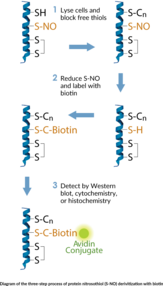
    Cayman’s S-Nitrosylated Protein Detection Kit (Biotin Switch) employs a modification of the Jaffrey et al. 'Biotin-switch' method to allow for the direct visualization of S-NO proteins in whole cells or tissues, as well as by western blot analysis.1,2 Using this method, free SH groups are first blocked (an addition of 125.1 amu per residue) and any S-NO bonds present in the sample are then cleaved. Biotinylation of the newly formed SH groups (an addition of 523.6 amu per residue) provides the basis for visualization using streptavidin-based colorimetric or fluorescence detection.

    Needed but not supplied: Please download the kit booklet to verify if UltraPure Water (Milli-Q or equivalent) or any other components are needed for this assay.

    WARNING This product is not for human or veterinary use.

    References & Product Citations
    Product Description References

    1. Ckless, K., Reynaert, N.L., Taatjes, D.J., et alIn situ detection and visualization of S-nitrosylated proteins following chemical derivatization: Identification of Ran GTPase as a target for S-nitrosylation. Nitric Oxide 11, 216-227 (2004).

    2. Jaffrey, S.R., Erdjument-Bromage, H., Ferris, C.D., et alProtein S-nitrosylation: A physiological signal for neuronal nitric oxide. Nat. Cell Biol. 3(2), 193-197 (2001).

    Product Citations

    Chen, J., Byun, H., She, Q., et alS-Nitrosylation of the virulence regulator AphB promotes Vibrio cholerae pathogenesis. PLoS Pathog. 18(6), e1010581 (2022).

    Agrawal, K., Bouchal, J., Das, V., et alLaboratory techniques in cellular and molecular medicine. (2021).

    Li, L., Zhu, L., Hao, B., et aliNOS-derived nitric oxide promotes glycolysis by inducing pyruvate kinase M2 nuclear translocation in ovarian cancer. Oncotarget 8(20), 33047-33063 (2017).

    Lee, W.-B., Kang, J.-S., Choi, W.Y., et alMincle-mediated translational regulation is required for strong nitric oxide production and inflammation resolution. Nat. Commun. 7, 11322 (2016).

    Vatolin, S., Phillips, J.G., Jha, B.K., et alNovel protein disulfide isomerase inhibitor with anticancer activity in multiple myeloma. Cancer Res. 76(11), 3340-3350 (2016).

    Salanova, M., Schiffl, G., Gutsmann, M., et alNitorsative stress in human skeletal muscle attenuated by exercise countermeasure after chronic disuse. Redox Biol. 1, 514-526 (2013).

    Park, Y.-J., Yoon, S.-J., Suh, H.-W., et alTXNIP deficiency exacerbates endotoxic shock via the induction of excessive nitric oxide synthesis. PLoS Pathog. 9(10), e1003646 (2013).

