
An internal standard for the quantification of (±)5-iPF-VI
Related Products
Unlabeled Version(s)
16300(±)5-iPF2α-VI
Technical Support & Resources

Visit our FAQ

Contact Us

Toll Free Phone (USA and Canada Only): (888) 526-5351
Direct Phone: (734) 975-3888
Request Technical Support

Technical Support Request

To streamline the process attach the appropriate questionnaire to your inquiry.

Download IHC QuestionnaireDownload WB Questionnaire

View Our Privacy Statement for details on how we use and protect your data. In addition, this site is protected by hCaptcha and its Privacy Policy and Terms of Service apply.

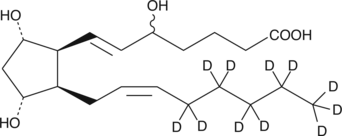
(±)5-iPF-VI-d11

Item No. 10006654

Technical Information
Formal Name
(±)5,9α,11α-trihydroxy-(8β)-prosta-6E,14Z-dien-1-oic-16,16,17,17,18,18,19,19,20,20,20-d11 acid
CAS Number
936565-17-2
Molecular Formula
C20H23D11O5
Formula Weight
Purity
≥99% deuterated forms (d1-d11)
Formulation
A 100 µg/ml solution in ethanol
DMF: 50 mg/mlDMSO: 50 mg/mlEthanol: 50 mg/mlPBS (pH 7.2): 1 mg/ml
SMILES
CCCCC/C=C\C[C@H]1C(O)CC(O)[C@H]1\C=C\C(O)CCCC(=O)O
InChi Code
InChI=1S/C20H34O5/c1-2-3-4-5-6-7-10-16-17(19(23)14-18(16)22)13-12-15(21)9-8-11-20(24)25/h6-7,12-13,15-19,21-23H,2-5,8-11,14H2,1H3,(H,24,25)/b7-6-,13-12+/t15?,16-,17+,18-,19+/m1/s1/i1D3,2D2,3D2,4D2,5D2
InChi Key
RZCPXIZGLPAGEV-AOORLBIGSA-N
Shipping & Storage Information
Storage
-20°C
Shipping
Wet ice in continental US; may vary elsewhere
Recommended Products

Certificates of Analysis & Batch Specific Data

Provide batch numbers separated by commas to download or request available product inserts, QC sheets, certificates of analysis, data packs, and GC-MS data.

    Add

    Add

    Lipid Resource Center
    Discover Products & Resources for Lipid Research
    • High-purity lipid standards
    • Lipid roles in biology
    • Lipids in health & disease
    • Lipids for pharmaceutical development
    • Protocols, advice, & resources
    EXPLORE NOW
    Product Description

    (±)5-iPF-VI-d11 contains 11 deuterium atoms at the 16, 16, 17, 17, 18, 18, 19, 19, 20, 20, and 20 positions. It is intended for use as an internal standard for the quantification of (±)5-iPF-VI (Item No. 16300) by GC- or LC-mass spectrometry. Isoprostanes are prostaglandin-like products of free-radical induced lipid peroxidation.1 Although the isoprostanes derived from arachidonic acid are the best characterized, many other polyunsaturated fatty acids can form isoprostanes.2 iPF-VI is one of dozens of possible stereo- and regioisomeric isoprostanes which can be formed from arachidonic acid. To date, the most extensively studied of these is 8-isoprostane (8-epi-PGF, iPF-III).3,4 However, 8-isoprostane is a minor isoprostane constituent when compared to some of the other isomers which form in natural conditions of oxidative stress,5 including iPF-VI of the type-VI isoprostanes. This class has been shown to be one of the major isoprostane products, in contrast to 8-isoprostane. In addition to being produced in greater abundance than 8-isoprostane, Type VI isoprostanes form internal lactones which facilitate their extraction and purification from biological samples.5,6,7,8

    WARNING This product is not for human or veterinary use.

    References & Product Citations
    Product Description References

    1. Morrow, J.D., Hill, K.E., Burk, R.F., et alA series of prostaglandin F2-like compounds are produced in vivo in humans by a non-cyclooxygenase, free radical-catalyzed mechanism. Proc. Natl. Acad. Sci. USA 87(23), 9383-9387 (1990).

    2. Parchmann, S., and Mueller, M.J. Evidence for the formation of dinor isoprostanes E1 from α-linolenic acid in plants. The Journal of Biological Chemisty 273, 32650-32655 (1998).

    3. Delanty, N., Reilly, M., Pratico, D., et al8-Epi PGF: Specific analysis of an isoeicosanoid as an index of oxidant stress in vivo. Br. J. Clin. Pharmacol. 42, 15-19 (1996).

    4. Reilly, M.P., Barry, P., Lawson, J.A., et alUrinary 8-epi PGF: An index of oxidant stress in vivo. Fibrinolysis & Proteolysis 11, 81-84 (1997).

    5. Reilly, M.P., Pratico, D., Delanty, N., et alIncreased formation of distinct F2 isoprostanes in hypercholesterolemia. Circulation 98, 2822-2828 (1998).

    6. Li, H., Lawson, J.A., Reilly, M., et alQuantitative high performance liquid chromatography/tandem mass spectrometric analysis of the four classes of F2-isoprostanes in human urine. Proc. Natl. Acad. Sci. USA 96(23), 13381-13386 (1999).

    7. Lawson, J.A., Li, H., Rokach, J., et alIdentification of two major F2 isoprostanes, 8,12-iso- and 5-epi-8,12-iso-isoprostane F-VI, in human urine. The Journal of Biological Chemisty 273(45), 29295-29301 (1998).

    8. Praticò, D., Barry, O.P., Lawson, J.A., et alIPF-I: An index of lipid peroxidation in humans. Proc. Natl. Acad. Sci. USA 95, 3449-3454 (1998).

