
A potent inhibitor of monoacylglycerol lipase
Technical Support & Resources

Visit our FAQ

Contact Us

Toll Free Phone (USA and Canada Only): (888) 526-5351
Direct Phone: (734) 975-3888
Request Technical Support

Technical Support Request

To streamline the process attach the appropriate questionnaire to your inquiry.

Download IHC QuestionnaireDownload WB Questionnaire

View Our Privacy Statement for details on how we use and protect your data. In addition, this site is protected by hCaptcha and its Privacy Policy and Terms of Service apply.

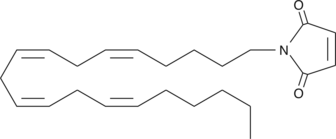
N-Arachidonyl Maleimide

Item No. 10007517

Technical Information
Formal Name
eicosa-5Z,8Z,11Z,14Z-tetraenyl-1-pyrrole-2,5-dione
CAS Number
876305-42-9
Synonyms
  • NAM
Molecular Formula
C24H35NO2
Formula Weight
Purity
≥98%
Formulation
A 50 mg/ml solution in methyl acetate
DMF: 30 mg/mlDMSO: 30 mg/mlEthanol: 50 mg/ml
SMILES
CCCCC/C=C\C/C=C\C/C=C\C/C=C\CCCCN1C(=O)C=CC1=O
InChi Code
InChI=1S/C24H35NO2/c1-2-3-4-5-6-7-8-9-10-11-12-13-14-15-16-17-18-19-22-25-23(26)20-21-24(25)27/h6-7,9-10,12-13,15-16,20-21H,2-5,8,11,14,17-19,22H2,1H3/b7-6-,10-9-,13-12-,16-15-
InChi Key
GZNZRHSGGQUYAP-DOFZRALJSA-N
Shipping & Storage Information
Storage
-80°C
Shipping
Dry ice in continental US; may vary elsewhere
Recommended Products

Certificates of Analysis & Batch Specific Data

Provide batch numbers separated by commas to download or request available product inserts, QC sheets, certificates of analysis, data packs, and GC-MS data.

    Add

    Add

    Add

    Lipid Resource Center
    Discover Products & Resources for Lipid Research
    • High-purity lipid standards
    • Lipid roles in biology
    • Lipids in health & disease
    • Lipids for pharmaceutical development
    • Protocols, advice, & resources
    EXPLORE NOW
    Product Description

    2-Arachidonoyl glycerol (2-AG) is an endogenous agonist of the central cannabinoid (CB1) and peripheral cannabinoid (CB2) receptors.1,2,3 2-AG is present at relatively high levels in the central nervous system and is the most abundant molecular species of monoacylglycerol found in rat brain.1,4 Monoacylglycerol lipase (MGL) hydrolyzes 2-AG to arachidonic acid and glycerol, thereby terminating its biological actions.5 N-Arachidonyl maleimide (NAM) is a potent, irreversible inhibitor of monoacylglycerol lipase (MGL) or MGL-like activity in rat cerebellar membranes, exhibiting an IC50 value of 140 nM.6 Inhibition of MGL by the sulfhydryl-reactive maleimide group of NAM suggests a critical cysteine residue is present in the substrate-binding site of the enzyme.

    WARNING This product is not for human or veterinary use.

    References & Product Citations
    Product Description References

    1. Stella, N., Schweitzer, P., and Piomelli, D. A second endogenous cannabinoid that modulates long-term potentiation. Nature 388(6644), 773-778 (1997).

    2. Sugiura, T., Kodaka, T., Nakane, S., et alEvidence that the cannabinoid CB1 receptor is a 2-arachidonoylglycerol receptor. Structure-activity relationship of 2-arachidonoylglycerol, ether-linked analogues, and related compounds. The Journal of Biological Chemisty 274(5), 2794-2801 (1999).

    3. Ben-Shabat, S., Fride, E., Sheskin, T., et alAn entourage effect: Inactive endogenous fatty acid glycerol esters enhance 2-arachidonoyl-glycerol cannabinoid activity. Eur. J. Pharmacol. 353(1), 23-31 (1998).

    4. Kondo, S., Kondo, H., Nakane, S., et al2-Arachidonoylglycerol, an endogenous cannabinoid receptor agonist: Identification as one of the major species of monoacylglycerols in various rat tissues, and evidence for its generation through Ca2+-dependent and -independent mechanisms. FEBS Lett. 429(2), 152-156 (1998).

    5. Dinh, T.P., Carpenter, D., Leslie, F.M., et alBrain monoglyceride lipase participating in endocannabinoid inactivation. Proc. Natl. Acad. Sci. USA 99(16), 10819-10824 (2002).

    6. Saario, S.M., Salo, O.M.H., Nevalainen, T., et alCharacterization of the sulfhydryl-sensitive site in the enzyme responsible for hydrolysis of 2-arachidonoyl-glycerol in rat cerebellar membranes. Chem. Biol. 12, 649-656 (2005).

