
Features
- Quantitation of cholesterol and/or cholesteryl ester in biological samples
- Assay 40 samples in duplicate
- Assay Range: 0-20 μM for fluorometric assay, 0-100 μM for colorimetric assay
- Rapid test; obtain results in 45 minutes
- Assay plate included
Technical Support & Resources
Visit our FAQ
Contact Us
Toll Free Phone (USA and Canada Only): (888) 526-5351
Direct Phone: (734) 975-3888



Technical Information
Shipping & Storage Information
Recommended Products
Certificates of Analysis & Batch Specific Data
Provide batch numbers separated by commas to download or request available product inserts, QC sheets, certificates of analysis, data packs, and GC-MS data.
Lipid Resource Center
Discover Products & Resources for Lipid Research
- High-purity lipid standards
- Lipid roles in biology
- Lipids in health & disease
- Lipids for pharmaceutical development
- Protocols, advice, & resources
Product Description
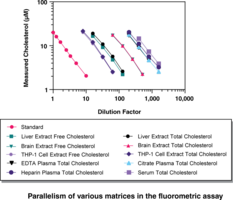
Cayman’s Cholesterol Fluorometric/Colorimetric Assay Kit provides a simple method for the sensitive quantitation of cholesterol in biological samples, such as plasma, serum, cell extracts, and tissue extracts. The assay is based on an enzyme-coupled reaction that detects both free cholesterol and cholesteryl esters. Cholesteryl esters are hydrolyzed by cholesterol esterase into cholesterol, which is then oxidized by cholesterol oxidase to yield hydrogen peroxide and the corresponding ketone product. By excluding cholesterol esterase, only free cholesterol will be oxidized and therefore can be distinguished from total cholesterol. Hydrogen peroxide produced by cholesterol oxidase activity is then detected using MaxiProbe, a highly sensitive and stable probe for hydrogen peroxide.1 In the presence of horseradish peroxidase, MaxiProbe reacts with hydrogen peroxide with a 1:1 stoichiometry to produce a compound, the fluorescence of which can be quantified at excitation and emission wavelengths of 530 and 590 nm, respectively. Alternatively, its absorbance can be measured at 570 nm. The fluorometric assay has a range of 0-20 μM with a lower limit of detection of 1 μM. The colorimetric assay has a range of 0-100 μM with a lower limit of detection of 1 μM.
Needed but not supplied: Please download the kit booklet to verify if UltraPure Water (Milli-Q or equivalent) or any other components are needed for this assay.
WARNING This product is not for human or veterinary use.
References & Product Citations
1. Fluorometric method for the enzymatic determination of cholesterol. J. Biochem. Biophys. Methods 38, 43-52 (1999).
Hair Follicle Stem Cell SLC3A2 Regulates Epithelial Regenerative Properties. J. Invest. Dermatol. (2025).
The soluble guanylate cyclase stimulator IW-
Serum polybrominated biphenyls (PBBs) and polychlorinated biphenyls (PCBs) and thyroid function among Michigan adults several fecades after the 1973-
Increased hepatic fatty acids uptake and oxidation by LRPPRC-
Role of cystathionine beta synthase in lipid metabolism in ovarian cancer. Oncotarget 6(35), 37367-37384 (2015).
Deletion of cyclophilin D impairs b-
Ruscogenin ameliorates experimental nonalcoholic steatohepatitis via suppressing lipogenesis and inflammatory pathway. Biomed. Res. Int. 652680 (2014).
Synthesis of apolipoprotein B lipoparticles to deliver hydrophobic/amphiphilic materials. ACS Appl. Mater. Interfaces 5(15), 7509-7516 (2013).
Zerumbone, a natural cyclic sesquiterpene of Zingiber zerumbet Smith, attenuates nonalcoholic fatty liver disease in hamsters fed on high-
Contact Info
Cayman Chemical1180 East Ellsworth RoadAnn Arbor, Michigan 48108 USAToll Free: (800) 364-9897(USA and Canada only)Fax: (734) 971-3640


